
Your Guide To Conference USA Basketball Tournament Betting Angles And Profitable Plays
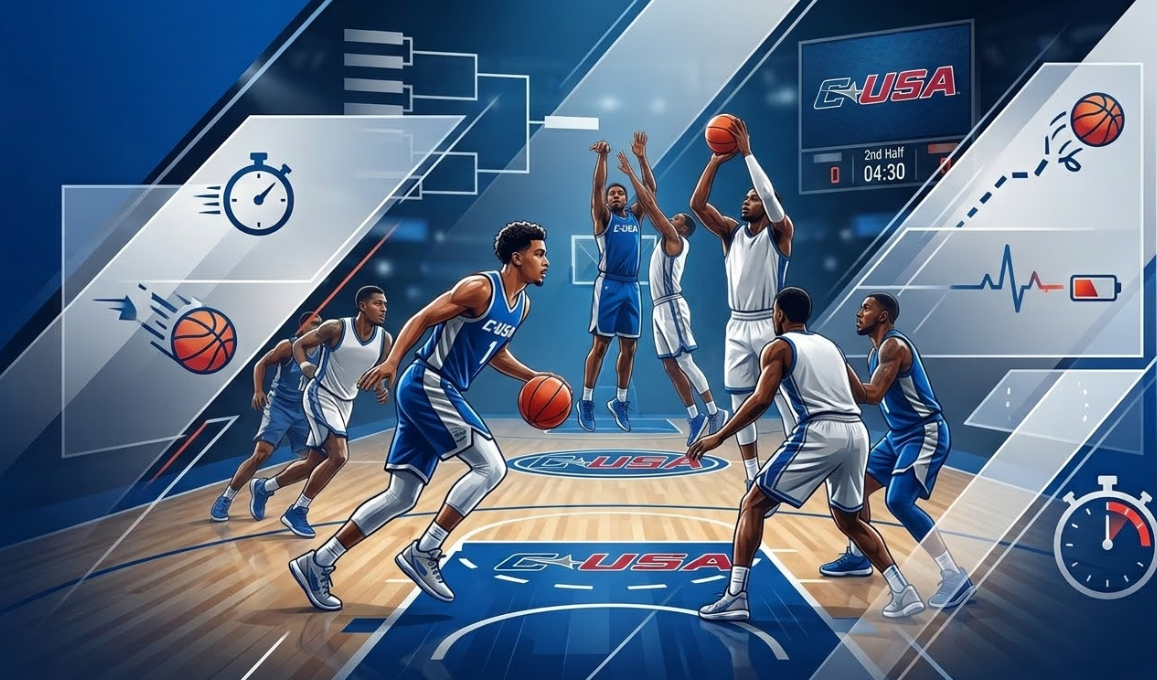
March means the Conference USA Tournament is here, and that brings a mix of neutral courts, back-to-back games, and unpredictable swings that can make or break a betting strategy. Every possession counts, and small edges in tempo, turnovers, and fatigue can turn into real ATS and totals opportunities if you know what to look for. This blog breaks down how to read those edges, spot value early, and time your bets without overcomplicating the process. You’ll learn which matchups travel well on neutral floors, how fatigue and rotations shape second-half outcomes, and ways to structure bets for both sides and totals. We also highlight how to use live opportunities and first-half angles to your advantage. All the insights here are grounded in data and tools you can trust, including ATSwins , which helps track trends, splits, and projections so you can make smarter, more confident tournament bets.
Table Of Contents
- Tournament Context And Format For Conference USA Basketball Tournament Betting Angles
- Matchup Metrics That Travel On Neutral Floors
- Schedule And Fatigue Angles
- Market Timing And Bet Construction
- Data And Process
- Schedule And Fatigue: Practical Scouting Tasks
- Market Timing Details: Concrete Examples And How-Tos
- Data Validation And Trustworthy References
- Tools And Templates You Can Reuse
- Responsible Play And Risk
- Conclusion
- Frequently Asked Questions (FAQs)
Key Takeaways
Neutral floors influence shot-making, but tempo gaps and turnover pressure travel reliably. Early games often lean under, and teams with strong defensive rebounding paired with low foul rates often present clear ATS and totals value. Fatigue plays a bigger role than most bettors anticipate, especially with back-to-back games, thin benches, and heavy guard minutes, which can create late-game opportunities for second-half overs or live betting entries. Bye seeds frequently offer early edges before the tournament heats up. Smarter ticket construction means hitting openers when edges appear, using first-half unders or team totals when pace is slow or rotations are limited, and monitoring officiating crews since tight whistles push free throw opportunities. Maintaining a simple model and disciplined bankroll is critical. Blending Elo ratings with four-factor analytics, adjusting for rest and neutral-court quirks, chasing closing line value, and knowing when to wait keeps betting sharp and controlled. All these strategies can be implemented through ATSwins, an AI-powered sports prediction platform that provides data-driven picks, player props, betting splits, and profit tracking across NFL, NBA, MLB, NHL, and NCAA competitions. Free and paid plans offer bettors actionable insights for smarter decision-making.
Tournament Context And Format For Conference USA Basketball Tournament Betting Angles
Conference USA, also known as C‑USA, runs a standard seeded bracket in its conference tournament. Top seeds typically earn byes into the quarterfinals while lower seeds must play extra games. This structure immediately creates a market lever. Teams with byes come in with fresher legs, more practice time at the host venue, and better preparation for opponent tendencies. Games take place on neutral courts, removing home-court noise and highlighting teams that travel well. Physical defenses, low turnover rates, and rosters that rebound efficiently become more valuable in this setting. Neutral floors also affect shooting comfort. Early sessions in unfamiliar arenas can mute shooting, particularly for teams reliant on deep three-pointers and long skip passes. Sightlines, unfamiliar rims, and lighting can depress three-point percentages slightly, enough to tip totals on close contests. Quick turnarounds are common, with Wednesday-to-Thursday back-to-backs shortening rotations and affecting teams with high-usage stars or coaches who ride starters. Travel matters even on neutral courts because C‑USA spans the Southeast and Texas. Long flights or late bus legs can reduce transition effectiveness in early game stages, which often appears in live-betting markets as short misses before teams find rhythm.
C‑USA often features pace contrasts, with fast guard-led teams pushing off misses and post-centric teams grinding half-court sets. On neutral floors, this contrast is magnified because officials are not influenced by home crowds, physical interior play may get fewer cheap fouls, and rebounding edges become more important. Offensive rebounds can create easy putbacks and foul opportunities, inflating totals in otherwise half-court games. Transition efficiency can soften without a familiar floor, reducing points per possession early. These factors often translate into ATS swings when fast teams struggle in transition and totals edges when cautious offenses meet without many turnovers.
Scheduling quirks are important to note. Early tips, such as morning or noon local starts, can depress perimeter shooting in the first 8–12 minutes, favoring first-half unders for low-turnover matchups. Coaches with simple, repeatable sets, like automatic baseline out-of-bounds plays, can add four to six points in tight games. Teams playing two games within 24–26 hours are influenced heavily by bench depth, foul discipline, and press efficiency. Teams relying on trapping or full-court pressure often tire by the second half. Pre-bet preparation includes tagging matchup notes with one-line labels per team, such as “needs rim attempts” or “switch-everything wings,” which allows quick lean decisions.
Matchup Metrics That Travel On Neutral Floors
Tempo differential serves as a currency in betting. Each team’s adjusted tempo and gap versus average opponent helps quantify the likely pace of the game. Fast teams relying on turnovers face reduced effectiveness against teams that handle the ball securely. Before betting on favorites that require a high tempo, consider how the extra possessions will materialize, whether through misses, live-ball turnovers, or opponent rebounding. Adjusted tempo can be projected as a weighted mean, blending team tempos with the league median and shaving a couple of possessions for early session adjustments.
Defensive turnover rates travel well. Teams ranked in the top 30 in forced turnovers maintain that edge on neutral courts because effort and discipline translate consistently. Ball security is the most reliable indicator for mid-majors. Underdogs with low offensive turnover percentages and high free-throw rates often hang in games even against superior competition. Similarly, rim attempts are more stable than three-point shots on neutral floors. Teams relying heavily on threes may see lower early scoring due to unfamiliar sightlines and arena quirks. Defensive rebounding and foul rates also translate reliably. Teams that secure a high percentage of defensive rebounds while maintaining low foul rates often produce stable ATS results. Bench usage matters as well. Even a small number of rotation players retaining 10–12 minutes each can preserve defensive intensity in back-to-back situations. Evaluating bench reliability on a scale of one to five allows assigning point adjustments to expected spreads.
Practical angles derived from these metrics include fading three-point–dependent underdogs against athletic, switch-capable wings, backing first-half unders when two low-turnover teams meet early in the session, betting favorites with strong defensive rebounding and low foul rates on day one, buying underdogs with turnover and free-throw advantages late in games via live moneyline, and opposing press-heavy squads on game two if they faced a high-possession game the day before.
Schedule And Fatigue Angles
Rest disadvantage can be quantified systematically. A simple model adds points for teams with byes, penalizes opponents for previous high-possession or overtime games, and adjusts for starter minutes exceeding thresholds. Travel can impose small first-half pace penalties when teams arrive close to tip-off. Tracking top players’ minutes, second-half shooting percentage differentials, and bus leg durations provides insight into early-game performance and live-betting opportunities. Early-session shooting often suffers due to new sightlines, creating openings for first-half unders, while live rebounds favor teams with fresher bigs and solid block-out fundamentals.
Market Timing And Bet Construction
Openers versus closers behave differently in C‑USA. Openers often align with season-long power ratings, while markets adjust quickly to turnovers and rebounding edges. Hitting sides on favorites with byes early, waiting on totals until narratives unfold, and staging live moneyline entries on dogs with turnover edges are key strategies. First-half unders perform best in early sessions featuring low-turnover teams or teams allowing low rim rates. Team totals are sharper when one side has an offensive rebounding edge versus thin frontcourts or when three-heavy teams face switchy wings. Middles become attractive when public betting inflates totals by four to six points while early game conditions suggest a slower pace or cold shooting.
Data and Process
A simple model blending Elo ratings, four-factor analytics, rest penalties, and neutral-court adjustments is effective. Elo provides a baseline spread, adjusted for matchups in effective field goal percentage, turnover rate, offensive rebounding, and free throw rate. Tempo projections, rest, and bench differentials refine spreads and totals. Validation involves backtesting against past tournaments and neutral-court games. Neutral-court splits and officiating tendencies offer further context. ATSwins provides tools for spotting early market leans, evaluating derivative angles, and tracking profit transparently. Pre-bet checklists consolidate tempo, shot profile, possession quality, fatigue, and officiating into actionable decisions. Stakes should remain disciplined, with flat units on most plays and staged entries on live opportunities.
Schedule And Fatigue: Practical Scouting Tasks
Monitoring injuries, rotations, and timeouts is essential. Minor knocks can impact thin benches significantly. Observing coaches’ timeout usage provides insight into pace control, which is critical in back-to-back situations. Foul-trouble substitutes can exacerbate fatigue effects. Totals can be bought or sold based on leg conditions, with early unders favored in methodical low-turnover games and live adjustments made when first-half whistles are tight. Fatigue on day two favors unders for limited bench teams with high offensive rebounding variance.
Market Timing Details: Concrete Examples And How-Tos
A workflow for openers begins the night before with model runs, tagging spreads and totals versus projected lines. Morning checks compare live openers to ATSwins data. Early placement on bye favorites with clear edges is advisable, with remaining stakes reserved for buybacks or favorable shifts. First-half unders are green-lighted when offensive turnover percentages are low, rim rates are constrained, pace differentials are minimal, and early tips are in place. Team totals are leveraged when offensive rebounding or shot-quality advantages exist, while middling totals allow capturing overreaction to narrative steam. The key is consistent application and monitoring of live conditions.
Data Validation And Trustworthy References
Reliable sources include Conference USA for scheduling and core info, KenPom and Bart Torvik T‑Rank for efficiency ratings and neutral splits, and NCAA NET resources for selection context. Cross-checking fair lines against efficiency data and market trends, then consulting ATSwins splits, ensures alignment between model expectations and public or sharp betting patterns.
Tools And Templates You Can Reuse
Minimal spreadsheets track inputs like team names, Elo, efficiency ratings, tempo, neutral flags, matchup deltas, rest, and bench grades. Outputs include fair spreads, totals, and derivative angle suggestions. Pre-game scripting incorporates status checks, ATSwins splits, crew tendencies, and first-half total confirmation to finalize bets before tip-off.
Responsible Play and Risk
Bankroll management caps exposure at a small percentage per day, with flat stakes for most plays and increased units only when edges align. Closing line value is tracked to measure process effectiveness rather than short-term wins. Documenting assumptions on tempo, whistle tendencies, and bench reliability helps decide when to pass on wagers. Tournament variance requires discipline and willingness to reduce stakes or skip plays when multiple conditions are not optimal.
Conclusion
Conference USA betting revolves around tempo gaps, turnover pressure, and fatigue management. Pricing rest, hitting openers, and using first-half or team-total angles when legs fade are critical strategies. Tracking matchup metrics and remaining disciplined in stake sizing enables bettors to exploit neutral-court quirks without overreacting to small samples. ATSwins provides data-driven picks, player props, betting splits, and profit tracking across NFL, NBA, MLB, NHL, and NCAA competitions, giving bettors the tools to make informed, efficient decisions.
Frequently Asked Questions (FAQs)
What are the most reliable Conference USA basketball tournament betting angles on a neutral court?
Start with tempo gaps, turnover battle, rim and three-point shot profiles, defensive rebounding, and foul rate. These factors travel well on neutral floors and provide actionable insights for early session unders, fading three-point–dependent underdogs, and leveraging rebounding advantages.
How do tempo and turnover pressure shape ATS in Conference USA basketball tournament betting angles?
Pace determines possession volume and variance. Slow, efficient favorites versus fast, sloppy underdogs often favor the disciplined team ATS. Pressing defenses versus secure ball-handlers tilt the edge toward consistent offenses and sometimes unders due to longer half-court possessions.
When should I bet sides vs totals using Conference USA basketball tournament betting angles?
Sides work best when matchup efficiency is the source of edge. Totals are preferable when pace, fatigue, or bench limitations create scoring deviations. First-half totals in early tips trend lower, while team totals are useful when one offense has a quality advantage over a noisy opponent.
How do I factor fatigue and officiating into Conference USA basketball tournament betting angles?
Monitor minutes for high-usage players, bench rotations, and coach pace control. Whistle profiles influence foul frequency and free throws, which in turn affect totals and ATS outcomes. Tight crews favor physical teams and overs; loose crews benefit switchy defenses and can suppress scoring.
How can ATSwins.ai help me find edges in Conference USA basketball tournament betting angles?
ATSwins provides AI-powered data-driven picks, player props, betting splits, and profit tracking across all major leagues. Models highlight tempo gaps, turnover mismatches, shot-quality advantages, and rest penalties, mapping them to ATS, totals, first-half, and team-total opportunities with a clear rationale.
Related Posts
AI For Sports Prediction - Bet Smarter and Win More
AI Football Betting Tools - How They Make Winning Easier
Bet Like a Pro in 2025 with Sports AI Prediction Tools
Sources
The Game Changer: How AI Is Transforming The World Of Sports Gambling
AI and the Bookie: How Artificial Intelligence is Helping Transform Sports Betting
How to Use AI for Sports Betting
Keywords:
MLB AI predictions atswins
AI MLB predictions atswins
NBA AI predictions atswins
basketball ai prediction atswins
NFL ai prediction atswins