
Why Picking Winners Is Not Enough in Sports Betting
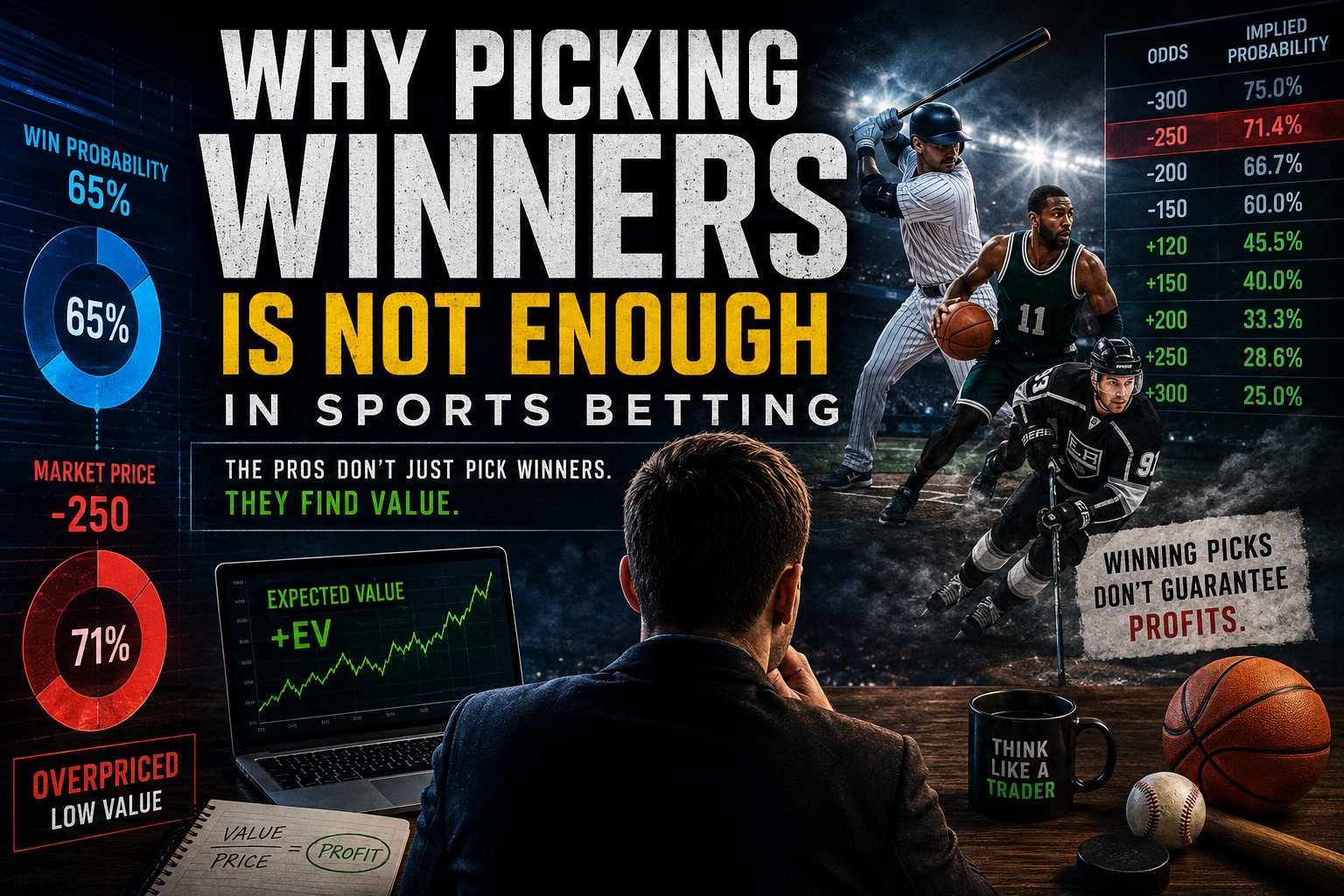
Let's be real for a second, because most people getting into sports betting are doing it completely wrong. They think the whole point is just to figure out who is going to win the game. It sounds so simple and logical when you first start out. You look at the slate, you see the sportsbooks posting their odds, and you check out what the analysts are saying. You try to forecast the outcome better than the next guy, and you assume that if you pick enough winners, the money will just start rolling in. It is a very fan-centric way of looking at things, but it is not how the actual market works.
The reality is that a lot of people who are actually pretty good at predicting games still end up losing their shirts in the long run. On the flip side, you have these professional bettors and sharp traders who might actually win fewer total bets than the loud guy at the bar, yet they are consistently profitable year after year. The massive disconnect here comes down to one concept that recreational bettors almost never wrap their heads around. Winning games and making profitable bets are two completely different universes. When a pro looks at a board, they aren't asking themselves who is going to win tonight. They are asking if the market is pricing the game incorrectly. That one little distinction changes everything about how you approach the board at ATSwins and how you manage your bankroll.
Once you actually get that difference between probability and price, sports betting stops being this degenerate gambling hobby and starts looking a lot more like high-level market trading. This shift is huge right now because the way we consume data is changing so fast. Most people are still thinking like fans who just want to root for their team or a superstar, but the sharp guys are thinking like traders who are looking for a mispriced asset. It is about moving away from the emotional high of a win and moving toward the cold reality of mathematical value.
The biggest trap that most bettors fall into is the constant search for certainty. As humans, we are basically hardwired to want to feel confident when we are putting our hard-earned money on the line. This is why everyone gravitates toward the big favorites, the dominant teams, the star players who are on a heater, and the narratives that just make sense in our heads. We want to believe in a story. The sportsbooks are fully aware of this, and they use it against us every single day. They know the public wants to feel safe, so they charge a premium for that emotional comfort. This is where you end up paying an inflated price just to feel like you are on the right side.
Think about a standard MLB matchup where the Dodgers are playing some bottom-tier team. A casual bettor looks at that and thinks the Dodgers are obviously the right side of the bet. And look, maybe they are the better team, and they probably will win. But that does not mean the bet itself is a good move for your wallet. If you do the actual math and look at the simulations at ATSwins, you might find the Dodgers have a 67 percent chance of winning based on the pitching matchup and the bullpen strength. Most people stop right there and place the bet. But if the market is pricing them as if they have a 76 percent chance of winning, you are actually making a terrible mathematical decision. You are overpaying for certainty and that is exactly how the house wins over time.
This is exactly where the new guys get trapped. They confuse a likely winner with a valuable wager. You have to understand that these are separate things. Professional betting is a pricing market, not a guessing game. It is about evaluating whether the current price on the screen accurately reflects the true probability of what is going to happen on the field. That is why the pros are obsessed with things like expected value and implied probability. They care about market movement and closing line value way more than they care about whether a team has a cool winning streak or a star player who just got back from injury. Casual bettors barely think about these things because they are too focused on the final score.
But the market does not care if your pick felt right or if you had a gut feeling. The market only cares if the price you paid created long-term value. This is why you see professionals making bets that look absolutely insane to the public. They might take a terrible team that everyone hates because the price has dropped so low that the value is undeniable. They aren't trying to feel good about the team they are backing. They are trying to maximize their expected value over thousands of bets. It is a massive difference in perspective that separates the people who treat this like a business from the people who treat it like a trip to the casino.
The rise of prediction markets has really pulled back the curtain on this. Unlike a traditional sportsbook that tries to balance action to protect its own margin, prediction markets act more like financial exchanges. People are trading probabilities against each other, and that changes the whole psychology of the room. Prices move fast because people react emotionally in real time. If a team gives up a few runs early or a star player looks a bit off, the public panics and the price shifts. The sharp traders are sitting there waiting for those moments because they know that the actual probability of the team winning hasn't changed nearly as much as the public's emotional state has.
Baseball is actually one of the best examples of why this works. It is a sport built on variance. Even the best teams in the league are going to lose sixty games a year. The worst teams are still going to win sixty. The public consistently underestimates how much chaos is actually involved in a 162-game season. They love betting on the big names and the winning streaks, but the pros know those narratives just drive the prices up. That is why you see the sharpest guys taking underdogs. They don't think the underdog is the better team; they just think the underdog is being disrespected by the market price. If a team has a 43 percent chance to win but they are being priced like they only have a 32 percent chance, that is a bet you have to make every single time if you want to be profitable.
The introduction of AI and high-level simulations has made this even more intense. Modern models can process things that a human brain just can't track all at once. We are talking about pitching matchups, travel fatigue, weather conditions, and even how a certain umpire might affect the strike zone. But the biggest edge the AI gives you isn't just picking the winner. It is identifying the divergence. It is finding that spot where the market says one thing and the data says another. That is where the edge lives. Most people struggle with this because it feels uncomfortable to bet on an underdog that the model says will lose more than half the time. But if you are getting a massive price on that team, you are winning in the long run.
Success in this arena now requires a sophisticated AI sports betting system optimization that focuses on capital preservation as much as growth. The public is always going to overreact to the latest news. They see a highlight on social media, or they hear a commentator talking about a momentum swing, and they move their money. This creates massive inefficiencies. Sharp bettors know that short-term outcomes do not justify these huge swings in probability. They stay disciplined, and they don't let their emotions dictate their unit size. This is actually why pro betting looks so boring from the outside. There are no huge celebrations or crushing breakdowns. It is just a series of calculated decisions made over and over again.
Many people who lose at betting are actually really smart sports fans. They know the rosters, and they know the injuries. They can tell you who is going to win a game at a pretty high clip. But they still lose money because they are gambling, not trading. They chase certainty, and they overpay for the teams they like. They get frustrated by a bad bounce and they double their bet to try and get it back. Professionals know that variance is just part of the game. You can make a perfect decision and still lose the bet. You have to judge yourself based on the quality of the decision and the price you got, not whether the ball hit the post or stayed out.
The whole industry is moving toward a trading model. We are looking at liquidity, timing, and probability distributions. We are thinking like portfolio managers who happen to use sports as the asset class. The market itself is often way more predictable than the game being played because human behavior is predictable. We know people are going to be greedy when things are going well and they are going to panic when things go south. Implementing a solid AI sports betting data science strategy allows you to quantify this human error and turn it into a measurable advantage. If you can exploit that human behavior, you don't even need to be a sports genius to make money. You just need to be a math genius who can stay calm when everyone else is losing their minds.
The biggest breakthrough you will ever have is the moment you realize that picking winners is for fans. Picking value is for pros. It is a mental shift that changes everything you see when you look at a betting board. Instead of looking for the team that is going to win, you start looking for the price that is wrong. That leads you down the path of risk management and long-term discipline. It is about using tools like the ones at ATSwins to find the edge that the emotional public is leaving on the table.
In the end, you have to decide what you want. If you want to have fun and root for your favorite players, then by all means, keep picking winners and enjoy the ride. But if you want to actually make this a profitable endeavor, you have to start thinking like a trader. You have to embrace the math, and you have to be okay with the fact that you are going to lose bets even when you make the right call. The compounding edge of making slightly better decisions than the market is where the real power is. Most people will keep chasing the high of a big win, but the smart money will keep chasing the value of a mispriced line. That is the difference between a gambler and a professional.
When we talk about long-term profitability, we have to talk about the grind. It is not about that one big parlay that hits and pays for a vacation. It is about the hundreds of individual bets where you had a two or three percent edge over the house. Over time, that math is undeniable. It is like being the house yourself. The casino doesn't care if one person wins a jackpot because they know the thousands of other people are playing a game where the math favors the house. When you bet for value, you are essentially turning the tables and becoming the one with the mathematical advantage.
It takes a lot of mental toughness to stick to a system when you are in a cold streak. Even the best models in the world have weeks where nothing seems to go right. The difference is that a pro doesn't change their strategy because of a bad week. They trust the process, and they trust the data. They know that if they are consistently getting the best of the number, the results will eventually catch up. This is why record-keeping is so important. You need to see where you are getting value and where you are just getting lucky.
If you are looking at the board at ATSwins and you see a line that hasn't moved yet even though some big injury news just broke, that is a window of opportunity. That is timing. In the trading world, being first to the information is everything. In the betting world, it is the same thing. You are trying to beat the market to the correct price. Developing an AI betting model automation strategy ensures that you can lock in these numbers before the books have a chance to adjust to the breaking news. If you can do that consistently, you are going to be ahead of 99 percent of the people putting money down today. It is about being proactive instead of reactive.
We also have to consider the impact of social media and the 24-hour news cycle on these markets. Everyone has an opinion and everyone is sharing it. This creates a lot of noise. A pro is able to filter out that noise and focus on the hard numbers. They don't care what the talking heads on TV are saying because those people are paid for entertainment, not for accuracy. The numbers don't have an agenda, and they don't have a bias. They just tell you the probability.
As we move further into this era of legalized sports betting and advanced data, the gap between the casuals and the sharps is only going to get wider. The tools are getting better, and the information is becoming more accessible, but the human brain is still prone to the same emotional mistakes it has been making for thousands of years. If you can master your own psychology and treat your bankroll like a business account, you are already halfway there. It is a long journey, and it requires a lot of patience, but the rewards of thinking like a trader are far greater than the fleeting joy of just picking a winner.
In a world full of people looking for a shortcut or a hot tip, be the person who looks for the value. Be the person who understands that the price is the only thing that matters. Whether it is the Dodgers in July or an obscure college basketball game in November, the principle remains the same. Find the mispriced asset, manage your risk, and let the math do the heavy lifting for you. That is how you win at this game. It is not about the glory of the pick; it is about the efficiency of the trade. If you can keep that perspective, you are going to be just fine in the long run.
The final piece of the puzzle is understanding that you never truly stop learning. The markets are always evolving. What worked three years ago might not work today because the books and the other traders are also getting smarter. You have to stay ahead of the curve by using the best technology available. You have to be willing to adapt and refine your models. It is a constant game of cat and mouse, but for those who enjoy the challenge of outsmarting the market, there is nothing else like it. It is the ultimate test of logic and discipline.
So the next time you are ready to place a bet, take a breath and look past the team names. Don't think about who you want to win or who you think is better. Look at the number. Ask yourself if that number represents the truth or if it represents a lie told by an emotional public. If you can find the lie, you can find the profit. That is the secret that nobody wants to tell you because it takes the "sport" out of sports betting and replaces it with cold, hard logic. But for a professional, that logic is the most beautiful thing in the world.
When we look at the sheer volume of games available to bet on every single day, it becomes clear that no human can possibly find every edge on their own. This is why we lean so heavily on the automated side of things. We use the simulations at ATSwins to do the heavy lifting of the initial data sort. Once the computer identifies the outliers where the price and the probability don't match, then we can apply our own context. It is a hybrid approach that combines the raw power of machine learning with the nuanced understanding of a seasoned trader.
This process eliminates the fatigue that usually leads to bad decisions. If you are trying to manually handicap fifteen games in a night, you are going to get tired, and you are going to start taking shortcuts. You might start relying on those narratives we talked about earlier just to get through the list. But a model doesn't get tired. It treats the last game of the night with the same clinical precision as the first one. That consistency is what allows a professional to maintain their edge over a long season.
Furthermore, we have to address the concept of the "closing line." If you are betting a team at minus 110 and the game starts with the line at minus 130, you have won. Even if the team goes out and loses the game, you made a winning trade because you bought an asset that increased in value by the time the market closed. If you can consistently beat the closing line, you are almost guaranteed to be a profitable bettor over a large enough sample size. It is the single best metric for determining whether you are a sharp bettor or just a lucky one.
The public rarely checks the closing line. They only check their account balance at the end of the night. But if you want to be serious about this, you need to be tracking your closing line value on every single play. It tells you if your process is working. It tells you if you are seeing the market moves before they happen. It is the ultimate scorecard for a trader. If you find that you are consistently on the wrong side of the movement, then your model needs a tune-up, regardless of what your actual win-loss record looks like.
One of the hardest parts of this whole lifestyle is the social aspect. Your friends are going to want to talk about the games like fans. They are going to ask you who you "like" in the Super Bowl or the World Series. It is hard to explain to them that you don't really "like" anyone, you just like the price on the under. They won't get it. They will think you are being a buzzkill or that you are overthinking things. But that ability to detach yourself from the fandom is your greatest asset. It keeps your head clear when everyone else is getting caught up in the hype.
The evolution of sports betting into a mature financial market is one of the most interesting trends of the last decade. It has moved from the shadows and into the mainstream, and with that move comes a level of sophistication we have never seen before. The people who are succeeding now are the ones who treat it with the same respect as they would a stock portfolio or a real estate investment. They are calculating their returns, they are diversifying their plays, and they are always looking for the next technological advantage.
So as you head back into the markets, remember that the game on the field is just the catalyst. The real game is happening on the screen in front of you. It is a game of numbers, psychology, and nerves. If you can master those three things, you don't need to be lucky. You just need to be right about the price. And in the long run, the price is the only thing that pays. Keep your focus on the value, keep your emotions in check, and keep using the tools that give you the mathematical upper hand. That is the path to the top.