
Why Most Bettors Lose: 7 Mistakes That Kill ROI (And How to Fix Them)
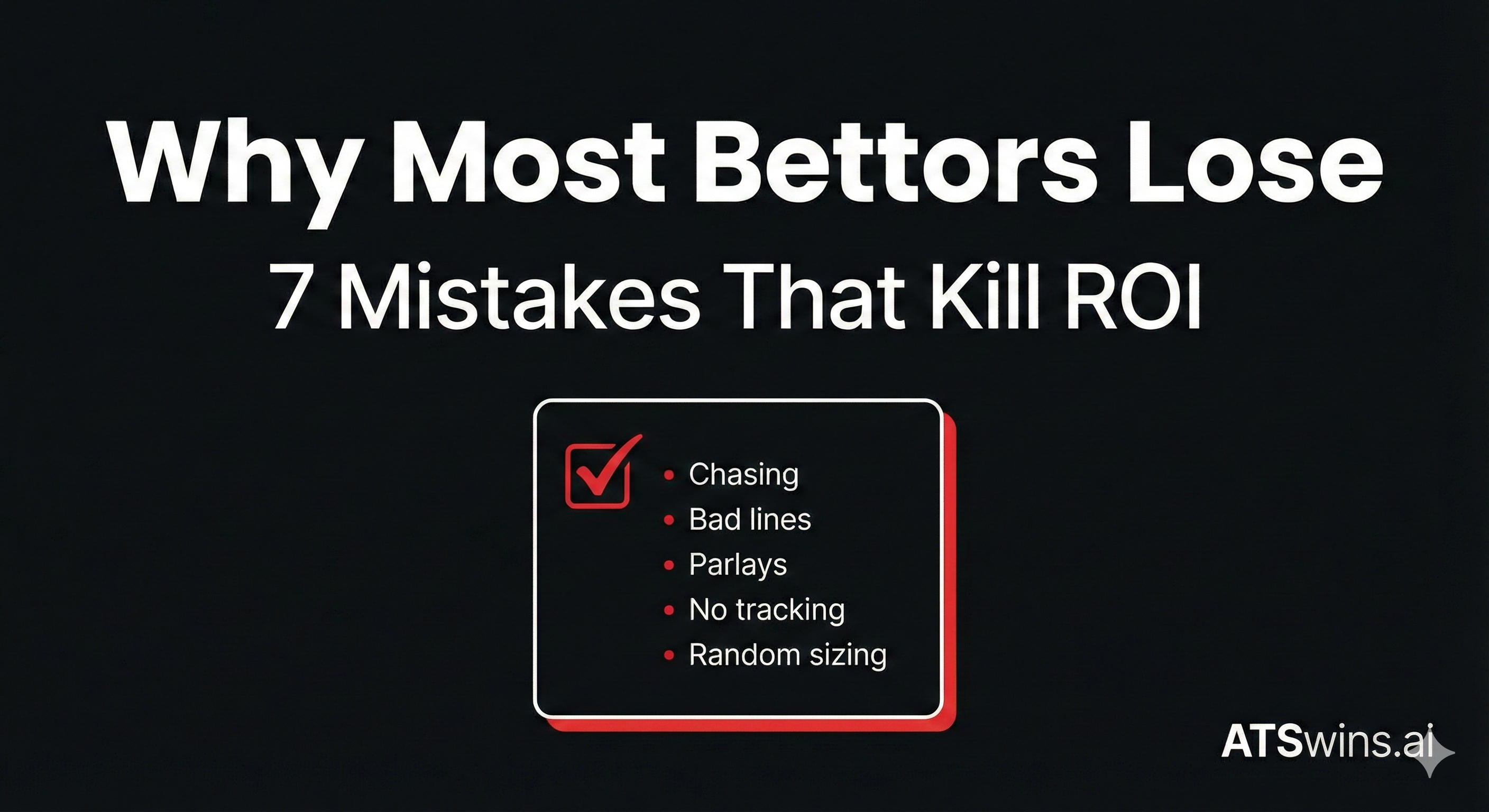
Most people don’t lose at sports betting because they’re “bad at sports.” They lose because they’re bad at the parts that actually matter: discipline, bankroll management, price, and repetition.
The sportsbook doesn’t need you to be wrong all the time. It just needs you to be sloppy consistently. Take a few bad numbers. Bet too big when you’re emotional. Force action when there’s no edge. Sprinkle in a couple parlays “for fun” that somehow turn into your whole personality. That’s more than enough for the math to take over.
If you’re trying to get out of the cycle of “I feel like I should be up” and into actual, measurable profit, these are the seven mistakes that quietly destroy ROI and exactly how to fix them. If you want a more consistent process and a cleaner way to filter higher-quality plays, ATSwins.ai is built for that.
Mistake #1: Betting without a bankroll plan (then acting surprised when it goes sideways)
A bankroll plan is not “I’m going to put $50 on stuff I like.” A bankroll plan is rules. Boring rules. The same way brushing your teeth is rules. You don’t “vibe” your way through it.
Most bettors do the opposite. They decide stake size based on confidence, mood, how their day went, or how loud their group chat is. Then when the inevitable downswing hits, they’re forced into desperate decisions because they sized too big early.
Here’s what actually happens:
-
You bet too big on a couple “locks.”
-
One or two don’t hit (because nothing hits 100%).
-
Now your bankroll is dented enough that you start changing behavior.
-
That’s when tilt decisions begin, and ROI gets murdered.
Fix it with one simple system: flat staking.
Pick a unit size that’s a small, survivable percentage of your bankroll and stick to it.
A clean guideline:
-
1 unit = around 1% of your bankroll (some bettors go lower; very few should go higher)
-
Most plays = 1 unit
-
“Higher confidence” should not mean 5x stake. If you want tiers, keep it tight, like 0.5u, 1u, 1.5u.
You’re not trying to win today. You’re trying to make your process durable enough to win over a season.
Mistake #2: Treating every slate like a “must-play”
This is the hobbyist leak. The average bettor sees games the way Netflix viewers see shows: “Something is on, so I should watch something.”
Except in betting, “watching something” costs money.
People load up a card because they want action, not because they have edge. That’s the difference between entertainment and a strategy. If you’re betting to stay entertained, that’s fine. But if you’re betting to win long-term, you need to stop pretending volume equals skill.
The sportsbook LOVES the bettor who bets everything:
-
They’ll take the first line they see.
-
They’ll bet games they didn’t research.
-
They’ll overreact to news they barely understand.
-
They’ll “just add one more” because they’re already on the app.
Fix:
build a filter, not a bigger card.
Before you place anything, force your bet to pass at least one basic test:
-
What’s the edge?
(Not the story. The edge.)
-
Is the price good?
(Would you still bet it if the line moved against you?)
-
Would you bet this exact play again tomorrow if nothing changed?
If you can’t answer those cleanly, it’s probably not a bet. It’s a coin flip with marketing.
Mistake #3: Chasing losses and betting emotional (tilt is an ROI assassin)
Chasing doesn’t always look like slamming your whole bankroll on the late game. Sometimes it’s sneaky. Sometimes it looks like:
-
“I’ll just add one more bet so I can end the day positive.”
-
“This is an easy bounce-back spot.”
-
“I can’t go 0-3. No shot.”
That’s not analysis. That’s your brain trying to emotionally regulate with money.
Here’s the brutal truth: after a loss, your decision-making is usually worse. Not because you’re dumb, but because you’re human. You start forcing certainty where none exists. You start needing the next bet to do a job for you, which is to erase the feeling of the last one.
Fix:
create “tilt guardrails” before you bet.
This is the part that feels childish until it saves you.
A few guardrails that work:
-
If you lose 2 straight, you stop betting for the day (or at least take a long break).
-
You never increase stake size on the same day to “get it back.”
-
You pre-write unit size rules and treat them like law.
-
You don’t live-bet out of anger. If you live-bet, it’s planned, not emotional.
Long-term profitability is mostly emotional control disguised as strategy.
Mistake #4: Paying the “bad line tax” (not line shopping, bad timing, worse prices)
This is the least exciting mistake and one of the most expensive.
A lot of bettors lose because they’re constantly taking slightly worse numbers than what’s available. They don’t notice it because it doesn’t scream at them like a bad beat. But over time, it’s brutal.
Examples:
-
You bet -115 when -110 exists elsewhere.
-
You take +3 when +3.5 was available earlier.
-
You bet a total after it moved 1.5 points and pretend it’s the same bet.
Those are not small differences. Those are profit leaks.
And the sportsbooks know it. That’s why they compete on user experience and promotions, not on always giving you the best number.
Fix:
shop lines and respect timing.
If you want to be serious, you need multiple books. You don’t need ten. But you need more than one, because the best line is rarely guaranteed to be where you already are.
Also, learn the idea of “the number matters.”
In some sports and markets, key numbers are everything. Getting +3.5 instead of +3 isn’t “half a point.” It can be the difference between profit and break-even across a season.
If you don’t want to think about it constantly, build a habit:
-
Check at least two options before placing.
-
If a line already moved hard, ask yourself why you’re late.
Mistake #5: Betting narratives instead of probabilities (the “sounds right” trap)
Narratives are comforting because they feel like control.
“Must-win game.”
“Revenge spot.”
“They’re due.”
“They’re fighting for a playoff spot.”
“Coach said they’re going to run the ball more.”
Sometimes these things matter. Most of the time, they’re just stories we use to justify bets we already wanted to make.
Sports betting is not about being confident. It’s about being correct relative to the price. The entire game is this:
Is the probability higher than what the odds imply?
If the answer is yes, it can be a good bet even if it feels uncomfortable. If the answer is no, it can be a bad bet even if it feels “obvious.”
Fix:
reframe your thinking to “price vs probability.”
Before betting, force yourself into one of these explanations:
-
“I think the true line should be X, and I’m getting Y.”
-
“I think the true probability is X%, and I’m being offered a price that implies less than that.”
If you can’t express it in that framework, you’re probably betting the story, not the edge.
Also, be honest about the difference between analysis and content.
A lot of betting content online is built to entertain, not to win. It’s hot takes, confidence, and highlight clips. If you copy that decision-making style, you’ll get the same results as most bettors.
Mistake #6: Falling in love with parlays (and calling it “strategy”)
Parlays are fun. They’re also the fastest way to torch ROI if they become your default bet type.
Sportsbooks promote parlays constantly because they print money for the book. The more legs you add, the more ways your ticket can die. And it will die, usually because of the one leg you added “just to boost it a little.”
A parlay also hides bad value:
-
You don’t want to lay -160, so you parlay it with another favorite.
-
Now you feel like you “created” value.
-
What you actually created is more variance and more chances for the bet to fail.
That doesn’t mean parlays are always bad. It means most bettors use them wrong.
Fix:
treat parlays like a spice, not the meal.
If you want to keep them in your life, use rules:
-
Small stake.
-
Fewer legs.
-
Only parlay bets you’d play straight anyway.
-
Never parlay just to avoid laying juice.
If you’re serious about ROI, straight bets should be your foundation. Parlays should be optional entertainment, not your main plan.
Mistake #7: Not tracking results properly (or tracking in a way that lies to you)
If you don’t track bets, you don’t actually know how you’re doing. You know how you feel.
And feelings are terrible accountants.
A lot of bettors think they’re “about even” because they remember their wins more clearly than their losses. That’s normal human bias. But it also means your brain will happily convince you you’re profitable while your bankroll quietly disagrees.
Tracking also solves another problem: it tells you what you’re actually good at.
Maybe you’re solid on spreads but terrible on player props. Maybe you crush totals but lose on moneylines because you always lay heavy juice. Without tracking, you never see the pattern.
Fix:
track like you mean it, and review it weekly.
At minimum, you need:
-
Date
-
Sport and market (spread, moneyline, total, prop)
-
Line and odds
-
Stake (units)
-
Result
-
Notes (optional, but helpful)
Then do a weekly review:
-
Which bet types are profitable?
-
Which bet types are bleeding?
-
Are you consistently taking bad prices?
-
Are your losses correlated with late-night chasing or “I’m bored” bets?
This is the difference between gambling and learning.
The uncomfortable truth: ROI is mostly behavior
A lot of bettors want one magic insight: the stat, the angle, the system, the secret.
Most of the time, the real problem is simpler:
-
They bet too often.
-
They bet too big when emotional.
-
They accept bad numbers.
-
They overuse parlays.
-
They don’t track.
Fixing those isn’t sexy, but it’s how you stop donating.
Even if you don’t change your “sports knowledge” at all, cleaning up these seven mistakes can improve your results immediately. Not because you suddenly became a genius, but because you stopped giving away free EV through sloppy habits.
A simple “better bettor” checklist you can follow tonight
Before you place a bet, ask yourself:
-
Do I have a unit size rule and am I following it?
-
Would I still bet this if I was already up today?
-
Did I check at least one other book/line?
-
Can I explain the edge without using a narrative?
-
If I’m adding it to a parlay, would I bet it straight?
-
Am I tracking this bet the moment I place it?
If you can’t answer yes to most of these, the bet is probably not worth your money.
Final thought
Most bettors lose because their process is built on emotion, convenience, and entertainment. A winning process is built on discipline, prices, and consistency. If you want to make betting feel less random and more repeatable, your goal isn’t to “be right.” Your goal is to make good decisions at good prices, over and over, and track the results honestly. That’s the whole formula. And if you want a tool that helps you stay organized and consistent with higher-quality plays, ATSwins.ai is there when you’re ready.
Related Articles:
AI For Sports Prediction - Bet Smarter and Win More
AI Football Betting Tools - How They Make Winning Easier
Bet Like a Pro in 2025 with Sports AI Prediction Tools