
UFC Fight Simulation Model: Predicting Fights with Data
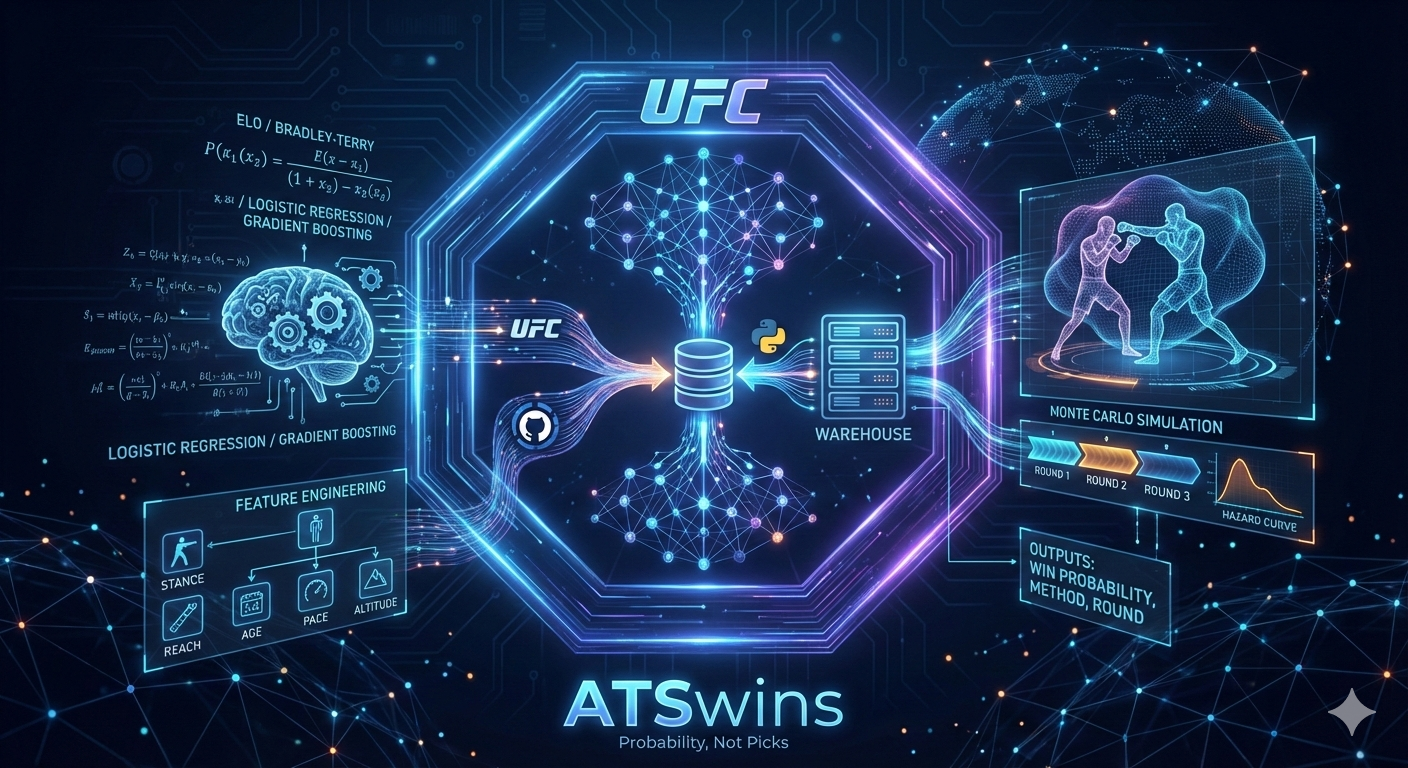
I’m a sports analyst who builds AI-driven UFC fight predictions, and this guide explains exactly how I translate raw data into real betting edges. If you’ve ever felt lost in a sea of stats, pace numbers, takedowns, and control times, this article is for you. We’ll break it down step by step: from pulling the right data to building calibrated probabilities you can trust. This is about clear examples, practical tools, and simple steps. No fluff, just smart UFC fight predictions that make sense when the cage door closes.
Table Of Contents
• Data and feature spine from first principles
• Modeling choices that actually predict
• Simulation engine: Monte Carlo round-by-round
• Validation and diagnostics that matter
• Tooling and delivery for ATSwins
• Templates, checklists, and examples
• Conclusion
• Frequently Asked Questions (FAQs)
Data and feature spine from first principles
Primary sources that hold up under scrutiny
If you’ve tried to scrape every available source, you already know the truth: the best path is reliable and repeatable. I rely on two main sources for UFC data. First, official UFC event and bout logs provide per-fight stats, per-round breakdowns, knockdowns, control time, significant strikes, and positions. While not perfect, these are sanctioned records and the most trustworthy numbers available. Second, open historical tables such as Kaggle MMA datasets help supplement roster history, fighter attributes, and past event archives. Kaggle is useful, but I always reconcile it with official UFC reports to avoid inconsistencies.
In practice, I keep a single normalized warehouse table keyed by fight ID and fighter ID. Per-minute and per-fight aggregates are stored together to allow fast joins and efficient walk-forward backtesting. This structure pays dividends when building simulations and evaluating predictions over time.
Schema: what to capture per fight and per minute
For a UFC prediction model to be meaningful, you need a minimum set of features that capture both the fighter and the context of the fight. Key elements include:
Fighter and opponent attributes, like age on fight day, height, reach, stance, weight class, layoff days, short-notice flags, and travel distance. Per-fight outcomes should include method of victory, round and time of finish, and, when available, round-by-round judge scores. Per-minute rates such as significant strikes landed and attempted, knockdowns, takedowns attempted and defended, control time, submission attempts, and pace proxies are critical. Contextual variables such as cage size, altitude, and late replacement flags improve realism. Storing both raw totals and normalized per-minute rates allows pace projections to adjust for varying fight lengths.
Strength-of-schedule and weight-class normalization
Raw rates alone are misleading. Opponent-adjusted rates provide a better measure of a fighter’s true skill. For example, calculating a fighter’s striking rate should remove the average effect of the opponents faced, weighted by recency with a decay factor. Similarly, weight-class normalization ensures that pace and finishing rates are compared within appropriate divisions. A lightweight’s pace looks very different from a heavyweight’s, so z-scoring metrics by weight class over a rolling three-year window ensures realistic comparisons.
Feature engineering playbook
Raw metrics need to be transformed into predictive features. Key categories include offensive and defensive splits, stance matchups, reach and height deltas, age curves, pace overlap, recent form, and volatility measures. Contextual adjustments like altitude, travel, short notice, and camp changes are also incorporated. Finally, finishing tendencies such as knockdown rates per head strike and submission attempts per minute help predict the likelihood of early finishes. Start with a small, consistent set of features and expand as your model matures.
Modeling choices that actually predict
Encode skill first: Elo or Bradley–Terry
A solid fight-level skill rating stabilizes your classifier and simulation. Elo ratings initialize fighters to a base value and update after each fight with K-scaling based on uncertainty. Bradley–Terry models fit a logistic function of win probability based on skill differences between fighters. Both approaches are useful, but Bradley–Terry is often easier to interpret and can incorporate covariates like weight class or stance.
Calibrated classifiers: logistic regression and gradient boosting
You don’t need exotic models to produce reliable probabilities. Logistic regression is fast, transparent, and works well with small datasets. Gradient boosting captures nonlinearities like age curves and stance-reach interactions. Calibration with isotonic regression or Platt scaling ensures that predicted probabilities match observed outcomes over time. A common approach is to feed BT skill ratings into a gradient booster and then calibrate the outputs.
Optional Bayesian hierarchical layer across divisions
For cross-division skill transfer, a Bayesian hierarchical model with partial pooling can stabilize estimates for debuting fighters and rare matchups. It shares effects such as stance and reach globally while allowing division-level variations. The trade-off is higher computation and complexity, which is usually worth it for platform-grade systems.
Market context as a weak prior only
Market odds are informative but noisy. Treat them as weak priors or input features rather than ground truth. Compare model versus market deltas to detect drift. Over-anchoring to market prices can erase your edge.
Handling stances, reach, age, altitude, travel, and camps
Small details often pay large dividends. Stance matchups, reach differences, age curves, altitude penalties, travel fatigue, and recent camp changes are all modeled carefully. Age effects vary by style, and reach advantage is nonlinear depending on clinch versus distance fighting. Camps rarely provide a direct boost, but they increase uncertainty, which should be reflected in variance.
Keep leakage out with time-based splits
Never allow post-fight data into pre-fight features. Split data by event date, build features only from information available at that time, and use rolling-origin evaluation with periodic refits. This ensures your model mirrors real-world conditions.
Output well-calibrated probabilities, not just picks
Predictions should include win probabilities, method-of-victory distributions, round-of-finish distributions, and confidence intervals. The classifier provides base probabilities, while the simulation engine refines method and round estimates.
Simulation engine: Monte Carlo round-by-round
Hazard models for finishes
Simulations start with hazard models representing instantaneous risk for KO/TKO, submissions, and other finish types. Base hazards derive from offensive and defensive rates, adjusted by reach, stance, pace, and cardio decay. Time slicing in 5–10 second intervals allows realistic modeling of damage accumulation and position transitions. Fatigue and pace are adapted between rounds, with championship rounds receiving distinct cardio decay curves.
Markov transitions for position and control
Positions drive scoring and finish probabilities. A compact state space includes neutral distance striking, clinch, top control, and bottom control. Transition probabilities depend on takedown odds, scramble tendencies, and referee behavior. Damage counters accumulate during ground and striking phases, influencing both KO hazard and round scoring.
Judge scoring with biased priors
Judging is simulated with bias priors to account for striking-friendly, wrestling-friendly, or mixed tendencies. Round scoring uses deltas of effective striking versus grappling and control. Sampling multiple judges produces realistic 10-9 or 10-8 round outcomes.
Propagate uncertainty from injuries, late replacements, and rust
Variance inflators adjust for late replacements, long layoffs, unknown camps, and weight misses. These factors widen uncertainty and more accurately reflect real-world fight dynamics.
Output distributions and tail risks
Monte Carlo simulations produce distributions for win probabilities, methods of victory, round finishes, time-to-finish brackets, and tail risks such as point deductions, cuts, or no-contests. These outputs feed moneyline, inside-the-distance, and round prop markets.
Validation and diagnostics that matter
Walk-forward backtests, not random splits
Random cross-validation is insufficient. Rolling-origin evaluation by event date, quarterly refits, and feature freezing ensures realistic testing. Performance should be reported by era and division to detect drift.
Brier score, log loss, and calibration plots
Brier scores and log loss measure prediction accuracy. Reliability diagrams and expected calibration error track consistency, and sharpness assesses probability distribution quality. Targeted recalibration may be needed for underperforming buckets.
SHAP and permutation importance for interpretability
Global and local feature importance explains why the model predicts a given outcome. Reach delta, takedown defense, and pace gaps are often highly influential.
Error bucketing and stability checks
Errors are analyzed by division, finishing rate, stance matchups, debutants, short-notice fighters, and scoring rules. Adjustments are made where systemic biases appear.
Post-fight residual analysis to update priors
After each event, residuals inform updates to fighter skill, judge priors, and opponent-adjusted rates, keeping the model honest over time.
Tooling and delivery for ATSwins
Prototyping and training stack
Start simple. Colab notebooks or local environments with modest GPUs are sufficient. Pandas or Polars for dataframes, parquet files for storage, and scikit-learn for classical models are reliable. PyTorch can be added for custom hazards or neural calibration layers.
Configs, experiment tracking, and drift monitoring
Version configs, log experiments with parameters and metrics, monitor data lineage, and track feature and probability drift over time. Discipline is more important than flashy tools.
Publishing probability cards and responsible wagering
ATSw ins delivers probability cards showing moneyline probabilities, method-of-victory splits, round distributions, key drivers, and market comparisons. Responsible wagering is emphasized: bet small, treat probabilities as ranges, and monitor markets for movement.
Step-by-step roadmap to build version 1.0
Start with a normalized data spine, fit skill ratings, train calibrated classifiers, implement a simple Monte Carlo simulation, validate with walk-forward backtests, generate probability cards, and iterate by adding context such as altitude, travel, cage size, and judge priors.
Templates, checklists, and examples
Minimum viable data dictionary includes fight IDs, event dates, fighter attributes, layoff days, per-minute rates, opponent-adjusted features, results, methods, and round times. Comparative tables guide when to use Bradley–Terry, logistic regression, gradient boosting, Bayesian hierarchical models, and Monte Carlo simulations. Example feature sets demonstrate real-world matchups and model interpretation. Pitfalls like leakage, over-trusting market odds, and ignoring stance or reach are highlighted with actionable fixes. Lightweight scoring recipes and calibration checklists maintain stability over time. ATSwins workflows integrate picks, props, betting splits, and profit tracking in a cohesive system.
Conclusion
From clean data to opponent-adjusted metrics, calibrated models, Monte Carlo simulations, and consistent validation, building realistic UFC fight predictions is achievable. Calibrated probabilities beat simple picks, round-by-round simulations reveal risk, and disciplined tracking maintains edges over time. At ATSwins, these methods translate into actionable insights for bettors across sports, helping users make smarter, risk-aware decisions and track results over the long term.
Frequently Asked Questions (FAQs)
What are AI sports predictions and how do they work?
AI sports predictions use machine learning to estimate outcomes, player props, and score ranges. Models learn from team form, injuries, pace, rest, betting splits, and historical matchups to produce probability distributions, not certainties.
Are AI sports predictions better than expert picks?
They are different tools. AI predictions are consistent, objective, and scalable, while expert picks add qualitative context. The best approach blends both and stakes bets according to model edge and observed qualitative factors.
How should beginners use AI sports predictions for betting?
Use probabilities to identify positive expected value, bet small, track all wagers, and avoid unnecessary parlays. Focus on markets where your model performs consistently.
What data improves AI sports predictions the most?
High-signal inputs include efficiency, pace, injuries, rest, opponent matchups, usage rates, recent form, and public betting splits. Time-based validation prevents optimistic backtest bias.
How does ATSwins use AI sports predictions to help bettors?
ATSwins provides AI-driven moneyline and prop picks, betting splits, and profit tracking across sports. Free and paid plans allow bettors to compare edges, track results, and make informed, disciplined wagers.
Related Posts
AI For Sports Prediction - Bet Smarter and Win More
AI Football Betting Tools - How They Make Winning Easier
Bet Like a Pro in 2025 with Sports AI Prediction Tools
Sources
The Game Changer: How AI Is Transforming The World Of Sports Gambling
AI and the Bookie: How Artificial Intelligence is Helping Transform Sports Betting
How to Use AI for Sports Betting
Keywords:
MLB AI predictions atswins
ai mlb predictions atswins
NBA AI predictions atswins
basketball ai prediction atswins
NFL ai prediction atswins
ai betting analysis