
The Ultimate NBA Playoff AI Long-Term Betting System: Building a Sustainable Postseason Edge
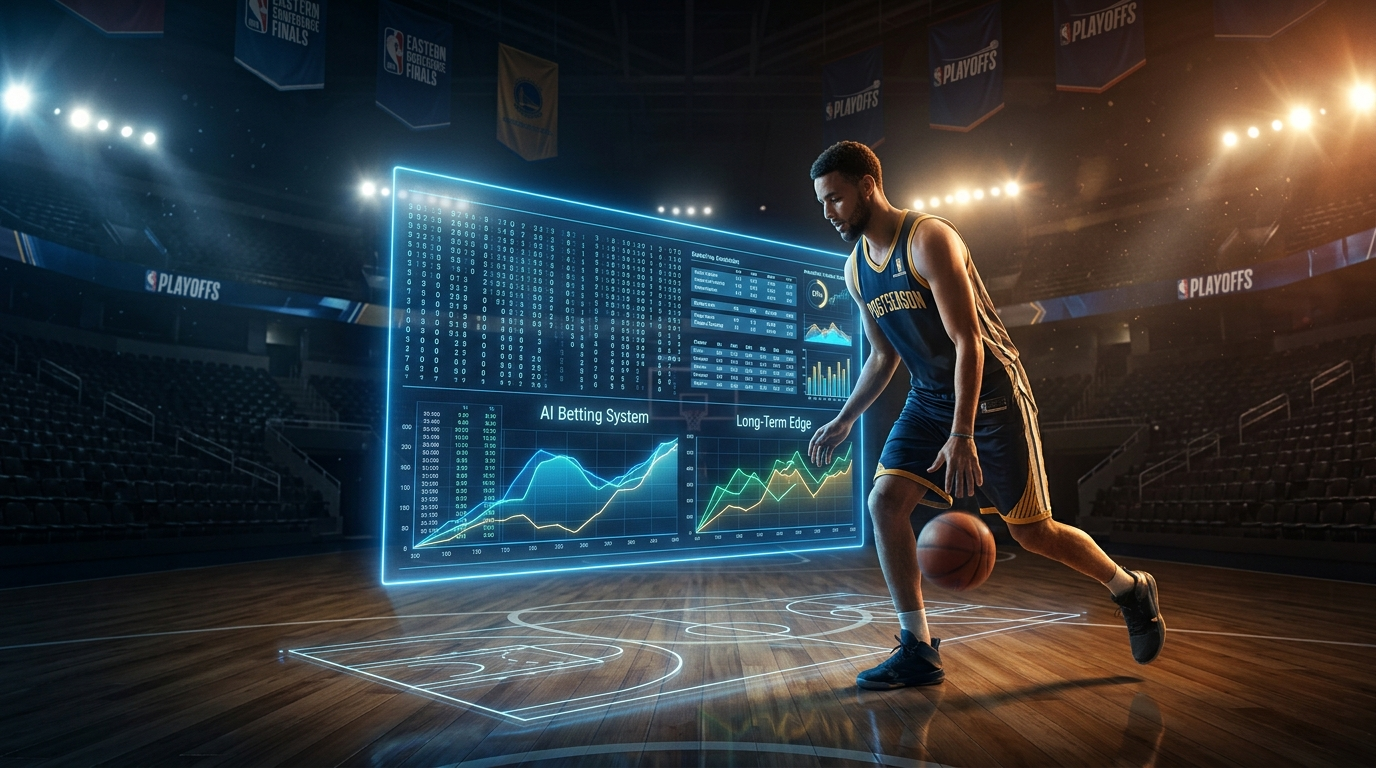
Building a professional-grade betting model isn't about chasing the occasional parlay or following a "gut feeling" during a heated Game 7. If you want to survive the 2026 sports betting landscape, you need a system that treats every possession as a data point and every line move as a signal. I build models for a living, and the nba playoff ai long term betting system I use is designed to find small, steady edges when the spotlight is brightest. We are going to turn possessions, injuries, travel, and closing lines into hard probabilities, then bet with surgical discipline. This is about a repeatable process, not hot takes or reactionary tweets.
Table Of Contents
- Framing the Long-Term Playoff Edge
- Data Pipeline and Feature Engineering
- Modeling and Validation Protocols
- Betting System and Bankroll Management
- Deployment and Real-Time Monitoring
- Practical Workflow with ATSwins
- Common Pitfalls and How to Avoid Them
- Frequently Asked Questions (FAQs)
Framing the Long-Term Playoff Edge
The Target Markets That Scale
For an AI betting system that lasts across playoff cycles, you have to prioritize liquid markets where your edge can compound and where lines move in predictable ways. Focus your modeling efforts on the three pillars of NBA betting. First, the Against the Spread (ATS) market allows you to predict score differential versus the spread. Books price this tightly, but playoff rotations and pace shifts often create seasonal pockets of inefficiency. Second, the Moneyline is where we predict pure win probability. This becomes increasingly useful as rotations shorten and star impact becomes more reliable game to game. Finally, Totals help us predict possessions and scoring efficiency. Totals are incredibly sensitive to pace, defensive schemes, travel, altitude, and even refereeing style.
A working system typically tunes for all three because the same core features explain each market. For instance, knowing that a star player like Luka Doncic is playing 42 minutes instead of 36 affects the spread, the moneyline, and the total simultaneously. You can opportunistically choose whichever market shows the larger edge on a given night while managing correlation across your entire portfolio.
What “Edge” Means in ROI and CLV Terms
In the world of professional sports analytics, "edge" isn't a vague concept; it is a measurable metric. We look at Return on Investment (ROI), which is simply your profit divided by total risked capital. If you risked $10,000 and profited $1,200 across a playoff run, you have a 12% ROI. However, the more important metric for long-term survival is Closing Line Value (CLV). This is the difference between your bet’s implied probability and the market closing number. CLV is the ultimate leading indicator of model quality. If you are consistently beating the close by a cent or a half-point, the math dictates you will profit long term.
Playoff-Specific Quirks That Move Numbers
The postseason is a different beast than the regular season. You cannot simply use an 82-game average and expect to beat the current NBA standings leaders. Rotations tighten significantly. Star players and best lineups log more minutes, so on-off impact is magnified. Pace also tends to slow down as teams familiarize themselves with each other's sets, which changes the distribution tails on totals.
Furthermore, travel cadence becomes a factor. The 2-2-1-1-1 format creates rest asymmetries that don't exist in the regular season. Cross-country travel shows up in shooting legs and transition volume. Even altitude effects, like the thin air in Denver, nudge pace and fatigue in ways that become more pronounced during a high-stakes series. Your AI system must measure game-level probability forecasts, the distribution of margin of victory, and expected possessions while keeping a close eye on line movement drivers like injury updates and public money.
Data Pipeline and Feature Engineering
Multi-Year Ingestion You Can Actually Maintain
You need repeatable data for at least five regular seasons plus all playoffs within that span. Your pipeline should ingest raw game logs and play-by-play data, normalize team and player names to resolve trades, and join odds with game IDs. It is vital to capture both the opening and closing lines to track how the market reacts to news.
Possession-Based Normalizations
Because pace differs so wildly by matchup, all core team stats should be calculated per 100 possessions. This includes offensive and defensive ratings, as well as the "Four Factors" of basketball: eFG%, turnover rate, rebound rate, and free throw rate. For totals, your model needs to project possessions as a function of both teams’ pace priors, adjusted for rest, travel, and the assigned referee crew.
Injuries, Rest, and Lineup Continuity
Injuries are not binary. A player being "questionable" requires a model that can estimate a minute delta. We use on-off impact estimates to translate absences into point adjustments. We also track lineup continuity, which is the percentage of team minutes from the same 8 to 9-man group over the last month. Higher continuity usually boosts stability, especially for teams looking to make a deep run in the NBA Playoffs .
Modeling and Validation Protocols
Gradient Boosting for Performance and Speed
I recommend starting with gradient boosted trees like XGBoost or LightGBM. These models handle nonlinearity and complex interactions—like how injury impact might interact with travel fatigue—much better than simple linear regressions. You want to predict two clean targets: Margin of Victory for spreads and Win Probability for moneylines.
Time-Series Cross-Validation
Playoff data is distinct from the regular season. You must validate your model on playoff-only folds grouped by year and round. Use a rolling window where you train on seasons prior to year Y and validate on the playoffs of year Y. This prevents data leakage and ensures your model isn't "predicting" the past with future information. We evaluate these models using the Brier score and log loss to ensure win probabilities are well-calibrated.
Betting System and Bankroll Management
From Probabilities to Fair Odds
Once your model spits out a probability, you have to convert it to fair odds. If your model says a team has a 60% chance to win, the fair decimal odds are 1.67. If the sportsbook is offering 1.80, you have a clear edge. However, you should only consider bets with a positive expected value after accounting for the "vig" or the bookmaker's take.
Fractional Kelly for Drawdown Control
The Kelly Criterion is a famous formula for bet sizing, but it can be incredibly aggressive. I suggest using a fractional Kelly (25% to 50%) approach. This provides a steadier growth curve and protects you from the inherent variance of a short playoff series. For example, if a full Kelly suggests a 5% stake, a 30% fractional Kelly would have you risk about 1.5%. You should also cap any single-game stake at 2% of your total bankroll and cap series-level exposure to 10% to prevent a single injury from wiping out your funds.
Deployment and Real-Time Monitoring
Automated ETL and Drift Alerts
Your system needs to run after games end to update stats and mid-day to capture price snapshots. It is also important to set up drift alerts. If your model's performance begins to decay or if the market begins to price injuries more efficiently than your model, you need a notification to pause and recalibrate.
Post-Mortems Every Round
After each round of the playoffs, you should refit your models with the newly acquired data. Some teams materially change their rotation identities after a series win. Summarize your CLV by market and identify where your biggest misses occurred. Did you underestimate a switch-heavy defense, or was a specific player's stat profile more impactful than anticipated?
Practical Workflow with ATSwins
To keep things streamlined, I use ATSwins as my primary hub for daily data checks. It aggregates data-driven picks and betting splits that serve as a great sanity check for my custom AI projections.
The Daily Loop:
Morning Scan: Pull the day's slate and early market numbers from the ATSwins NBA games page to see matchups and prices.
Update Injuries: Cross-check expected rotations against the latest news. You can check the latest NBA player news to see if a star's status has shifted.
Run Projections: Generate possessions and win probabilities using your model.
Edge Scan: Flag edges that exceed your threshold for ATS, Moneyline, and Totals.
Finalize and Log: Place your bets at the best available price and log them in your tracker.
Post-Close Review: Compare your entry price to the closing price. Check your results against the NBA results area on ATSwins to keep a clean record.
Using a platform like ATSwins.ai won't replace your custom modeling, but it accelerates the day to day decision checks and helps you track your profit across multiple leagues.
Common Pitfalls and How to Avoid Them
One of the biggest mistakes is overweighting the last game. If a team had a massive outlier shooting night, you have to check the shot quality. If their expected effective field goal percentage didn't actually change, don't swing your ratings too far. Another trap is ignoring correlation. Piling into a series with multiple related bets—like a series price and individual game moneylines—can look great until a single injury flips the script.
Furthermore, failing to calibrate your model is a recipe for disaster. Accuracy is not enough; if your probabilities are off, your Kelly sizing will be dangerous. Always run calibration checks to ensure your 60% predictions actually happen 60% of the time. Finally, maintain strict timestamp discipline. Any leakage in your data will ruin your cross-validation and give you a false sense of confidence.
Frequently Asked Questions (FAQs)
How much data do I really need for a playoff model?
You need at least five years of both regular season and postseason data. The playoffs are a different environment with different officiating and rotation patterns, so having a deep historical well is the only way to capture those nuances accurately.
Why is pace so important in the playoffs?
Pace dictates the number of opportunities for points. In the postseason, teams often slow down to reduce transition opportunities and play more half-court defense. If your model doesn't account for a drop of three to five possessions per game, your totals will be consistently off.
Should I bet player props with this system?
While this system focuses on main markets like spreads and totals, you can adapt it for props. However, be careful with liquidity. Props often have lower limits and can be more volatile than the official NBA scores and game outcomes.
How do I handle "Questionable" injury tags?
The best way is to run two projections: one where the player is active and one where they are out. This gives you a "fair value range." If the market price is outside of that range regardless of the player's status, you have a high-conviction bet.
What is the best way to track my success?
Track your Closing Line Value (CLV) above everything else. If you are consistently betting numbers that are better than the final closing line, you are winning the battle against the bookmaker, regardless of the short-term result of a single game.
Can I use this for other sports?
The principles of possession-based modeling and fractional Kelly sizing apply to most sports, but the features will change. For instance, in an MLB totals projection, you would focus more on weather and park factors than on travel fatigue.
Related Posts
AI For Sports Prediction - Bet Smarter and Win More
AI Football Betting Tools - How They Make Winning Easier
Bet Like a Pro in 2025 with Sports AI Prediction Tools
Sources
The Game Changer: How AI Is Transforming The World Of Sports Gambling
AI and the Bookie: How Artificial Intelligence is Helping Transform Sports Betting
How to Use AI for Sports Betting
Keywords :
MLB AI predictions atswins
ai mlb predictions atswins
NBA AI predictions atswins
basketball ai prediction atswins
NFL ai prediction atswins