
The NHL Entry Draft Guide: Making Sense of Models, Odds, and Strategy
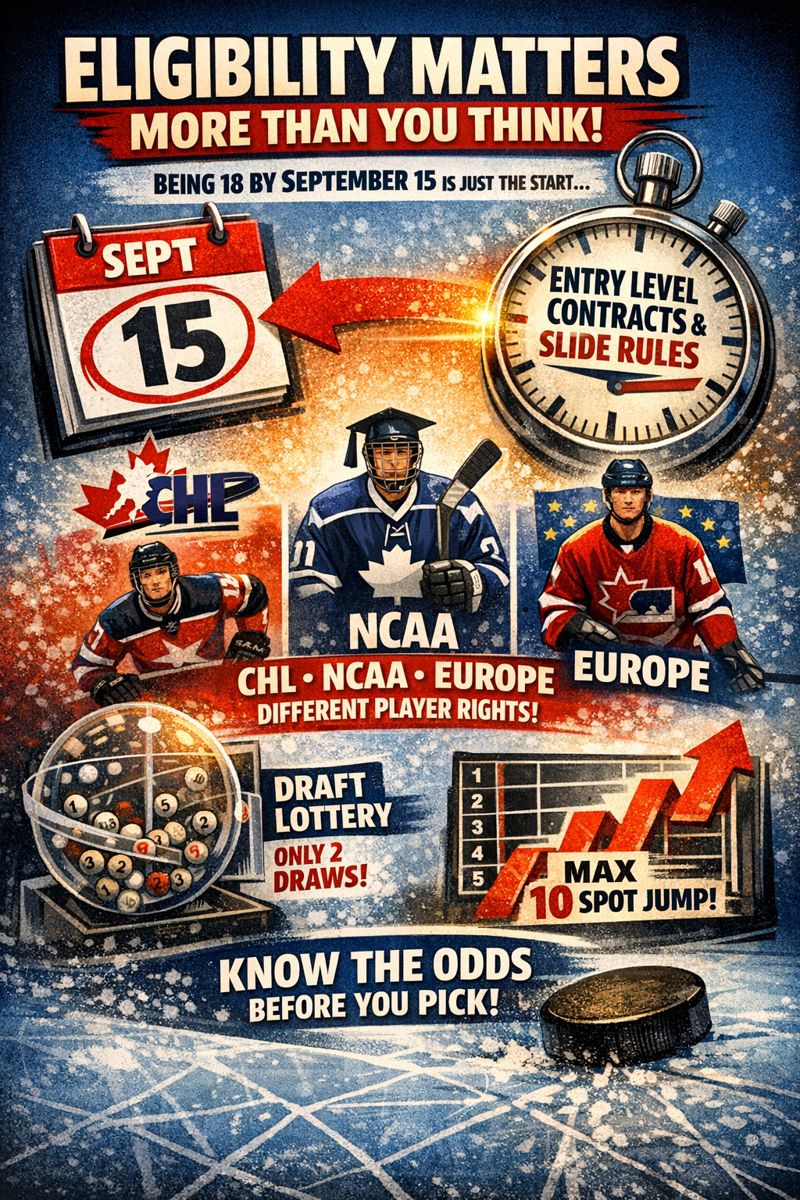
The NHL Entry Draft looks chaotic from the outside, but there is a clear logic behind who is eligible, how the lottery moves picks, and where real value hides. As a sports analyst who leans heavily on AI models, I am going to unpack the signals that actually matter. We are talking about things like age adjusted scoring and league strength plus practical steps for smarter draft day decisions.
Eligibility matters more than you think because being eighteen by September 15 is just the start. You have to consider Entry Level Contract timing plus the slide rules and the totally different rights for players coming from the CHL or the NCAA or Europe. You absolutely need to know the clock before you draft or trade picks. The lottery moves are actually pretty limited since there are only two drawings and a maximum ten spot jump with odds that are tied strictly to the standings. This shapes tank risk and protections and determines exactly how far your board must stretch. Signals that travel well include age adjusted scoring and even strength primary points per sixty along with league strength plus microstats like entries and shot assists. You should always pair these numbers with video and context. Plan for variance by building ranges rather than single targets and expect goalie swings while mining day two value. Use live decision trees to react when the board breaks your way. We use ATSwins.ai which is an AI powered sports prediction platform offering data driven picks and player props and betting splits and profit tracking across the NFL and NBA and MLB and NHL and NCAA. Free and paid plans give bettors insights and guides to make smarter and more informed decisions.
NHL Entry Draft: Mechanics, Models, and Edges for Bettors
What the NHL Entry Draft is and how it works
Eligibility windows, who’s in and when
The first time eligibility for a player centers entirely on age. A player is eligible in the year he turns eighteen by September 15. Most of the first time eligible players you see walking up to the stage are eighteen on draft day. The rules split significantly when you look at North American versus international prospects. North American players which includes those in the CHL and USHL and NCAA can be drafted until the year they turn twenty by December 31. If they are not drafted by then they become free agents once the draft passes. Non North American players can be drafted through age twenty one. If they go undrafted by that point they become free agents. Re entry eligibility is another layer. A player who was previously drafted but goes unsigned can re enter a later draft or depending on their birthdate and rights status they might become a free agent when the rights window closes. This is the simple version but if you need to verify a nuance you should check the official league resources.
Draft order basics you actually use
The draft order starts with the sixteen non playoff teams which are ordered by the draft lottery results and then by regular season standings. The lottery can shift the top of the board but we will get into those details in the next section. The sixteen playoff teams fill out picks seventeen through thirty two. The Stanley Cup winner picks thirty second while the Cup finalist picks thirty first. The Conference finalists pick twenty ninth and thirtieth and are ordered by their regular season points. The remaining playoff teams are slotted by the round of elimination and their regular season points. Tiebreakers for standings which include regulation wins and ROW and head to head and goal differential ripple into lottery odds and then into the ordering of playoff teams for later picks.
Trading draft picks, common protections, and how they’re written
All draft picks can be traded except for the obvious rule that the same pick cannot be traded twice at once. Pick protection is routine in this league. You will often see clauses like top ten protected or top two protected which means the pick conveys in a future year if the selection lands in that protected range once the lottery finalizes the order. For bettors protections matter in futures and for modeling team timelines. A rebuilding club with a protected outgoing first rounder might accept short term pain knowing they will keep the pick if the season goes off the rails. Conversely an unprotected pick often drives conservative behavior late in the season.
Entry-level contracts and the slide rules
The length of an Entry Level Contract or ELC is based on the player's age on September 15 of the year the contract is signed. If the player is between eighteen and twenty one years old it is a three year deal. If they are twenty two or twenty three it is a two year deal. If they are twenty four it is a one year deal. If they are twenty five or older it is a standard NHL contract and not an ELC. The slide rule is where things get interesting for cap management. If a player is eighteen or nineteen as of September 15 and plays fewer than ten NHL games that season the ELC slides one year. The contract effectively starts the next season and keeps the AAV friendly entry level window open longer. Slides can happen twice at ages eighteen and nineteen if the ten game NHL threshold is not met. This is a huge betting angle because slides affect Calder eligible seasons and development timelines. If you bet on rookie scoring or Calder futures you must verify whether a top prospect is likely to slide or to stick.
CHL vs NCAA vs Europe: rights windows that drive decisions
Rights are held for different periods based on the league the player was in at the time of the draft. This changes how quickly clubs must sign a player. When you look at the CHL which covers the OHL and WHL and QMJHL teams have two years to sign the player. If they remain unsigned the player can re enter the draft. Under the CHL NHL agreement players under twenty generally cannot play full AHL seasons so it is either the NHL or back to junior with some late season exceptions. The slide likelihood is high for eighteen and nineteen year olds if they play less than ten NHL games. NCAA players are different. Teams generally hold their rights until thirty days after the player leaves school. If the player completes four years and declines to sign he can become a free agent on August 15. NCAA players cannot play in the AHL and keep NCAA eligibility so they can sign after their college season and then join the AHL or NHL. The slide likelihood is also high for eighteen and nineteen year olds if they get NHL tryouts under ten games. For Europe covering the SHL and Liiga and others it is commonly four years to sign. If the player was drafted from a league without a transfer agreement rights can be held indefinitely. These players are eligible for the AHL in North America once signed otherwise they can stay in Europe. The same ten game NHL threshold applies to slides for eighteen and nineteen year olds. This strategy signal means shorter rights windows force earlier decision making and tend to increase the use it or lose it urgency on CHL skaters while European rights give more patience. This shapes how teams balance drafting older versus younger prospects and how they pipeline to the AHL.
Lottery mechanics and draft order volatility
Two lottery draws, max 10-spot jump, and win limits
The modern lottery uses two draws to determine the top two picks and then the remaining non playoff teams slot in by reverse order of their standings. There is a maximum jump rule where a lottery winner can move up no more than ten spots. So only the bottom eleven teams can win the first overall pick. There are also win limits meaning a single team can win the lottery no more than two times across any rolling five year period. All official parameters and odds live on the league's official pages.
How standings points and tiebreakers feed odds?
Teams are sorted by fewest points at the end of the season. Tied teams are split by league tiebreakers like regulation wins and ROW and head to head and goal differential. Those positions determine your odds table entry. The difference between finishing thirtieth or twenty ninth is real and clubs weigh risk versus reward down the stretch. Modeling the marginal lottery odds value of each point can be informative but it is never just math because PR and the room matter.
Tanking risk management and pick protection ideas
With only two lottery draws and a cap on jump distance finishing last no longer guarantees a top two pick. It just gives you the highest odds and the smallest downside risk. If you track expected value of draft slots you can set a floor for what you will accept in late season moves. For example if your team projects to twenty eighth the EV of the final draft position after the lottery might be something like five point four. If you add three standings points via call ups you may end with an EV of six point zero and a narrower path to a franchise tier player. You have to decide if the room needs those points.
How to simulate lottery scenarios for planning and betting?
To simulate this properly you need a step by step process. First pull year end standings or live projections before the final week. Map each team to its lottery odds row using official odds. Run fifty thousand lottery simulations with two draws and the ten spot cap. Record distributions of final slots for each team plus the EV of the pick number. Layer protections like top ten protected to compute the probability the pick conveys now versus next year. Update prospect value curves for the draft class to translate pick EV into WAR or surplus value distributions. This is useful to price exact draft position props or project the chance a given team picks in the top five. It also helps evaluate futures that depend on a team adding a low cost star ELC in two years.
Scouting pipelines and signals
The common pathways and what they tell us
The CHL including the OHL and QMJHL and WHL remains the core for North American skaters because it offers larger sample sizes and easier comps year over year. The USHL and NTDP are also key. The USHL produces a mix of NCAA commits and NTDP stars while the NTDP adds context via international play and heavy exhibition schedules. The NCAA features older and stronger competition so production at eighteen or nineteen in the NCAA can be a strong indicator for top picks. Sweden's J20 Nationell to SHL and Finland's U20 SM sarja to Liiga offer transparent progression where translation factors are well studied. Russia's MHL and VHL to KHL is a bit tougher because context varies widely regarding ice time and special teams usage but it is still a rich talent pool. For bettors early SHL or Liiga minutes at eighteen are big signals. CHL dominators who score at even strength and not just on the power play track best. USHL to NCAA transitions identify speed and habits that scale.
Combine testing, measurables, and true edges
The NHL Scouting Combine offers VO2 and bench and vertical jump and grip and jump tests and agility measures. It is not perfect but strong lower body power correlates with NHL zone exit speed and rush chances. Grip and pull patterns map loosely to board battles but video confirms fit. You should use the combine as a tiebreaker and not a driver. If your model moves a player more than ten to fifteen spots on combine alone you need to re check.
Age-adjusted production and translation factors
Rate stats per game can mislead. You should prefer per sixty at even strength and adjust for league and age. The age curve matters because a seventeen year old scoring zero point nine points per game in the WHL is not the same as a nineteen year old at one point one points per game. You also need to look at the strength of the league. Convert to NHL equivalency or NHLe for a first pass. Do not use a single global multiplier but instead use positional and era aware modifiers. Add on signals include primary points share and involvement rate on team goals. Shot volume and quality or xG and shot assists and rush entries with control are also vital. Penalties drawn versus taken acts as a proxy for agility and deception.
Injury history and late-birthday effects
Late birthdays for those born in late summer mean they are younger relative to the cohort often with more runway. Under the hood rates can beat raw point totals here. Persistent injuries complicate sample size. You have to create adjusted priors with rolling windows and regress to team or league means to avoid over penalizing a small sample injury year.
Microtracking and public xG, without overfitting
Use public microtracking where available for zone entries and exits and defensive gap wins. Sample sizes can be thin so blend public xG with team adjusted baselines. Weight microstats higher when video confirms repeatable habits like shoulder checks and middle lane drives and delay plays. For goalies shot context like east west passes and slot xG matters more than raw save percentage. If you lack pre shot movement data widen your uncertainty bands.
Draft boards that travel well
To build a board that travels across leagues you need to normalize per sixty production for league and age. Add tiered tool grades for skating and puck skill and shot and sense and motor with zero point five point increments to avoid fake precision. Use an environment penalty when the team ecosystem inflates numbers like a stacked power play or overage teammates. Keep bands not a single number. A Tier 1 with five players gives flexibility when the board breaks your way.
Modeling and decisions
Ingredients for a prospect model that helps bettors
A prospect model needs specific inputs. You want age adjusted even strength production per sixty. You need league strength priors by position. Include skating and tool grades from public and internal scouts. Size and reach should be interaction terms not primary drivers. Context like quality of teammates and usage and zone starts is crucial. Track record in international tournaments gets a small weight. Your targets should be the probability of reaching two hundred NHL games by year seven and Expected WAR over the first seven NHL seasons. Also look at Time to NHL or TTN which is the years from draft to the first forty game season. Outputs feed futures because if your model upgrades a team's odds of adding a one point zero WAR player on an ELC in two years that informs win total overs in that horizon and Calder markets.
Uncertainty bands and scenario planning
Do not report a single WAR outcome. Show the P10 and P50 and P90 WAR for years one through seven. Show the TTN distribution. Use cross scenario graphs if the player lands in the NHL immediately or goes to the AHL for one year or stays in Europe. Draft decisions are about risk appetite. A team with a deep NHL roster can take a higher variance swing while rebuilding teams might prefer safer second line center or defense outcomes.
Cross-checking video with data in three passes
Pass one is the data scan where you flag outliers on production and entries and retrievals. Pass two is the video check where you validate mechanics like edge work and posture and deception and repeatability. Pass three is the context fix where you adjust for usage. If the player only scores off power play one timers you have to downgrade even strength translation risk.
Hit rates by round and realistic timelines
Big picture truths stand up in most samples. First rounders carry the bulk of NHL impact and reach the league sooner commonly one to three years from the draft. Second and third rounds produce meaningful contributors but with longer timelines of two to four years and more variance. Day three rounds four through seven hits exist and are clustered around late bloomers and fast risers and overage skaters with strong tools and occasionally goalies. For betting use priors that Calder winners are typically top ten picks entering the NHL immediately or year plus one. Exceptions exist but you will want fair prices.
Where to avoid overfitting?
Do not over index on height and weight without evidence of skating leverage. Size is a force multiplier when the feet and edges are there otherwise it is noise. Year specific NHLe coefficients can produce curve fitting so smooth coefficients over multi year windows. Overweight playoff samples cautiously because opposition quality can be uneven and micro samples introduce spurious jumps.
History, outcomes, and strategy
First-round certainty vs day-2 and day-3 value pockets
In round one the top five picks have consistent star rates and are secure when a class has multiple franchise caliber centers or defensemen. Picks six through fourteen offer an upside versus certainty tradeoff so pick toward team development strengths. Picks fifteen through thirty two are a tiered bet on tools and hockey sense and taking goalies here is brave. Day two offers best value in underscouted leagues or role agnostic wingers with transport skill. Centers who drive entries age very well. Day three is for overage skaters with elite speed or short track history or late growth spurts. European defensemen with efficient retrievals and first pass rates are also good targets.
Goalie volatility, why it’s different
Goalie performance is context heavy and matures late. Draft them for traits like edge control and post integration and tracking through traffic and active hands. Look for save selection under duress and sequencing on lateral plays. For your model use wide priors and bigger uncertainty. Think of goalie picks like options because you will not hit often but hits are valuable. Do not force them in round one unless the class demands it.
Post-2005 CBA trends to know
The ELC and cap era improved the value of getting NHL ready contributors on cheap years. Teams that convert early round picks into legitimate ELC contributors build multi year edges. Development staffs matter more now. The gap between teams with robust skills coaching and those without has widened. The draft is step one but development is steps two through twenty.
Team identity and development resources change expected value
A fast rush heavy NHL team lifts prospects who transport the puck. A grind and cycle team boosts big net front types and defenders who seal walls and win pucks. Translate fit into your model by adding a team style vector and compute interaction with player traits. A zero point two WAR player in a poor fit can become zero point five WAR in a perfect fit. That changes futures value.
Actionable steps for pre-draft prep
Build a rolling draft board from Tier 1 to Tier 5 with five to eight players per tier. Assign P50 and P90 WAR and TTN for each. Do a league by league audit looking at CHL even strength primary points and entries per sixty. Check NCAA rate stats plus penalty differential. For SHL and Liiga any NHL translatable minutes at eighteen or nineteen get a bump. For KHL and MHL adjust for scarce ice and weigh shot quality when available. Validate with official lists comparing to NHL Central Scouting. Disagreements are healthy but big gaps require a second look. Prepare trade down guardrails by defining minimum acceptable return when moving down within a tier versus across tiers.
Live-draft decision trees that work
Use a minute by minute checklist. If your tier is intact trade down only within the same tier. If your final player in a tier is about to go be willing to move up a few spots. Run three quick scenarios to take the skater with the highest P90 WAR or the safest TTN or the positional scarcity play like a right shot defender or high end center. Consider rights windows because CHL picks bring faster sign or re enter pressure while Europeans allow patience if your NHL roster is capped. Regarding risk palatability if your team's NHL roster is thin down the middle breaking ties in favor of centers is fine.
Post-draft development tracking for bettors
Build a tracking dashboard by prospect. In year zero to one look at camp reports and AHL assignment and usage and power play or penalty kill status. In year one to two look for even strength impacts and shot quality and zone exits and entries progression. Red flags include no even strength impact by age twenty in high end junior or twenty one in NCAA which often signals slower TTN. For betting keep a Calder watchlist and verify games played and ELC slide. A prospect who will stick for seventy plus NHL games deserves attention at longer preseason prices. For team futures when three prospects are projected to add one point five to two point zero combined WAR on ELCs that is a quiet bump in the season points market.
Scouting pipelines and signals, in practice for ATS and props
How I rank across leagues with a simple template?
I use a spreadsheet with specific columns to track. I list Player and league and age on Sept 15 and position and handedness and height and weight. I track ES points per sixty and primary points per sixty and PP share and shot attempts per sixty and xG per sixty. I also look at entries with control per sixty and exits with control per sixty and retrievals won per sixty. Penalties drawn per sixty and penalties taken per sixty are important. I include tool grades for skating and puck skill and shot and hockey sense and motor on a zero to nine scale. Environment flags catch stacked power plays or coach usage rate or overage status. I estimate TTN in years along with P50 WAR for years one through seven and P90 WAR. My weights are forty five percent data including production and microstats and thirty five percent tools and ten percent environment and ten percent uncertainty insurance to penalize when missing data.
Public tools and data, and how to use them
NHL Central Scouting lists are a sanity check for player ranges so compare your board to theirs to spot biases. Use public databases for data context and team or league sites for game logs. Official league materials for rules and odds live at the league's official sites. For the modeling stack use Python or R for simulations or for quick hits Google Sheets plus add ons works with IMPORTXML for pulling public leaderboards. If you track odds and props record your hit rates versus model tiers. Keep it simple.
Step-by-step: building a board that impacts bets
Step one is to gather and clean by pulling player stat lines and normalizing per sixty at even strength and adding age and league corrections. Step two is the first pass model where you calculate NHLe like translations per league and position and age and estimate TTN and P50 and P90 WAR. Step three is the scout overlay where you watch two to three full games per top fifty prospect and tag five to ten clips for skating and decision making both good and bad. Step four is tiering where you assign to tiers with uncertainty bands. Do not force a numeric rank across tiers. Step five is scenario simulation where you simulate the lottery and pick ranges and map probability the team can draft exact names in each slot. Step six is the betting checklist. Fire on draft position props when your tier suggests a player is seventy percent plus to go inside a range that the book prices below sixty percent. For Calder adjust preseason odds for players likely to step straight into top six or top four minutes. For team futures upgrade rosters with ELC contributors and remember cheap value drives add on signings at the deadline.
ELC timing in betting markets
Where ELC slides and rights windows hit your slip?
For Calder futures know whether a player hits the ten game threshold. If a prospect is on the bubble the team might prefer the slide to extend the ELC. That often kills Calder value for that season. For regular season props young defenders often start sheltered so block shots might be live before points props become viable. For forwards PP2 time can be enough for shots on goal overs if volume travels. For team point totals one high floor first round pick who can contribute zero point five WAR in year one is worth roughly one point five standings points. Stack two or three such players over two years and you change the outlook.
Draft-day trading and pick-value curves
How to value picks with a simple curve?
Use a monotonic pick to WAR curve with a steeper slope in the top ten flattening by the late first then a long tail. To trade down if the expected surplus from moving down six spots is less than adding an extra second round pick's EV and your tier has four names left take the trade. If your last Tier 2 name is on the board moving down across tiers is a tax you do not pay without a premium.
Pick protections, what they really cost
Top ten protection cuts the downside tail for the seller in a bad season. The buyer should demand a sweetener like a prospect or extra pick or an unprotected future year. Use two step logic for pricing. Simulate the probability the pick falls into the protected range. Adjust expected return for the temporal shift because a year later pick is discounted a bit and for class strength variance.
Using ATSwins to surface edges quickly
Quick workflow that pairs modeling with market moves
Pre draft I load my board and simulate lottery and expected ranges for key prospects. I track how early steam on first defenseman selected or over under draft positions compares to my sims. Live during the draft when a faller enters my tier window I expect immediate market reaction. I am ready with preset thresholds for betting first round yes or no or head to head draft matchups. Post draft I update team level models with expected ELC contributions in years one through three. I watch how books adjust win totals and Calder prices.
What to track inside a betting dashboard?
Track prospects to NHL arrival timeline and probability of NHL games in Year 1. Track team level ELC pipeline looking at expected WAR and savings versus market AAV. Track draft pick EV and protections you have modeled so trade rumors are priced faster.
Getting started with ATSwins tools
If you are building these models and want automated alerts when market prices move away from your EV on prospect props or futures the ATSwins NHL workspace keeps it clean. Check the NHL section of the ATSwins NHL hub to plug in your board and test scenarios and track profit.
Verification and quick fact checks
Simple rules I keep taped to my monitor
I keep simple rules taped to my monitor. Eligibility is eighteen by September 15 to be first time eligible with North American players generally through age twenty and non North American through twenty one. The lottery has two draws and a max ten spot jump and two wins per five year window per team with official odds and structure maintained by the league. ELCs for ages eighteen to twenty one are three years with slides at under ten NHL games for eighteen and nineteen year olds. Signing rights are two years for CHL and until exit or August 15 after senior year for NCAA and often four years for Europe while leagues without transfer agreements can create longer rights. When in doubt confirm in the CBA sections.
Practical templates and checklists
Draft board template (copy the columns)
My draft board template tracks identity including Player and position and shot and league and team and birthdate and age on Sept 15. It tracks usage like TOI per GP and ES TOI share and PP share and PK share. Production columns are ES goals per sixty and ES primary assists per sixty and points per sixty and primary involvement percentage and on ice xG per sixty and shooting percentage. Micro columns are entries with control per sixty and exits with control per sixty and retrievals per sixty and DZ denial rate and slot pass completion percentage. Penalties drawn per sixty and taken per sixty are listed. Tools include skating and puck skill and shot and sense and motor on zero to nine scale. Context includes teammate rating and competition rating and coach usage tag and overage flag. Outputs are TTN and P50 WAR years one to seven and P90 WAR and uncertainty band width. Notes cover injury status and combine tags and interview takeaways.
Live-draft call sheet
If player X and Y are on the board at pick N I prefer X if the team lacks centers else I prefer Y for TTN plus one. For trade down thresholds I accept if remaining tier count is greater than or equal to three and the return is greater than or equal to pick value curve plus fifteen percent premium. For protected pick logic if acquiring a top ten protected future first I ask for an added second rounder or a B minus prospect.
Prospect monitoring after the draft
Monthly I look at ES involvement rate and entry exit growth and usage trendlines. Quarterly I update TTN and adjust WAR projections and re scan injury risk. Yearly I check ELC slide status and AHL readiness and if the NHL camp role makes Calder routes live.
Draft-related markets and how to price them
Draft position props
Build a distribution for each player's likely pick range using mock consensus as a trimmed mean prior. Use your model shift based on league adjusted production and tools. Factor in team needs for teams picking near those slots. Fire when your P70 for Under nine point five is greater than sixty five percent and the line is minus one fifteen or better. Be careful with big swings twenty four hours pre draft because news sensitivity spikes.
Exact team to select player
Price with a tree. Take the probability the player is available at each pick k multiplied by the probability team k selects the player given availability. Adjust for publicly reported interviews and second combines and visits.
Calder and rookie props after the draft
If a top ten pick projects to play NHL games immediately with PP time price their points props versus historical comps for similar age and league and usage. Look for midseason call up windows. Shots on goal overs land earlier than points props for rookies who shoot but do not get PP1 right away.
Putting it all together, fast
A 30-minute workflow during draft week
From zero to five minutes update lottery sim distributions and pick protections for any traded picks. From five to fifteen minutes refresh player tiers for top fifty names tagging those with news movement like injury clears or extra interviews. From fifteen to twenty minutes set automated alerts for key prop lines like first defenseman selected and top ten over under and head to heads. From twenty to twenty five minutes preload team needs notes for picks one through twenty. From twenty five to thirty minutes confirm official rule checks with official FAQs for any last minute protection or lottery structure questions and update the board.
A few heuristics that keep you out of trouble
Don't bet against late breaking medicals. Give more weight to even strength production than PP points. Respect teams with strong development records at certain positions because their picks are worth a little more than the slot.
Quick-reference: league facts for bettors
Draft eligibility is eighteen by Sept 15 with North American versus international age windows as noted. Draft order is determined by lottery for non playoff teams and playoff teams are slotted by round advanced then points. Lottery rules involve two draws and a ten spot max jump and win caps within five year windows. ELCs are three years for eighteen to twenty one year olds with a slide for eighteen and nineteen year olds if less than ten NHL games are played. Rights for CHL are two years to sign. Rights for NCAA are until the player leaves school or becomes a UFA on August 15 after senior year if he chooses not to sign. Rights for Europe are often four years but longer in leagues without transfer agreements. Use official links for rules and calendars and odds and mechanics and your modeling plus trusted public scouting reports to fill in the rest.
Conclusion
We covered NHL Entry Draft basics and lottery levers and how to blend video and data for smarter picks. You have to know eligibility and odds and use age adjusted rates while planning for uncertainty rather than hype. Ready to act? ATSwins's expertise in ATSwins is an AI powered sports prediction platform offering data driven picks and player props and betting splits and profit tracking across the NFL and NBA and MLB and NHL and NCAA. Free and paid plans give bettors insights and guides to make smarter and more informed decisions.
Frequently Asked Questions (FAQs)
What is the NHL Entry Draft, and who is eligible?
The NHL Entry Draft is the league’s annual event where teams select the rights to amateur players. For eligibility most North American players must be eighteen years old by September 15 of the draft year and not older than twenty by December 31. Europeans can be older if they have not been drafted before. If a player is not selected they can re enter in later years within age rules. Players coming from the CHL and NCAA and USHL and SHL and Liiga and KHL all filter through the same NHL Entry Draft just with different signing rights timelines after.
How does the NHL Entry Draft lottery affect the draft order?
The lottery decides which teams can move up for the top picks. There are two drawings and a team can jump a maximum of ten spots. Odds are weighted by the regular season standings so a worse record equals better odds. A club can only win the lottery a limited number of times within a set five year window and some traded picks have top ten protections. Bottom line the lottery reshuffles the top then the rest of the order follows the standings meaning rounds two through seven go by points and tiebreakers.
After the NHL Entry Draft, when do players sign and debut?
Most prospects sign an Entry Level Contract or ELC within two years but timing varies. CHL players often return to juniors. If they play fewer than ten NHL games in a season the ELC can slide a year which helps teams with cap planning. NCAA players can stay in college and keep their eligibility if they do not sign. Their NHL rights typically last until they leave school. European players may stay with their club teams overseas for another season or two. Debut timelines range from immediate which is rare to two to four years though goalies usually take longer.
What are the best stats and signals to evaluate NHL Entry Draft prospects?
Keep it simple but sharp. Look for age adjusted scoring rates where younger players producing against older competition is a green flag. Consider league strength and translation factors since SHL and Liiga and KHL production usually carries more than junior numbers. Focus on even strength primary points per sixty not just power play totals. Use microstats when available like entries with control and dangerous pass rate and shot quality or xG contribution. Check tools and context like skating and puck retrievals and compete and size to skill balance and injury history. Late birthday effects and growth curves matter. Do not overweight one tournament or combine test but use it as context not the story.
How can ATSwins.ai help me with the NHL Entry Draft and season bets?
ATSwins.ai is an AI powered sports prediction platform offering data driven picks and player props and betting splits and profit tracking across the NFL and NBA and MLB and NHL and NCAA. Around the NHL Entry Draft I use our models to do a few things. I track prospect indicators that often translate to early NHL impact which helps with future markets and pre season edges. I compare team tendencies regarding development pipelines and roster needs and cap situations to spot smarter long shots. I log all wagers with profit tracking so you can see what is working and what is not in plain view. Free and paid plans give bettors insights and practical how tos to make more informed decisions. If you want a cleaner numbers first way to work the NHL Entry Draft and the season that follows ATSwins.ai has you covered.
Related Posts
AI For Sports Prediction - Bet Smarter and Win More
AI Football Betting Tools - How They Make Winning Easier
Bet Like a Pro in 2025 with Sports AI Prediction Tools
Sources
The Game Changer: How AI Is Transforming The World Of Sports Gambling
AI and the Bookie: How Artificial Intelligence is Helping Transform Sports Betting
How to Use AI for Sports Betting
Keywords:
MLB AI predictions atswins
ai mlb predictions atswins
NBA AI predictions atswins
basketball ai prediction atswins
NFL ai prediction atswins
ai betting analysis