
Sports Betting Strength Of Schedule Model - How To Model SOS
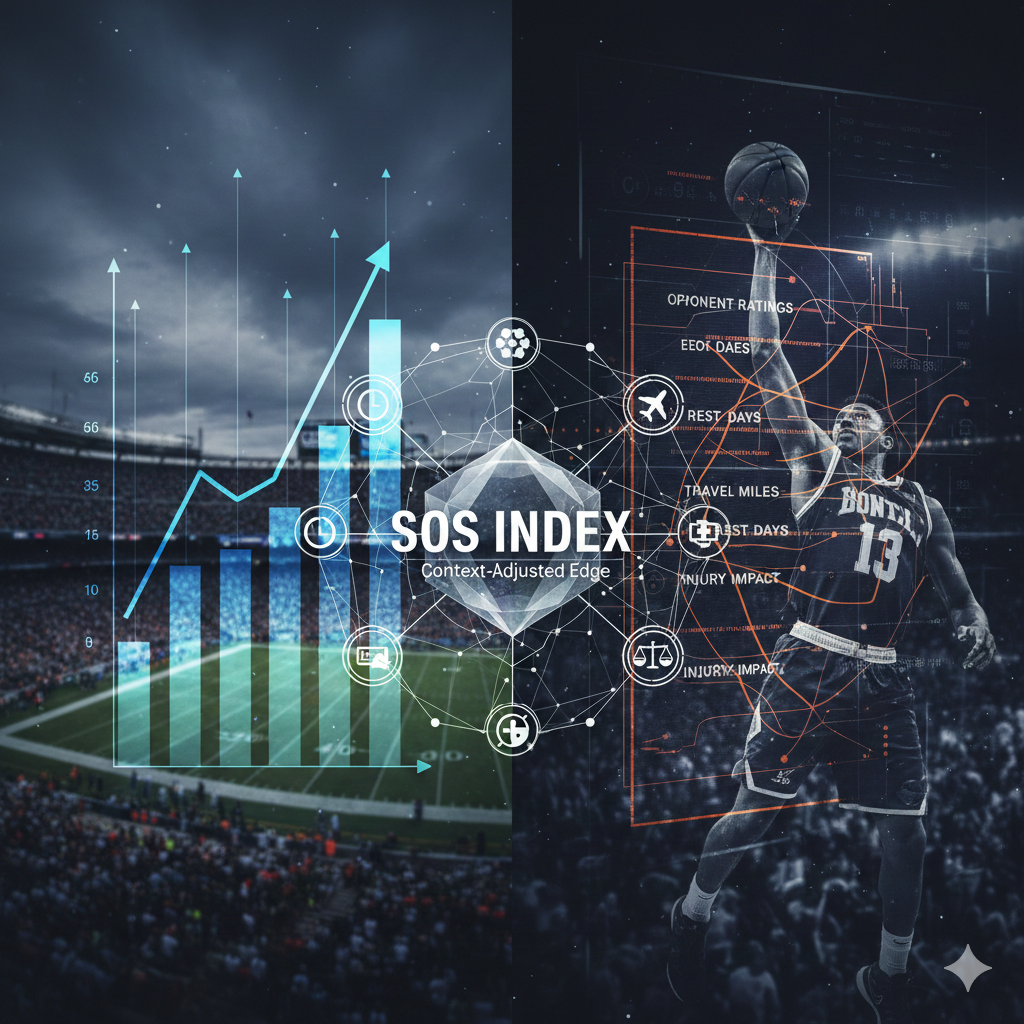
Strength of schedule is not just a buzzword; it is the backbone of how I price games using AI. By measuring who a team played, when, and where, SOS transforms noisy records into real team strength. In this blog, I’ll walk through how to build a betting-oriented SOS, validate it, and use it alongside market data, injuries, and context to find sharper, lower-variance edges.
Table of Contents
- Scope and Context
- Data Pipeline and Feature Engineering
- Modeling Approaches That Translate to Edges
- Practical Build and Tooling
- A Practical SOS Framework Bettors Actually Use
- Evaluation, Deployment, and Risk
- How SOS Connects to ATSwins Workflows
- Worked Example: From Opponent Ratings to a Usable SOS Index
- Practical Heuristics That Work
- Tooling Tips and Small Wins
- A Short Buyer’s Checklist: Datasets and References You Can Use Right Now
- A Compact “From Scratch” Template You Can Adapt
- Putting It to Work for NFL, NBA, and NCAA
- Why Schedule Context Persists in Market Pricing
- Conclusion
- Frequently Asked Questions (FAQs)
Strength of schedule is not just a buzzword; it is the backbone of how I price games using AI. By measuring who a team played, when, and where, SOS transforms noisy records into real team strength. In this blog, I’ll walk through how to build a betting-oriented SOS, validate it, and use it alongside market data, injuries, and context to find sharper, lower-variance edges.
Scope and Context
When most people talk about strength of schedule, they are thinking about resume points for playoff debates or ranking teams. For bettors, however, SOS has to do more than summarize past performance. You want a dynamic, opponent- and context-adjusted signal that shows how a team’s schedule has affected current strength and what it implies for upcoming games. It quantifies how tough a stretch is compared to league average, attributes that difficulty to measurable factors such as opponent quality, rest, travel, and injuries, and produces a forward-looking index you can plug directly into spreads, totals, and props.
Without adjustment, a five-game win streak versus soft opponents does not carry the same predictive value as a 3–2 stretch against elite competition on the road with short rest. That is exactly why ATSwins integrates SOS into its modeling stack so picks and player props do not overreact to noise.
There are three levels of SOS adjustment. First is unadjusted SOS, which simply averages opponent win percentages or point differentials. This is quick but too crude to be useful in betting. Second is opponent-adjusted SOS, where schedule difficulty is measured by opponent ratings such as Elo or efficiency metrics, and weighted by when games were played. This provides a decent baseline. Third is context-adjusted SOS, which layers in rest, travel, pace, altitude, and injuries. This is where true betting edges emerge because the market often lags on compounded situational effects.
Different sports require tweaks. In the NFL, small samples, bye weeks, and single injuries can dramatically shift strength. For the NBA, back-to-backs, long road trips, and altitude penalties matter. College football and basketball have uneven schedules, non-conference games, and massive talent gaps, so hierarchical pooling and conference priors are essential. Across all sports, the goal is to normalize units per play, per possession, or per plate appearance, to keep comparisons fair.
Data Pipeline and Feature Engineering
The first step in building a betting SOS is sourcing and cleaning schedules, game logs, and opponent ratings. You need schedules with team, date, opponent, home/away designation, start time, stadium, and if possible, travel routing. Game logs should contain final score, closing spread, possession or play counts, tempo, turnovers, and injury status. Ratings inputs include prior-year strength, Elo, adjusted efficiency, EPA per play, and opponent-specific splits. Availability data must include injuries, projected lineups, and minutes or usage information. For football and baseball, check weather and dome/outdoor settings, wind, and altitude.
Once collected, normalize these metrics across sports. NFL and college football use per-play measures like EPA or success rate. NBA and college basketball rely on per-100 possessions offensive and defensive efficiencies. Baseball and hockey use per-plate appearance or expected goals. Then, compute team-date granularity SOS, with rolling windows such as the last 10 NBA games or last 3–5 NFL games, with exponential decay so recent games matter more than older contests. Each SOS entry should include opponent strength, rolling mean and variance, rest days, travel miles, injury adjustment, pace fit, weather, and market differences.
Modeling Approaches That Translate to Edges
Opponent-adjusted SOS is often built using iterative rating systems like Massey or Colley or weighted least squares to solve for each team’s adjusted efficiency. Elo-based systems are another option for fast, online updates. Bayesian hierarchical pooling is particularly useful for early season or college data where small samples are noisy. Fatigue costs from back-to-backs, 3-in-4 games, miles traveled, time zone shifts, and altitude changes can be explicitly modeled with GLMs or regression on spread residuals. Walk-forward backtesting ensures time-dependent validation, and linking SOS to spreads and totals via regression gives points-based edge estimates for betting.
The output of these models is not just descriptive; it’s actionable. Spread models use SOS components, fatigue, injuries, and pace differences to predict deviations from the market spread. Totals models leverage pace and matchup fit, including weather and travel penalties, to project points. By calibrating probabilities and testing against actual market outcomes, you can refine edges, account for uncertainty, and avoid overbetting noise.
Practical Build and Tooling
The technical stack is flexible. Python with pandas, numpy, statsmodels, and scikit-learn works well. For Bayesian modeling, PyMC or Pyro can help. R with tidyverse, data.table, and brms/Stan is also viable. Data storage should allow reproducibility, with raw → cleaned → features layered pipelines, using SQLite locally or Postgres/BigQuery in production. Daily ETL should include schema validation, as-of dating, duplication checks, and outlier tagging.
Dashboards track SOS distribution, feature drift, and spread residuals. Alerts notify when SOS shifts exceed thresholds, enabling quick recalibration. Parameterization via YAML or JSON ensures reproducibility and reduces hardcoding. The workflow from raw data to scored features includes assembling ratings, computing opponent-adjusted difficulty, rolling SOS indices, forward-looking SOS for next games, feature export, training spread/total models, and finally scoring upcoming slates with confidence bands.
A Practical SOS Framework Bettors Actually Use
Unadjusted SOS is fast but often misleading. Opponent-adjusted SOS is solid as a mid-season tool. Context-adjusted SOS, incorporating rest, travel, injuries, and pace, provides the most predictive signal for betting. Schedule stress can be calculated as a weighted sum of back-to-backs, travel, time zone shifts, altitude, and short rest. Fitting weights on historical residuals translates these penalties into points adjustments for spreads.
Before betting, check SOS variance, pace, injury clusters, and the alignment of market-implied and SOS-adjusted ratings. This ensures stakes are applied when edges are genuine.
Evaluation, Deployment, and Risk
Metrics must align with bet types. MAE vs closing spread, log loss for moneylines, and calibration for totals are critical. ROI alone is misleading; track volatility, drawdowns, turnover, and Kelly fraction usage. Guard against lookahead by freezing ratings and injuries as of game date. Rolling-origin validation simulates live deployment. Stacking SOS-adjusted ratings with market-implied ratings often improves edge while down-weighting bets when uncertainty is high. Injury modeling, weather integration, and rapid propagation of late news further refine SOS-adjusted projections.
How SOS Connects to ATSwins Workflows
At ATSwins, SOS is embedded into daily picks and player props. Spread and total models include opponent ratings, schedule stress, pace fit, and injuries. SOS segmentation explains consensus errors and helps track profitable edges. For props, pace fit and fatigue penalties directly alter usage and efficiency projections. ATSwins provides daily insights, betting splits, and tracking so users can see SOS in action.
Worked Example: From Opponent Ratings to a Usable SOS Index
Step one is calibrating opponent ratings, initializing priors, and iterating updates with time decay. Step two estimates schedule stress per game, incorporating rest, travel, altitude, and injuries. Step three combines opponent rating, home edge, schedule stress, injury adjustments, and pace fit into game-level difficulty. Step four creates rolling SOS means and variances. Step five translates these into spread and totals model features, including delta SOS, fatigue, injury differences, pace indexes, and weather bins. Step six validates against market outcomes using walk-forward testing. Step seven automates daily recalculation and scoring.
Practical Heuristics That Work
Early season requires heavy priors to avoid overreacting to noise. Fatigue compounds late season, and back-to-backs at altitude can create outsized penalties. Cross-country NFL travel and early kickoff times produce measurable efficiency losses. College mismatches demand pace normalization and opponent adjustment. Cluster injuries often have greater impact than single stars in certain units.
Tooling Tips and Small Wins
Maintain team context cards summarizing SOS rolling, travel, rest, injuries, pace, and weather. Keep a log of what moved the line to compare market drift against SOS expectations. Start with simple baselines before adding complexity, track subgroup performance, and document assumption changes for reproducibility and PnL analysis.
A Short Buyer’s Checklist: Datasets and References You Can Use Right Now
Basketball-Reference for SOS definitions, nflfastR for NFL play-by-play and EPA, cfbfastR for college football, and academic write-ups on Massey and Colley rating systems are excellent starting points. They provide both the data and theoretical foundation for building opponent-adjusted SOS.
A Compact “From Scratch” Template You Can Adapt
Key data tables include: games_raw, ratings_asof, context_factors, injuries_asof, sos_features, market_lines, and predictions. Minimal daily workflow: update ratings_asof, join context_factors, compute game difficulty, roll into SOS features, score vs market_lines, and publish predictions. Monitoring artifacts include MAE vs close, reliability plots, and SOS drift reports.
Putting It to Work for NFL, NBA, and NCAA
NFL SOS leverages EPA/play, success rate, run/pass splits, injury clusters, wind tiers, and early kickoffs. NBA SOS accounts for back-to-backs, 3-in-4 penalties, altitude, pace mismatches, and rotation-aware injuries. College SOS benefits from hierarchical pooling, neutral-site adjustments, and talent gap priors. Each sport has pitfalls, from small samples and quarterback volatility to late scratches and non-conference mismatches. Monitoring fatigue, schedule stress, and injury stacking is essential.
Why Schedule Context Persists in Market Pricing
Markets are efficient, but fatigue, travel, and player availability compound in ways that a single closing number does not capture. Bettors still anchor on raw records or margins. Context-adjusted SOS feeds rating engines with the right priors, allowing smaller, steadier edges, controlled turnover, and avoidance of noise-driven bets.
Conclusion
Building a betting SOS model means adjusting for opponent quality, rest, travel, injuries, and pace, then connecting it to spreads, totals, and props. Key takeaways: respect time, avoid lookahead, validate against the market, and track SOS vs lines. ATSwins.ai provides AI-driven projections, data-driven picks, player props, betting splits, and profit tracking across major sports to help bettors make smarter, informed decisions.
Frequently Asked Questions (FAQs)
What is a sports betting SOS model?
It measures how tough a team’s opponents have been and adjusts for context like home/away, rest, travel, injuries, and pace. This creates cleaner power ratings and better betting signals.
How do I start building a simple SOS model?
Collect game logs, assign opponent ratings, compute rolling averages, add context adjustments, and recalculate weekly. Use Python or R with public datasets like Basketball-Reference and nflfastR.
How does SOS change bets?
Spreads: prevent overrating teams that beat soft schedules. Totals: adjust pace and efficiency. Props: predict regression when tougher matchups appear.
How do I test if SOS works?
Walk-forward testing vs closing line using MAE, log loss, and calibration curves. Avoid lookahead, use rolling windows, and sanity-check early-season noise.
How does ATSwins.ai use SOS for edges?
SOS integrates opponent quality, rest, travel, injuries, and pace into picks, props, betting splits, and tracking. Free and paid plans provide insights for smarter, data-driven bets.
Related Posts
AI For Sports Prediction - Bet Smarter and Win More
AI Football Betting Tools - How They Make Winning Easier
Bet Like a Pro in 2025 with Sports AI Prediction Tools
Sources
The Game Changer: How AI Is Transforming The World Of Sports Gambling
AI and the Bookie: How Artificial Intelligence is Helping Transform Sports Betting
How to Use AI for Sports Betting
Keywords:
MLB AI predictions atswins
ai mlb predictions atswins
NBA AI predictions atswins
basketball ai prediction atswins
NFL ai prediction atswins
ai betting analysis