
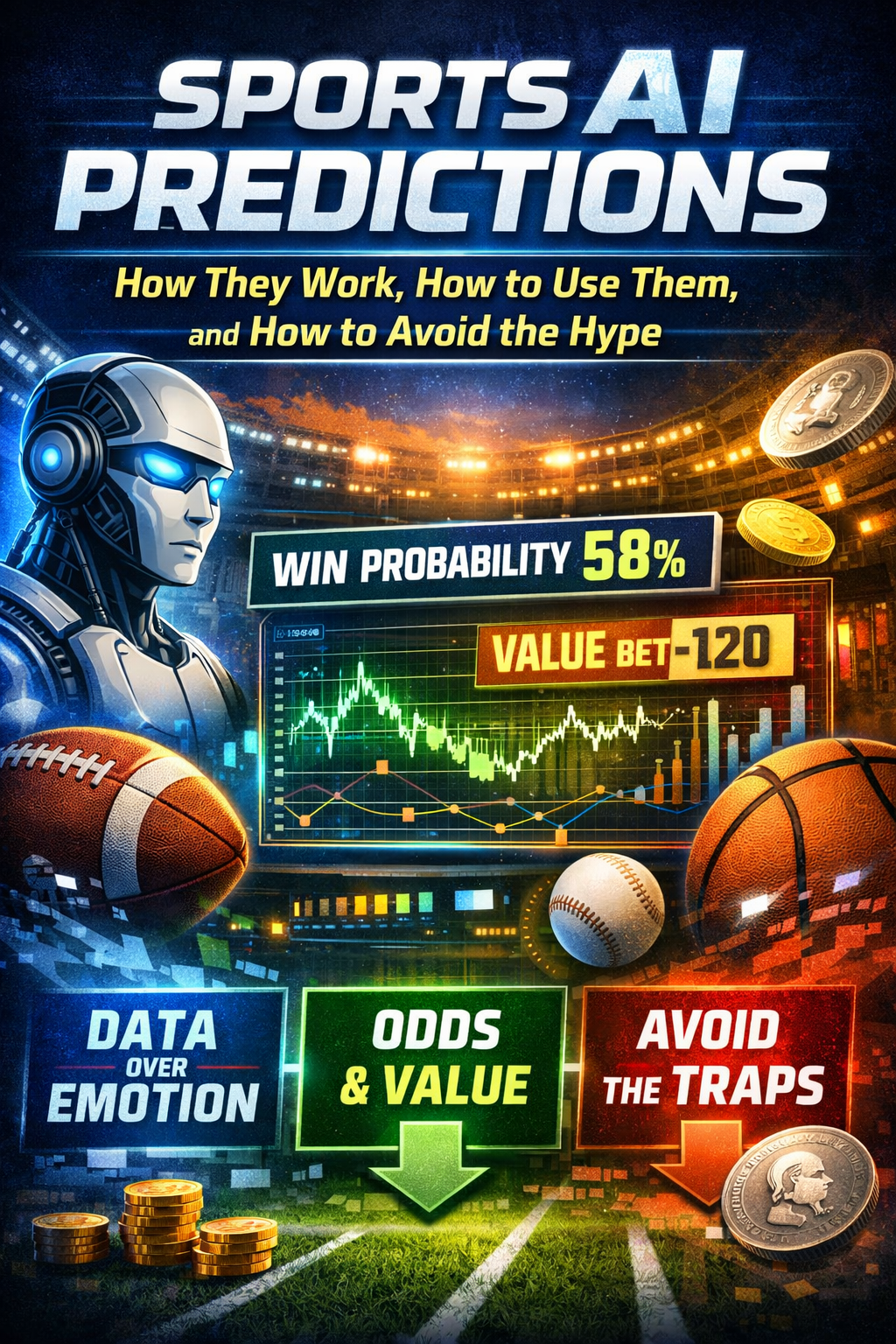
Sports AI Predictions: How They Work, How to Use Them, and How to Avoid the Hype
If you’ve ever stared at a slate of games and thought, “There’s no way I can process all of this,” you’re not wrong. Between injuries, schedule spots, travel, pace, matchups, market movement, and that one random role player who suddenly turns into prime Michael Jordan on a Tuesday… it’s a lot.
That’s exactly why sports AI predictions have exploded. Not because AI is magical. Not because it “knows the future.” But because it can do what humans are terrible at: consistently crunch huge amounts of information, apply the same logic every time, and avoid emotional decision-making.
The catch? Not all “AI predictions” are built the same. Some are legit models with real evaluation. Others are basically a coin flip wearing a lab coat.
So let’s break this down in plain English: what sports AI predictions actually are, how they’re created, what makes them trustworthy, how to use them like a grown-up, and how to avoid the classic traps that turn “data-driven” into “I’m down 12 units and blaming variance.”
What Are Sports AI Predictions?
At the simplest level, sports AI predictions are model-generated forecasts about a sporting event or outcome. That outcome could be:
-
Who wins (moneyline)
-
Who covers (spread)
-
Total points/goals/runs (totals)
-
Player performance outcomes (props)
-
Team totals, 1H/1Q lines, alt lines, futures, etc.
The model takes inputs (data) and outputs probabilities or projections. A good system doesn’t just say “Team A will win.” It says something like:
-
“Team A has a
58%
win probability.”
-
“Fair line would be
-138
.”
-
“If the market is offering
-120
, that’s value.”
That difference matters. Predictions without probabilities are like weather forecasts that only say “rain” with no percentage. Cool… but not helpful.
Why People Use AI Predictions (And Why They Should)
Humans are built for stories. Sports are basically story factories. “Revenge game.” “Must-win spot.” “He’s due.” “They want it more.”
AI doesn’t care about vibes. It cares about inputs and outputs. That’s the advantage.
Here’s what AI can do better than most people:
1) Process more information than you can
You might check 5–10 factors for a game if you’re being thorough. AI can evaluate hundreds of variables at once (and do it consistently).
2) Stay consistent
Humans change their standards based on mood. AI doesn’t. It doesn’t “feel good” about a pick. It applies the same logic every time.
3) Reduce emotional decisions
The biggest leak in sports decision-making is emotional tilt: chasing losses, overreacting to a bad beat, or betting because you’re bored. AI predictions can help you stick to a process.
But AI isn’t automatically “better.” It’s better when the system behind it is built correctly and used correctly.
How Sports AI Predictions Are Made (The Non-Boring Version)
Most sports AI prediction systems follow a pipeline that looks like this:
Step 1: Data collection
Inputs can include:
-
Team performance metrics (efficiency, pace, scoring margins, shot quality, etc.)
-
Player usage, minutes/roles, injury status
-
Rest days, travel distance, schedule congestion
-
Matchup variables (style clashes, rebounding vs rebounding, etc.)
-
Contextual factors (home/away, altitude, weather, officiating tendencies—depending on sport)
-
Market data (odds, line movement, vig)
Step 2: Feature engineering (translation into model-friendly signals)
Raw data is messy. Models need clean, comparable signals.
Example:
-
Instead of “Team A scored 118 last game,” a better feature is “Team A’s last 10 offensive efficiency adjusted for opponent quality.”
Step 3: Model training
Common approaches include:
-
Regression models (good baseline for projections)
-
Gradient boosting (often strong for structured tabular sports data)
-
Elo-style ratings (useful as components)
-
Neural networks (can help in some contexts, but not always necessary)
The best systems typically use multiple models and combine them, because no single approach dominates every sport and market.
Step 4: Validation (where the adults separate from the scammers)
The model is tested on historical data it didn’t train on. If it can’t perform there, it won’t perform in the real world.
Key tests include:
-
Out-of-sample accuracy
-
Calibration (more on that soon)
-
Stability across seasons
-
Performance by market type (spread vs totals vs moneyline)
Step 5: Output delivery
A good platform doesn’t just dump picks. It provides:
-
Probabilities or projections
-
Edge vs market
-
Filters to personalize
-
Grading/tiering
-
Tracking and transparency
This is where tools like ATSwins.ai shine: the value is not just “a pick,” it’s the decision support system —the process that helps you make cleaner, more disciplined moves.
The Two Numbers That Matter Most: Probability and Price
If you only remember two things from this article, make it these:
-
The model’s probability
-
The price you’re getting
Because you don’t win long term by being “right.” You win long term by consistently getting good prices relative to true probability.
Quick example
If a model says a team wins 55% of the time, that’s a fair moneyline of:
-
Fair odds = 1 / 0.55 = 1.818 decimal
Convert to American (roughly): about -122
If the market offers
-110
, you have an edge.
If the market offers
-140
, you probably don’t.
Sports AI predictions are only useful when they’re paired with price awareness.
What “Good” Sports AI Predictions Look Like
A legitimate AI prediction system should show some combination of:
1) Transparent performance tracking
Not vague “we win a lot.” Actual tracking by market and timeframe.
2) Calibration
This is huge and underrated.
If a model says “60% probability” 100 times, you’d want it to win around 60 of those times over a meaningful sample.
A model can be “accurate” in a basic sense but poorly calibrated, which makes it hard to size decisions properly.
3) Market-awareness
Lines move. Sports markets are dynamic. A good system recognizes that value is relative to current price, not yesterday’s line.
4) Consistent methodology
You don’t want a platform that changes its logic randomly because it got cooked last week.
5) Context filters
Different users want different risk profiles:
-
Some want only the highest-confidence plays
-
Others want more volume
-
Some prefer certain sports/markets
ATSwins.ai offering custom filtering (and saved filters) is the kind of feature that moves someone from “random betting” into “repeatable process.”
How to Use Sports AI Predictions Without Losing Your Mind
Let’s talk about the practical part: how you should actually use AI predictions day-to-day.
1) Pick your lane: volume or selectivity
Most people mess up by mixing styles midstream.
-
If you want
high confidence
, you should accept fewer plays.
-
If you want
higher volume
, you need stricter bankroll discipline because variance will punch you in the mouth sometimes.
A platform like ATSwins.ai helps here by letting you filter by stronger edges/grades so you’re not forced into “bet everything.”
2) Treat AI predictions as a shortlist, not a command
You’re not outsourcing your brain. You’re upgrading it.
A good workflow:
-
Use AI to identify value spots
-
Check key context (injuries, lineup changes, rest)
-
Compare the current number to the model’s value threshold
-
If it still qualifies, then act
3) Respect numbers, not narratives
The sports world is loud. The market is louder.
AI predictions help you stop betting storylines like:
-
“They’re due”
-
“Revenge game”
-
“Momentum”
None of those are always wrong. But when they override price and probability, they become expensive entertainment.
4) Don’t chase steam blindly
If a line moves and you missed it, your job isn’t to emotionally sprint after it.
Your job is to ask:
-
Is there still edge at the current number?
-
Did something change (injury news)?
-
Is the value gone?
AI predictions paired with live market comparison are helpful because you can quickly see whether the move killed the edge.
5) Track everything (yes, everything)
If you don’t track your results, you’re basically driving with your eyes closed and telling yourself you’re “pretty sure you’re doing fine.”
Track:
-
Market type (spread/total/ML/props)
-
Odds
-
Closing line value (CLV) if available
-
Profit/loss in units
-
Filters used
If you’re using a platform like ATSwins.ai, you’re already halfway there because the experience is built around transparency and performance awareness.
The Biggest Mistakes People Make With AI Predictions
Let’s roast the common mistakes (lovingly).
Mistake #1: Thinking AI means “guaranteed”
AI predictions are probabilistic. Even the best edges lose all the time. A 57% edge still loses 43% of the time.
That’s not failure. That’s math.
Mistake #2: Using tiny samples to judge performance
“AI went 1-4 yesterday so it’s trash.”
Okay. By that logic, flipping a coin and landing tails five times means the coin is broken.
You need volume and time to evaluate performance. Think in weeks and months, not nights and vibes.
Mistake #3: Betting too many markets without understanding them
Spreads, totals, moneylines, and props behave differently.
Your edge may be strong in one market and weak in another. That’s why filters and grading matter.
Mistake #4: Ignoring bankroll management
This is the silent killer.
A good AI prediction system can find value. But if you bet like an absolute maniac, you’ll still go broke.
A simple approach:
-
Flat betting (same unit size) is fine for most people
-
Keep units small (1–2% of bankroll per play is common)
-
Increase size only when you have a proven edge and strong discipline
Mistake #5: Line shopping? Never heard of her.
If you can get -105 instead of -110 consistently, that’s not “being picky.” That’s building profit through small edges that add up.
AI predictions are most powerful when you respect pricing.
What to Look for in a Sports AI Prediction Platform
If you’re evaluating AI prediction tools, here’s the checklist that actually matters:
Must-haves
-
Clear performance tracking
-
Probabilities or projections (not just “picks”)
-
Ability to compare to the market
-
Filters for confidence/edge
-
A consistent update cadence
Nice-to-haves
-
Saved filters by sport (so you don’t redo settings daily)
-
Grading tiers (A–D style, for example)
-
Simulation win percentages
-
Bankroll tools and tracking
ATSwins.ai checks a lot of these boxes by focusing on personalization, filtering, grading, and clear performance context—so you can build a process instead of gambling on vibes.
A Simple Daily Workflow for Using Sports AI Predictions
Here’s a clean routine you can actually follow:
-
Open your AI prediction dashboard
(ATSwins.ai if that’s your home base)
-
Filter for your style
-
Example: highest grade/strongest edge only
-
Example: highest grade/strongest edge only
-
Scan for number quality
-
Are you getting the right price?
-
Are you getting the right price?
-
Quick context check
-
Injury/news/rotation changes
-
Injury/news/rotation changes
-
Set your unit size
-
Don’t freestyle this in the moment
-
Don’t freestyle this in the moment
-
Log the play
-
Don’t stare at it like it owes you money
-
Let variance exist
-
Let variance exist
This turns sports AI predictions into a repeatable system—aka the thing most bettors never develop.
The Real Superpower: Turning Predictions Into Decisions
Here’s the truth: most people don’t lose because they “can’t pick games.” They lose because they:
-
Take bad prices
-
Bet too big
-
Chase
-
Overreact to tiny samples
-
Don’t track
-
Don’t have a process
AI predictions can help, but only if you use them as a decision framework , not as a “tell me what to do” button.
The best approach is the boring one:
-
Identify value
-
Take good prices
-
Size properly
-
Track results
-
Repeat
Boring is profitable. Chaos is expensive.
Final Thoughts: Sports AI Predictions Done Right
Sports AI predictions aren’t about replacing your sports knowledge. They’re about leveling up how you apply it—more consistently, with fewer emotional swings, and with better respect for probability and price.
If you want to use AI predictions the smart way, focus on:
-
Transparent results
-
Probability-based outputs
-
Edge vs the market
-
Filters that match your risk tolerance
-
A process you can run every day
That’s the lane ATSwins.ai aims to live in: helping you filter the noise, focus on measurable edges, and build a repeatable routine that doesn’t rely on “I had a feeling.”
Because feelings are fun. But numbers pay the rent.
Related Posts:
AI For Sports Prediction - Bet Smarter and Win More
AI Football Betting Tools - How They Make Winning Easier
Bet Like a Pro in 2025 with Sports AI Prediction Tools
Sources:
The Game Changer: How AI Is Transforming The World Of Sports Gambling
AI and the Bookie: How Artificial Intelligence is Helping Transform Sports Betting
How to Use AI for Sports Betting
Keywords:
MLB AI predictions atswins
AI MLB predictions atswins
NBA AI predictions atswins
basketball ai prediction atswins
NFL ai prediction atswins