
Probability Trading Sports: Mastering the Mathematics of Smarter Betting
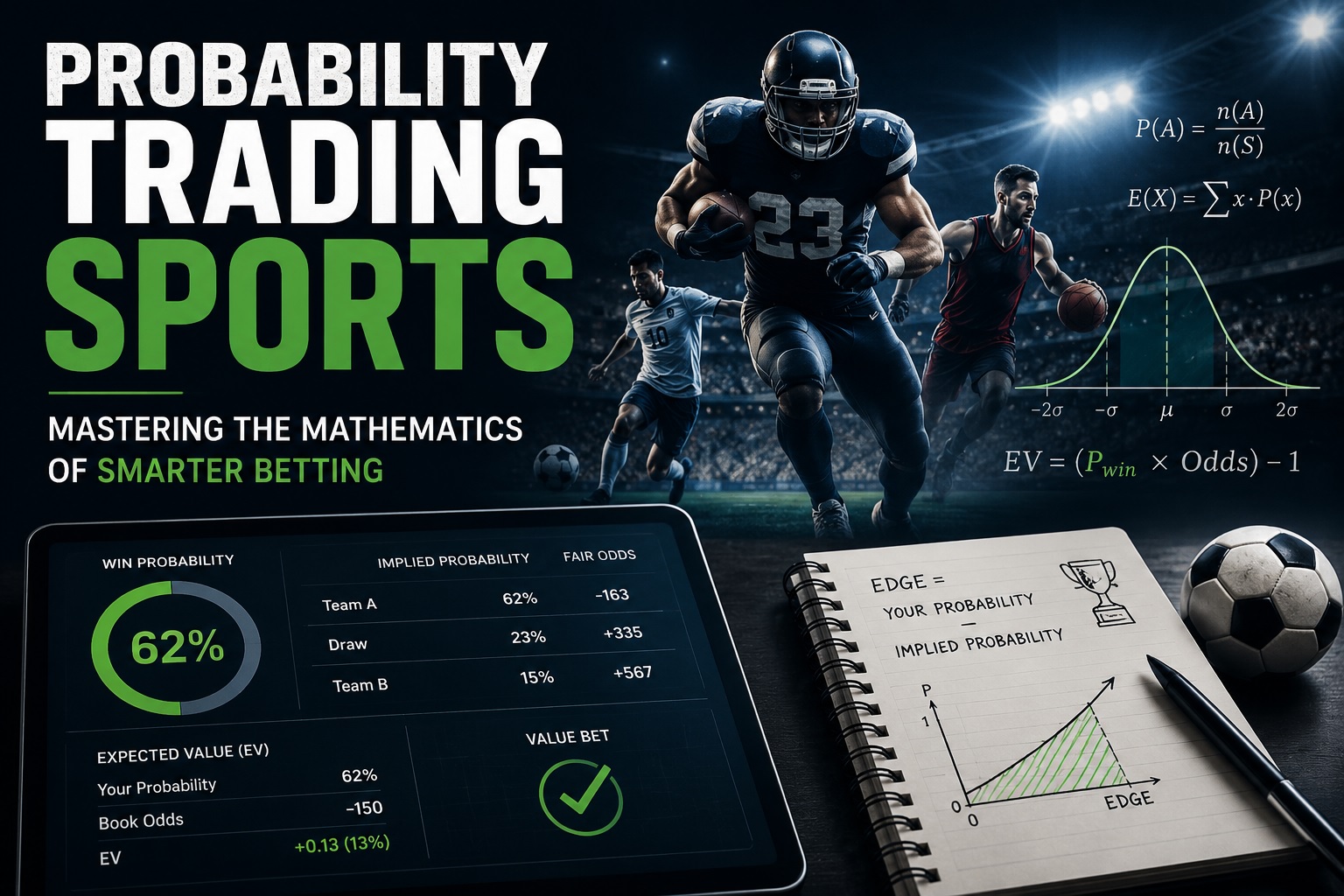
Table Of Contents
- Probability Trading in Sports: From Odds to Execution with an Analyst’s Edge
- Foundations of Probability Trading in Sports
- Modeling and Calibration
- Edge Detection and Execution
- Evaluation, Risk, and Feedback
- Ops and Compliance
- How ATSwins Fits into the Workflow
- Hands-on How-To: Calculators and Checklists
- Market Timing and News
- Putting It All Together
- Final Thoughts
Probability Trading in Sports: From Odds to Execution with an Analyst’s Edge
Sports betting, at least the way most people approach it, feels like guessing dressed up as confidence. That is not how I see it at all. For me, this is closer to trading than gambling. It is about probabilities, decision making under uncertainty, and building repeatable systems that hold up over time. The goal is not to be right every time. The goal is to consistently find spots where the price is wrong and take advantage of it.
If you zoom out, every bet is just a probability problem. Odds are just another way of expressing those probabilities, but the market wraps them in a format that can feel confusing if you do not break it down. Once you translate everything into probabilities, things get a lot clearer. You stop thinking in terms of “this team will win” and start thinking in terms of “this team wins 57 percent of the time, but the market is pricing them at 52 percent.” That gap is where money is made.
This whole approach depends on a few core ideas. You need to understand how odds translate into probability. You need to build or use models that produce reliable estimates. You need to compare those estimates to the market and decide if there is value. And then you need to manage your bankroll in a way that lets you survive variance while still growing over time. None of this is flashy, but it works if you stick with it.
Foundations of Probability Trading in Sports
The first thing you have to get comfortable with is converting odds into probabilities. Odds look different depending on the format, but they all represent the same thing underneath. Whether it is moneyline, decimal, or fractional, you can always turn it into a percentage chance.
Once you do that, you start to see the market differently. Instead of thinking of a team as “-150,” you think of them as having about a 60 percent implied chance to win. That shift is huge because it lets you compare your own estimates directly against the market.
But there is a catch. The market is not perfectly fair. Sportsbooks build in a margin, which is often called the vig. That means the implied probabilities you calculate from the raw odds are slightly inflated. If you do not adjust for that, you will think there is value where there is none.
Removing the vig is honestly one of the most important habits you can build. It sounds technical, but it is just normalizing probabilities so they add up to 100 percent. Once you do that, you get a clearer picture of what the market actually believes.
Another piece that people underestimate is market structure. Not all betting markets are created equal. Some are deep and efficient, like major NFL games right before kickoff. Others are thin and volatile, like niche player props or smaller college games. That affects everything from how much you can bet to how quickly prices move.
This framing aligns closely with the approaches discussed in “ How To Think Like A Sports Trader – 7 Ways To Price Odds ” , particularly the emphasis on translating odds into implied probabilities and treating pricing as a structured market process rather than intuition.
Timing matters too. Early lines can be softer because there is less information baked in, but they also come with more uncertainty. Late lines are sharper, but sometimes the value is already gone. In-play markets are a whole different game, with fast-moving prices and bursts of liquidity. Understanding when and where to act is just as important as identifying value in the first place.
Modeling and Calibration
Once you understand probabilities, the next step is figuring out how to generate your own. This is where modeling comes in. You do not need to build something insanely complex right away. In fact, starting simple is usually better.
At a basic level, you want to estimate how strong each team is and adjust for context. That includes things like injuries, travel, rest, and matchups. Over time, you can layer in more detail, like player-level data or advanced metrics.
The key is that your model should produce probabilities, not just picks. Saying “Team A will win” is not useful. Saying “Team A wins 58 percent of the time” is something you can actually work with.
But even good models are not perfect. They can be biased or overconfident. That is where calibration comes in. Calibration is basically checking whether your probabilities line up with reality over time. If you say something has a 60 percent chance of happening, it should happen about 60 percent of the time in the long run.
You can measure this with things like Brier score or log loss, but the main idea is simple. Your probabilities need to mean what they say. If they do not, your edge calculations will be off.
Simulation is another powerful tool here. Instead of just producing a single number, you can simulate games thousands of times and look at the distribution of outcomes. That gives you a better sense of uncertainty and helps you identify edges in different markets, including spreads, totals, and props.
Edge Detection and Execution
Once you have reliable probabilities, finding value becomes a math problem. You compare your probability to the market’s probability and see if there is a gap. If your number is higher than the market’s implied probability, you might have a positive expected value bet.
Expected value, or EV, is basically the average amount you expect to win or lose per bet if you could repeat it over and over. Positive EV means you are making a good bet in the long run, even if it loses sometimes.
But finding value is only half the battle. Execution matters just as much. You need to decide how much to bet and how to place your bets in a way that minimizes costs.
This is where bankroll management comes in. The Kelly Criterion is often used as a guide for sizing bets based on your edge. It tells you how much of your bankroll to risk to maximize long-term growth. In practice, most people use a fraction of Kelly because full Kelly can be very volatile.
There are also practical considerations like slippage and price impact. In smaller markets, placing a large bet can move the line against you. Even in bigger markets, you might not always get the exact price you see. That needs to be factored into your decisions.
Another layer is correlation. Not all bets are independent. If you are betting multiple props in the same game, they might be influenced by the same underlying factors. Ignoring that can lead to taking on more risk than you realize.
Evaluation, Risk, and Feedback
A big part of doing this seriously is tracking your results in a structured way. You cannot just look at wins and losses. You need to measure things like ROI, closing line value, and the accuracy of your probabilities.
Closing line value is especially important. If you consistently beat the closing line, it is a strong signal that your process is sound. Even if you have short-term losses, beating the close usually means you are on the right track.
You also need to think about risk in a realistic way. Variance is unavoidable. Even with a solid edge, you will have losing streaks. The goal is to manage those periods without blowing up your bankroll.
Stress testing can help with this. You can simulate different scenarios and see how your bankroll would perform under various conditions. That gives you a better sense of what kind of drawdowns to expect.
Post-mortems are another underrated tool. When things go wrong, you should dig into why. Was it bad luck, or was there a flaw in your model or execution? That feedback loop is what helps you improve over time.
Ops and Compliance
Behind the scenes, there is a lot of operational work that goes into doing this well. Data quality is a big one. If your inputs are wrong, your outputs will be too. That means having reliable sources, consistent formatting, and proper time stamping.
You also need to monitor for drift. Markets change. Teams change. Rules change. If your model is based on outdated assumptions, it will start to perform worse. Setting up alerts and regular checks can help you catch those issues early.
Record keeping is another piece that people often overlook. Keeping detailed logs of your bets, including the odds you got and the closing line, makes it much easier to evaluate your performance and identify patterns.
If you are automating any part of your process, you also need to be aware of rules and limitations. Different platforms have different policies, and it is important to stay within them. Responsible bankroll management should also be built into your system from the start.
How ATSwins Fits into the Workflow
ATSwins plays a really useful role in this whole setup. It is not something you blindly follow, but it is a strong tool to plug into your process.
One of the easiest ways to use ATSwins is as a starting point. Their projections can act as a baseline that you compare your own numbers against. If you are aligned, that can give you more confidence in a play. If you are not, it is a signal to dig deeper.
It is also great for tracking and organization. Being able to see performance across different leagues and bet types helps you understand where your edge actually is. Over time, that kind of feedback is invaluable.
Another benefit is timing. Seeing how betting splits move can give you a sense of where the market is going. That can help you decide whether to bet early or wait for a better number.
Overall, ATSwins fits best as part of a system. It is not about replacing your own thinking. It is about adding another layer of information that helps you make better decisions.
Hands-on How-To: Calculators and Checklists
At a practical level, it helps to have a simple workflow you can repeat every day. That usually starts with pulling market odds and converting them into probabilities. From there, you compare those probabilities to your own estimates and look for gaps.
Having a basic calculator for EV and bet sizing can save a lot of time. You input the odds, your probability, and any estimated costs, and it tells you whether the bet clears your threshold.
Checklists are also useful. Before placing a bet, you can run through a quick set of questions. Is the probability calibrated? Has the vig been removed? Is there any major news that could impact the line? Is the market liquid enough for your stake size?
These small steps might seem tedious, but they help prevent mistakes. Over hundreds or thousands of bets, avoiding small errors adds up.
Market Timing and News
One thing that really separates casual bettors from more serious ones is how they handle news. Injuries, lineups, and weather can all move markets quickly. If you are prepared, those moments can create opportunities.
The key is not just reacting quickly, but having scenarios planned out in advance. If a key player is ruled out, you should already have an idea of how that affects your probabilities. That way, you are not scrambling to figure it out in real time.
Timing also depends on the type of market. In some cases, it makes sense to bet early before the market adjusts. In others, it is better to wait for more information. There is no one-size-fits-all answer, but being intentional about timing is important.
Putting It All Together
When you put all of this together, it becomes a repeatable loop. You start with data and probabilities. You compare them to the market. You identify value. You size your bets. You execute. Then you track the results and feed that information back into your system.
It is not glamorous, but it is consistent. Over time, small edges compound. That is where the real value comes from.
The biggest mistake people make is trying to shortcut this process. They look for picks instead of building a system. That might work in the short term, but it is not sustainable.
Final Thoughts
At the end of the day, this approach is about thinking differently. Instead of chasing wins, you are chasing value. Instead of reacting emotionally, you are following a process.
It takes time to build the skills and discipline needed to do this well. There will be mistakes along the way. But if you stay focused on probabilities, edges, and execution, you give yourself a real chance to come out ahead.
Using tools like ATSwins can make that process smoother, but the foundation still comes down to how you think and how consistently you apply that thinking. Once you get that part right, everything else starts to fall into place.