
NHL Playoff AI Upset Prediction Model - How to Model Upsets
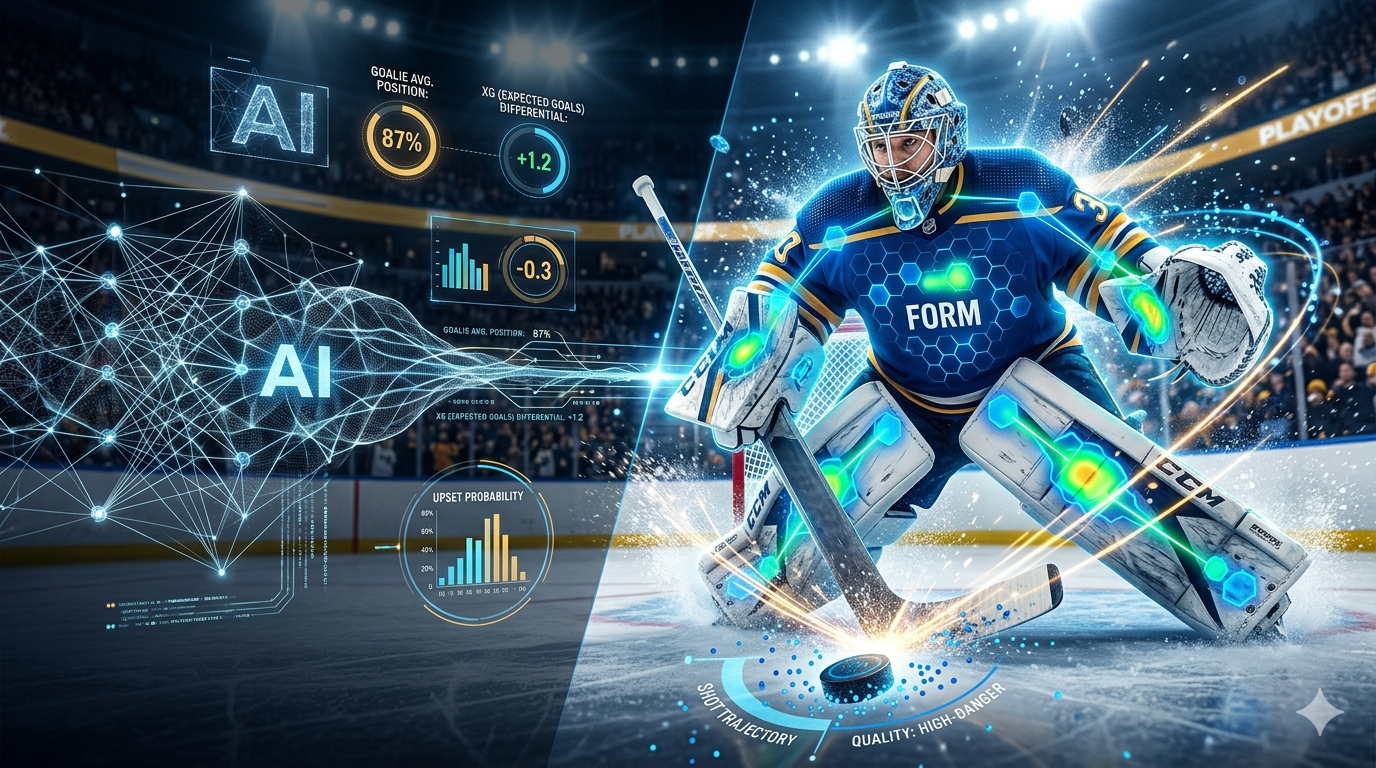
Stanley Cup hockey has this weird way of making smart people feel dumb. One minute you think you’ve got it figured out with shot metrics, goalie trends, and matchup edges, and the next minute a “supposed” underdog steals a series because a goalie turns into a wall and a power play goes ice cold at the worst possible time. That’s exactly why I started building structured models for it instead of relying on gut feeling or highlight bias.
What I’ve learned over time is that playoff hockey is less about who is “better” in a general sense and more about who controls the right slices of the game at the right time. Shot quality, special teams, fatigue, travel, and goalie form matter way more than regular season reputation. So instead of trying to predict hockey like it is random chaos, I treat it like a system with measurable inputs that can be modeled, tested, and improved.
This write-up is basically the full breakdown of how I build that system from scratch and evolve it into something that can actually estimate upset probability in NHL playoff series. It’s not magic and it’s not hype. It’s structured probability thinking applied to a chaotic sport.
Table Of Contents
- Defining the problem and labels
- Data sources and feature engineering
- Modeling approach
- Training, validation, and leakage control
- Evaluation and diagnostics
- Building the pipeline
- Series-state logic and home-ice adjustments
- Handling uncertainty: goalies and injuries
- From game model to actionable series probabilities
- Practical deployment and monitoring
- Evaluation as a decision system
- Limitations and risk management
- Roadmap and extensions
- Implementation checklist
- Conclusion
- Related Posts
- Frequently Asked Questions (FAQs)
Defining the problem and labels
The first mistake people make in hockey modeling is thinking “upset” is obvious. It is not. You need a strict definition or your model will drift into storytelling instead of prediction.
I define an upset in two ways, depending on the layer of modeling.
A seed-based upset is when the lower seed wins a game or series. It is simple but kind of blunt because it ignores injuries, goalie form, and market expectations.
A market-based upset is more useful. That is when the team that the betting market says is less likely to win actually wins. This is stronger because it reflects real-world expectations instead of just standings.
For modeling purposes, I lean heavily on the market-based definition when possible because it already encodes a lot of hidden context like lineup news and late-season form.
At the core, I frame outputs as probabilities. Not predictions like “this team will win,” but probabilities like “this team has a 36.4 percent chance to win this series.” That difference is everything.
Now here is where things start getting more structured.
When I build a system like an nhl playoffs prediction model ai , I separate the problem into two levels. One is game level prediction and the other is series level prediction. Game level feeds into series simulation, and series simulation feeds back into calibration.
Game level is simple. Who wins Game 1, Game 2, etc.
Series level is cumulative. You simulate all remaining games after each update.
This layered approach is what makes the model actually usable instead of just academic.
Data sources and feature engineering
Data is where most models either become strong or fall apart quietly. The biggest trap is mixing inconsistent signals or accidentally using information that would not have been known before the game.
Everything has to be pre-game available.
I group data into a few core buckets.
Team performance at even strength is the most important foundation. I focus on shot quality metrics like expected goals for and against, not just raw shots. The reason is simple. Shot volume lies. Shot quality tells you intent and danger.
Special teams matter even more in the playoffs than people admit. Power play efficiency and penalty kill suppression can swing entire series. I translate those into expected goal contributions per game instead of raw percentages.
Goaltending is its own universe. I treat goalie performance as a volatile signal that needs smoothing over multiple windows. Short term spikes happen constantly, so I combine recent form with longer baseline performance.
Injuries and lineup shifts are handled as value adjustments instead of binary flags. Losing a top defenseman is not just “bad,” it is a measurable expected goals swing.
Rest and travel are underrated. A team flying long distances or playing on shorter rest consistently underperforms relative to baseline.
Home ice exists, but it is not as strong as people think. It mostly matters through last change and matchup control.
Now, when building a nhl playoffs ai scoring projection model , I turn all of this into structured features that represent expected goals differential per game. That becomes the backbone of the prediction engine.
Instead of thinking in terms of goals directly, I think in terms of probability generating processes. If a team consistently creates more high danger chances and suppresses them better, that translates into a higher win probability.
Everything becomes relative to opponent strength. Absolute numbers are less useful than differential metrics.
The final step is normalization. I standardize everything so that different seasons and different eras of hockey do not distort the model.
Modeling approach
Once features are ready, the next step is choosing how to map them into probabilities.
I usually start simple.
A logistic regression baseline is always step one. It forces clarity. If your simple model does not work, your complex model will just be a more complicated failure.
Then I move into stronger models like gradient boosted trees, which handle nonlinear interactions better. Hockey is full of nonlinear relationships. A hot goalie plus weak defense is not equal to average performance. It is explosive variance.
I also like hybrid approaches. One model handles structure, another handles interaction effects, and then I blend outputs.
For series prediction, I often simulate outcomes instead of directly predicting them. I run thousands of simulated series using game-level probabilities and update between games.
This is where things start connecting to real decision making.
When you understand how to build an ai sports betting model, you realize it is not about guessing winners. It is about modeling probability distributions accurately enough that you can identify when the market is off.
That means calibration matters more than raw accuracy.
If your model says 60 percent and reality is 50 percent, you are not just slightly wrong. You are structurally miscalibrated.
So every model I build gets calibration layers applied after training.
Training, validation, and leakage control
This is where most models silently fail.
The biggest issue is data leakage. If your model accidentally learns from information that would not have existed before the game, your results will look amazing in testing and collapse in real life.
To prevent this, I use time-based validation. That means I train on past seasons and test on future seasons without mixing them.
No random splits. Ever.
I also separate playoff rounds because Round 1 hockey is not the same as Round 3 hockey. The intensity, strategy, and fatigue levels change the dynamics.
Another important concept is rolling updates. Instead of retraining from scratch constantly, I update models as new games happen, using only information that was available at that time.
This keeps the system realistic.
Evaluation and diagnostics
Evaluating a model is not just about whether it “wins predictions.” That is a lazy metric.
I focus on three main things.
First is log loss, which punishes overconfidence heavily. If you are wrong with high confidence, you get penalized hard.
Second is Brier score, which measures how close your probabilities are to actual outcomes.
Third is calibration curves, which show whether your predicted probabilities actually match reality.
If I see that my 40 percent predictions win 55 percent of the time, something is broken.
I also compare performance against simple baselines like “home team advantage only” or “higher seed wins.”
If I cannot beat those consistently, the model is not ready.
Building the pipeline
Once modeling works, I focus on system design.
Data ingestion has to be automated and consistent. Features must update before every game without manual intervention.
I store everything in structured datasets tied to game IDs so that I can reconstruct any prediction later.
This is important for debugging.
If a prediction was wrong, I want to know exactly what inputs caused it.
Series-state logic and home-ice adjustments
Series state changes everything.
A team down 0-2 plays differently than a team up 2-0. Pressure changes strategy, and strategy changes performance.
So I encode series score directly into the model.
Home ice also matters more in elimination games because of crowd intensity and last change control.
These effects are not huge individually, but they stack.
Handling uncertainty: goalies and injuries
Goalies are the hardest part of hockey modeling.
One hot goalie can destroy an otherwise perfect model.
So instead of treating goalie performance as fixed, I model it as a distribution.
I also weight uncertainty higher when recent performance is inconsistent.
Injuries are treated similarly. A player’s impact is not binary. It is a weighted expected value based on replacement level performance.
From game model to actionable series probabilities
Once game probabilities are stable, I simulate full series outcomes.
Each simulation runs through possible game sequences, adjusting for home ice and updated conditions.
This produces a distribution of outcomes, not a single answer.
That is what makes the system usable in real decision environments.
Practical deployment and monitoring
Once deployed, the model has to be monitored constantly.
Hockey seasons change. Rule emphasis changes. Play styles evolve.
So I track performance drift over time and retrain when needed.
If calibration starts slipping, I fix it immediately.
Evaluation as a decision system
A model is only useful if it helps decisions.
So I also test it like a decision engine.
Would I act on this probability difference?
If the answer is no, the model is not adding value.
This is where sports betting context matters, but even outside betting, it helps evaluate whether the system is actually meaningful.
ATSwins plays into this ecosystem as well since ATSwins.ai is an AI-powered sports prediction platform offering data-driven picks, player props, betting splits, and tracking tools across major leagues including NHL . It is useful as a comparison layer when checking whether model signals align with broader market intelligence.
Limitations and risk management
No model survives contact with randomness.
Playoff hockey has extreme variance.
A single deflection or goalie hot streak can override strong structural edges.
So uncertainty must always be acknowledged.
Never overfit short playoff samples.
Never trust small sample dominance shifts too quickly.
Roadmap and extensions
The next step in evolution is player-level modeling.
Instead of team averages, I break everything into line combinations and matchups.
That allows much deeper precision in forecasting.
Implementation checklist
Build clean data pipeline
Define pre-game feature rules
Train baseline logistic model
Add advanced tree model
Calibrate outputs
Validate across seasons
Simulate series outcomes
Monitor drift continuously
Conclusion
At the end of the day, hockey playoffs are not about guessing. They are about understanding probability under chaos.
A strong model does not eliminate randomness. It just measures it better.
When you combine structured data, careful validation, and realistic uncertainty handling, you get something that can actually identify real upset conditions instead of reacting emotionally to highlights.
That is the entire goal.
Related Posts
AI sports prediction tool overview with ATSwins
How predictive modeling changes modern sports betting strategy
Understanding probability models in playoff sports analytics
Frequently Asked Questions (FAQs)
What makes playoff hockey harder to model than regular season hockey?
Because sample sizes shrink and variance increases. Goalies swing harder, matchups matter more, and tactical adjustments happen faster.
Can AI really predict NHL playoff upsets?
It can estimate probability, not certainty. Upsets are still random events, but probability edges can be identified.
What is the most important factor in predicting NHL playoff games?
Goaltending stability combined with shot quality differential is usually the strongest signal.
Why do models fail in playoffs sometimes?
Because variance is higher and small sample noise dominates short series outcomes.
Related Posts
AI For Sports Prediction - Bet Smarter and Win More
AI Football Betting Tools - How They Make Winning Easier
Bet Like a Pro in 2025 with Sports AI Prediction Tools
Sources
The Game Changer: How AI Is Transforming The World Of Sports Gambling
AI and the Bookie: How Artificial Intelligence is Helping Transform Sports Betting
How to Use AI for Sports Betting
Keywords:
MLB AI predictions atswins
ai mlb predictions atswins
NBA AI predictions atswins
basketball ai prediction atswins
NFL ai prediction atswins