
NFL Playoff Sharp vs Public Analysis: Spotting Real Money Moves in the Market
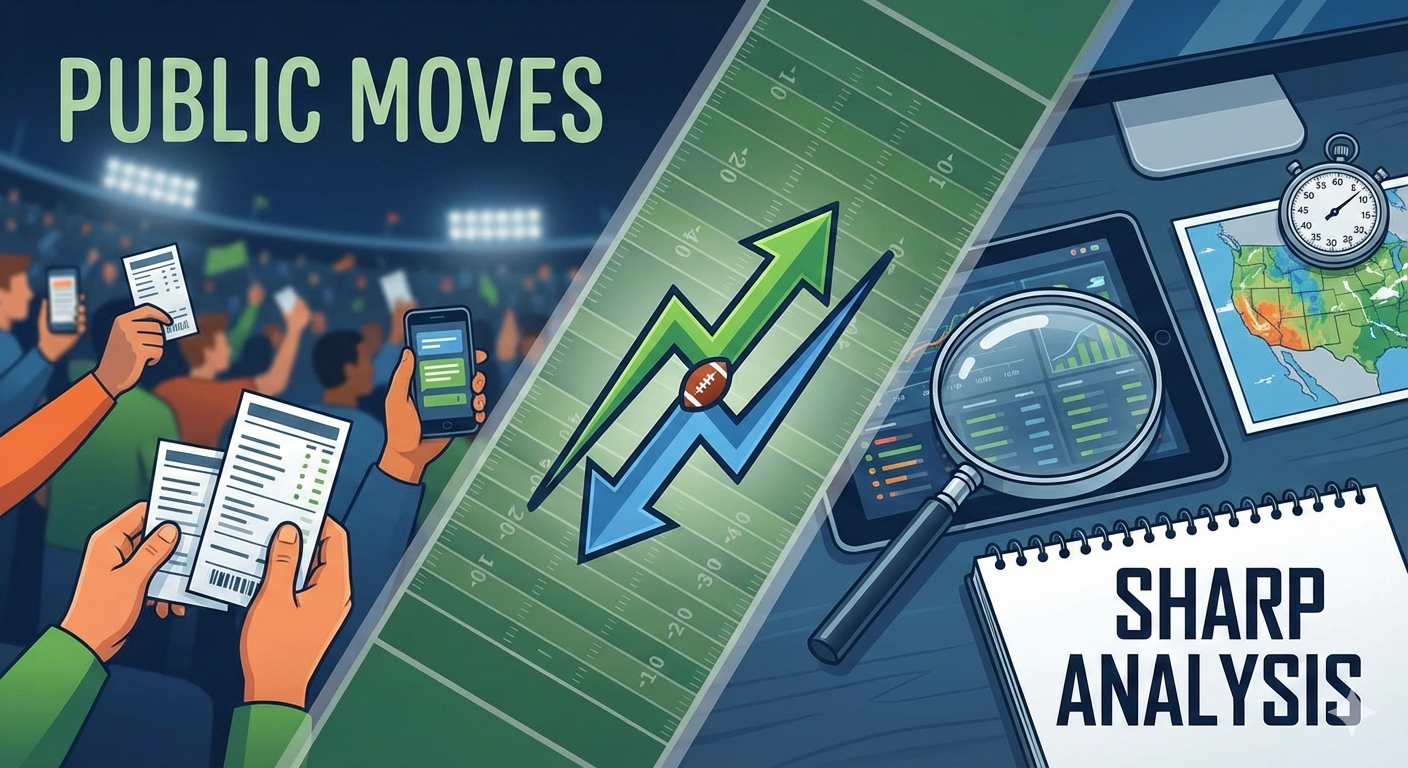
The NFL playoffs aren’t just about who has the best roster or the hottest quarterback. For serious bettors, every spread, total, and limit becomes a high-stakes puzzle, and understanding how the market moves is everything. This is where NFL playoff sharp vs public analysis comes in. Essentially, it’s about seeing who is moving the line—the sharps, the professional or highly skilled bettors hunting for edges—and who is just following the crowd. By tracking ticket and handle splits, timing of bets, injuries, weather, and key numbers like three and seven, you can spot where real money is influencing the market versus casual chatter. This blog dives into exactly how to read those shifts, interpret steam and reverse line movement, model your fair prices, and execute bets in a disciplined, data-driven way. Whether you’re chasing closing line value or just trying to avoid common pitfalls, this guide lays out a clear, practical approach to getting an edge in the NFL playoffs.
Table Of Contents
- What “Sharp vs Public” Really Means in January
- Detecting Sharp-Public Splits You Can Trust
- Modeling and Validation that Respects the Market
- Execution, Bankroll, and Tactics that Fit Playoff Liquidity
- Conclusion
- Frequently Asked Questions (FAQs)
Key Takeaways
In the NFL playoffs, the focus is always on pricing the number rather than backing a team based on perception. Protecting key numbers like three and seven matters because those points carry extra weight in spreads. Once the market has absorbed sharp action, chasing steam is usually a losing strategy. Closing line value, or CLV, acts as the compass: tracking open-to-close moves, ticket versus handle splits, and consistent performance against the close helps verify your reads. Timing your bets around quarterback or offensive line news and factoring in weather is essential, but adjustments should be made to your price, not your feelings. Risk management is critical, and using fractional Kelly, first-half lines, or alternate spreads can provide better risk-adjusted exposure when the full-game market is tight. Platforms like ATSwins provide a centralized hub for projections, splits, and profit tracking across NFL, NBA, MLB, NHL, and NCAA. Access to data-driven picks, player props, and betting analytics can guide bettors to make smarter, more informed decisions.
What “Sharp vs Public” Really Means in January
During the playoffs, betting lines become more sensitive because stakes rise, limits increase, and money concentrates on fewer games. Sharp money and public money are different in both intent and execution. Sharps are professional or highly skilled bettors who either create their own numbers or have proven timing and pricing ability. They tend to act earlier in the week, scale their bets as limits increase, monitor injury and reporting cycles, and measure success by closing line value rather than short-term wins. Public money comes from casual bettors, fans, or trend-followers who are drawn to favorites, overs, and well-known quarterbacks. They usually place bets closer to kickoff and gauge success by immediate return on investment, which can swing wildly, particularly in small playoff samples.
A simple rule is that sharps bet numbers while the public bets teams. A statement like “I laid minus two and a half” or “I took plus three and a half at negative one-oh-five” conveys a price bet. Saying “I am on Team A because they are hot” is team-centric and public-oriented.
The playoff market tightens as sportsbooks lift limits. Higher maximum wagers invite professional shape-making, and books lean on sharp-oriented market-making shops to calibrate lines. Liquidity compresses edges, meaning early-week mispricings are corrected more rapidly, while lines may linger in tight ranges because more eyes are monitoring them. With fewer games, money concentrates on each line. One significant position can nudge a line, but it often requires respected sharp accounts or multiple groups acting simultaneously to push through key numbers.
Steam, reverse line movement, and key numbers all have a profound effect. Steam occurs when multiple books move quickly in the same direction, usually driven by sharps, new information, or quant signals. Reverse line movement happens when the line moves against the overwhelming ticket majority. For example, if seventy percent of bets are on a favorite but the line drifts toward the underdog, it signals respected money on the dog. Key numbers, especially three and seven, are central to NFL spreads. Moving from plus three to plus two and a half, or minus two and a half to minus three, typically involves sharp action because those points are particularly valuable. Totals are influenced by numbers like forty-one, forty-four, and forty-seven, with minor adjustments for coaching trends or extra points. In the playoffs, possessions are often slower and fourth-down aggression can increase variance.
Closing line value remains the most reliable indicator of alignment with sharps. Beating the close consistently is more important than short-term wins or losses. Sharps also act according to timing, taking advantage of limit cycles and buying news ahead of the crowd. Injuries and late news matter more during the playoffs because fewer players are rotated, so quarterback or offensive line issues and secondary absences can shift spreads and totals dramatically. Handle concentration can distort perceived splits. If one or two books hold disproportionate volume, ticket percentages may appear skewed and not reflect overall sentiment, so comparing across books and timeframes is essential.
Detecting Sharp-Public Splits You Can Trust
Start by examining consensus openers. Recording the opening spread and total across market-making books, or using a reputable composite, sets a baseline. Then track ticket percentages versus handle percentages over time. While ticket percentage shows the count of bets, handle percentage reflects the money behind those bets. A significant handle skew with fewer tickets often indicates sharp activity, especially at respected books. Watch for reverse line movement and steam: if sixty-five to eighty percent of tickets sit on one side but the line moves the other way, it signals sharp influence, particularly if movement crosses key numbers like three or seven. Compare open-to-close deltas by logging line paths and identifying where respected money encountered resistance. Overlay weather, field conditions, altitude, and travel effects, as these factors influence totals and second-half unders. Quarterback and offensive line cluster injuries deserve special attention; multiple absences can affect both spread and total by several points.
Validation should rely on CLV rather than short-term ROI. Consistently beating the close, even by half a point or one point, indicates meaningful alignment with the market. Respect the closing line consensus, as it reflects the market’s best estimate and serves to calibrate priors and risk assessments.
Interpreting ticket percentages and handle percentages without bias is crucial. Ticket percentage alone can be misleading, as a popular favorite may dominate tickets but not the handle. Handle percentage at a respected book is a stronger indicator than the same metric at a public-facing book. If tickets favor a favorite but the line drifts toward the dog near a key number, treat it as sharp leaning dog. Sticky lines that refuse to cross key numbers despite heavy betting also convey information about market sentiment.
Practical examples demonstrate these principles. Consider a game opener with the Chiefs minus three and a total of forty-seven. By Monday, if sixty-eight percent of tickets favor the Chiefs but the handle is fifty-five percent, and the line briefly hits minus three and a half before returning to minus three, it shows an early sharp push. Weather forecasts predicting strong winds can push totals lower while handle shifts to the under. Later in the week, sharp bets on the dog may move the line from plus three to minus two and a half, while favorite tickets increase to seventy-two percent. Totals drop in response to weather and offensive line issues. Reading these shifts requires understanding which side offers better value after accounting for juice and market adjustments.
Modeling and Validation that Respects the Market
Start modeling with a market-informed prior, anchored to recent closing spreads and totals and adjusted for opponent strength. This approach reduces variance and guards against overfitting playoff noise. Overlay team and unit-level performance features to capture shifts that the market may underweight. Important features include offense and defense metrics such as EPA per play, success rates split by dropback versus rush, pressure rate allowed and generated, time to throw, explosive pass and rush rates, red-zone efficiency, early-down tendencies, fourth-down aggression, matchup splits, special teams performance, rest and travel conditions, and weather inputs including hourly wind and temperature. Playoff-specific adjustments consider rematch flags, coaching tendencies, quarterback experience, and condensed rotations.
Training should use walk-forward cross-validation to avoid leaking future context. Train on Weeks 1–10 and validate on Weeks 11–13, then extend the training window and validate incrementally through the playoffs. Recalibrate predictions weekly, as in-season performance is more relevant than August priors. Evaluate outcomes using log loss or Brier score for binary ATS outcomes and compare model implied fair price against market closing lines to track CLV. Use calibration plots to confirm model reliability, prioritizing consistent but modest edges over high but unreliable claims.
A practical model stack can rely on Python pandas and NumPy for data wrangling, and scikit-learn tree ensembles for predictive modeling, with optional exploration of XGBoost or LightGBM. Guard against feature leakage by ensuring injury status or other time-sensitive variables only use information available at the time. Freeze the feature set before playoffs, make minimal explainable changes, and audit predictions using SHAP values. Version models and log feature sets, training windows, and validation scores for reproducibility.
Blend model outputs with market signals carefully. A model projecting plus two and eight against a market of plus three and a half may indicate passing unless an injury or steam creates a real edge. If the model adjusts toward the market after a downgrade and still shows a positive edge, this can be actionable. Respect closing lines as a check against persistent opposition without CLV.
Execution, Bankroll, and Tactics that Fit Playoff Liquidity
Always price the number first and the team second. A well-priced line is more valuable than a team pick that lacks value. Scarcity in the playoffs means value is thin, so scale bets conservatively. Timing with limits is crucial: early-week openers may offer stale lines before news is incorporated, midweek limit increases often correspond with the first sharp wave, and late-week confirmations of injuries or weather can offer last-minute edges. Avoid chasing late steam unless your fair price still exceeds the current market number.
Use fractional Kelly to size bets, reducing volatility and controlling bankroll exposure. Estimate win probability from your model versus market-implied probability, calculate edge after juice, and apply a fraction of Kelly to determine bet size. Consider first-half lines, alternate spreads, and player props when the main line offers limited value. Always set a pregame plan and live-betting constraints, including maximum exposure per game.
Archiving every bet is critical. Record the open and close of the market, your fair price, stake size, book, timestamps, outcomes, and realized CLV. Track seasonality, noting differences in totals due to wind or cold weather, and monitor favorite versus dog behavior around key numbers. ATSwins fits this workflow by offering market splits, price histories, projections, and tracking tools. The platform allows comparison of your fair prices against market movement, evaluation of player prop correlations, and tracking CLV in a single hub, keeping all insights centralized.
Weekly playoff prep follows a consistent rhythm. On Sunday night, log openers and compile team-level EPA and success rate splits. On Monday, review injuries, especially key players, and run initial model projections. Midweek, monitor weather trends, RLM, and adjust projections based on injury or participation updates. Late in the week, re-run models with the latest inputs, scale entries, and prepare derivatives such as first-half lines or props. Confirm final statuses and limits before kickoff, set exposure caps, and maintain a live plan. Postgame, archive outcomes, CLV, and notes to improve model calibration.
Attention to detail yields edges. Early weather nuances, coaching tendencies, route consolidation, and special teams effects on totals create small but actionable advantages. A compact checklist ensures sharp versus public reads remain accurate: track line moves through key numbers, correlate with limit changes or injuries, monitor handle concentrations, verify weather alignment, and compare fair prices against the market. Keep consistent snapshots for spreads, totals, injuries, weather, fair price, closing lines, and outcomes. Totals respond quickly to environmental and personnel factors, while spreads may adjust more gradually. Weekly sanity checks of model outputs ensure directional alignment with player efficiency, weather conditions, and rematch adjustments. Simple grading of bets using CLV and edge size identifies variance versus process-consistent outcomes.
Conclusion
Reading sharp versus public action requires respecting key numbers, prioritizing closing line value, and managing stakes and timing strategically. The main takeaway is to price the number first, plan entries carefully, track results, and avoid chasing steam. Platforms like ATSwins provide a centralized hub for picks, splits, and profit tracking, enabling bettors to align their workflow with proven market-informed practices. Consistency, discipline, and process awareness are essential to gaining an edge during NFL playoff betting.
Frequently Asked Questions (FAQs)
What is the NFL playoff sharp vs public analysis?
This analysis compares where professional bettors place their money versus public money. Sharps seek edges around key numbers like three and seven, react quickly to injury and weather news, and aim for closing line value. Public money often follows narratives and favorites. Understanding the split explains why lines move and whether the movement reflects sharp influence or public noise.
How can I spot sharp action versus public action?
Key indicators include ticket versus handle splits, reverse line movement, timing around news or weather, and consistently beating the closing line. Combining these factors offers a clearer view of true sharp influence.
When should I place a bet using this analysis?
Start with your fair number and plan entries carefully. Early-week bets target stale lines, midweek bets account for injuries and practice participation, and late-week opportunities should only be acted on if value remains. The playoffs tighten markets, making edges thin.
What mistakes do bettors make?
Common mistakes include overrating ticket/handle splits, ignoring key numbers, chasing late steam, neglecting matchup specifics such as quarterback or offensive line issues, and grading performance based on short-term ROI rather than CLV.
How does ATSwins help?
ATSwins provides AI-driven projections, player props, splits, and CLV tracking. Bettors can layer these tools to evaluate spreads, totals, and props, compare their fair prices against the market, and maintain centralized tracking for consistent, process-driven decision-making.
Related Posts
AI For Sports Prediction - Bet Smarter and Win More
AI Football Betting Tools - How They Make Winning Easier
Bet Like a Pro in 2025 with Sports AI Prediction Tools
Sources
The Game Changer: How AI Is Transforming The World Of Sports Gambling
AI and the Bookie: How Artificial Intelligence is Helping Transform Sports Betting
How to Use AI for Sports Betting
Keywords:
MLB AI predictions atswins
AI MLB predictions atswins
NBA AI predictions atswins
basketball ai prediction atswins
NFL ai prediction atswins