
NFL 49ers vs Eagles point spread predictions - 3 Ways to bet
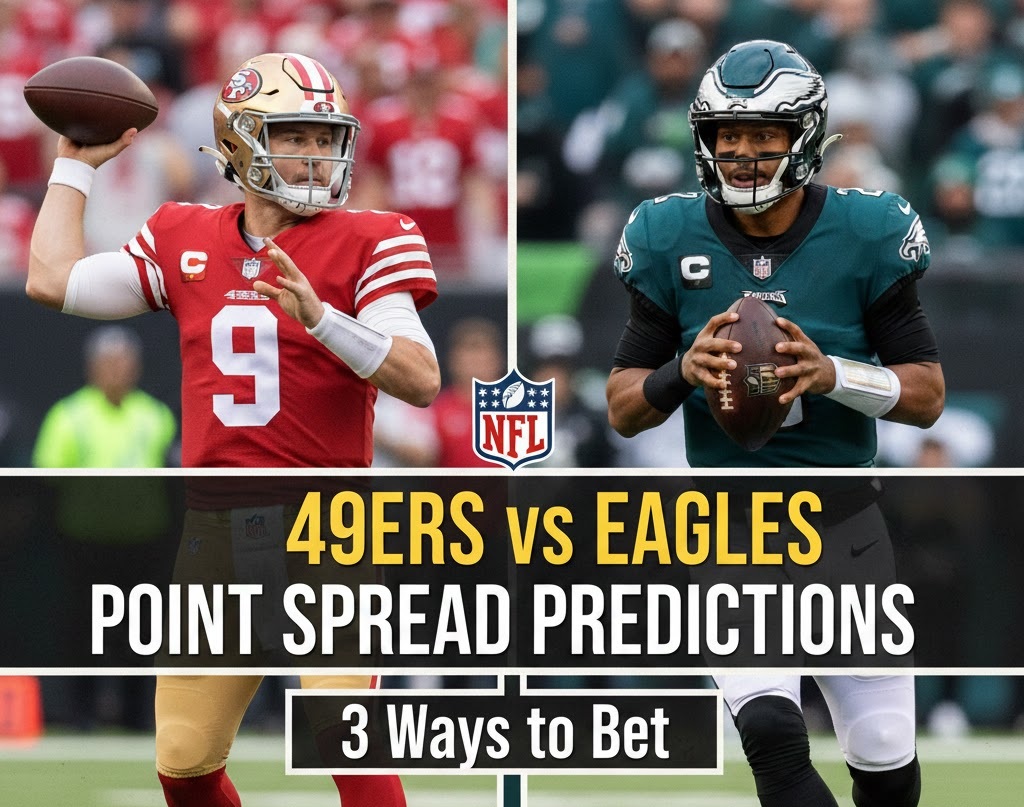
Table Of Contents
- Reading the Line: 49ers vs Eagles Point Spread Through an AI Lens
- Market Snapshot for 49ers vs Eagles Point Spread Predictions
- Matchup Edges That Actually Move a Number
- Modeling the Spread Step by Step
- Decision Framework and Risk Management
- What to Watch Right Before Kickoff
- Putting It All Together for ATS Decisions
- Refining the Process Over Time
- Final Thoughts on 49ers vs Eagles Spread Betting
- Conclusion
- Frequently Asked Questions
Reading the Line: 49ers–Eagles Point Spread Through an AI Lens
This matchup is one of those games where the market looks efficient on the surface, but the details underneath can still create real edges. Both teams are elite, both have strong coaching, and both have rosters built to win now. That is exactly why you cannot be sloppy. Half points matter here. Juice matters here. Timing matters here.
I approach this game the same way I would build a fair line inside a model. I take injuries, recent form, travel, weather, and matchup tendencies, and I force them into point values. Once you do that, the spread stops being abstract. It becomes something you can argue with logically instead of emotionally.
This writeup walks through that entire process step by step, using the 49ers vs Eagles spread as the working example. The goal is not just to pick a side. The goal is to understand when the price is right and when it is not.
Market Snapshot for 49ers vs Eagles Point Spread Predictions
Before you even think about matchups, you need to understand how the market got to its current number. The opening line matters because it tells you where oddsmakers believed true value lived before money and information started shaping the market. The current line matters because it reflects where the smartest and largest bets have landed so far.
When I log a game like this, I always record the opener, the current spread, the juice attached to it, and how quickly the line moved. A move from minus one and a half to minus three is not the same as a move from minus three to minus four. One crosses a key number and the other does not. That distinction alone can decide whether a bet is playable.
Juice is just as important as the spread itself. A flat minus three is very different at minus one ten compared to minus one twenty. That extra cost eats into your edge faster than most bettors realize. In games like this, where spreads are tight and push probability is real, paying the wrong price can completely erase what looked like a good bet on paper.
I also always note how the total is moving alongside the spread. Totals influence play calling, late game aggression, and fourth down decisions. A lower total often favors underdogs staying inside the number, while a higher total can benefit favorites with explosive offenses. The spread and total are connected, even if they look independent at first glance.
Inside ATSwins , this entire snapshot gets saved so it can be compared to the model’s fair line and tracked against the closing number later. That feedback loop is how you get better over time.
Matchup Edges That Actually Move a Number
The biggest mistake bettors make in games like this is focusing on surface level stats instead of pressure points. Not every matchup detail matters equally. Some things look important but barely move the spread at all. Others quietly swing a game by a full point or more.
The trenches are always where I start. If one team can generate pressure without blitzing and the other team struggles to protect with standard formations, that is a real edge. Pressure changes play design, limits route combinations, and increases turnover risk. If the 49ers can consistently affect the quarterback with four rushers, that shapes the entire game script in their favor.
Run game efficiency is the next layer. Not total rushing yards, but success rate and consistency on early downs. When an offense can stay ahead of the chains, it keeps the playbook open and reduces variance. That matters a lot for covering spreads, especially short ones. The 49ers’ run design puts stress on defensive discipline, while the Eagles rely heavily on winning at the point of attack. How those styles collide matters more than raw yardage totals.
Explosive plays are another quiet spread mover. Teams that generate yards after the catch and chunk plays over the middle can flip field position quickly without needing perfect execution. Defenses that struggle with tackling or communication in space tend to give up these types of plays. Even a small edge in explosive play rate can be worth half a point when everything else is equal.
Red zone efficiency often decides whether favorites cover or not. Touchdowns instead of field goals separate a three point win from a seven point win. If one offense consistently finishes drives while the other settles for kicks, that difference shows up on the scoreboard even if the rest of the game feels close.
Special teams and field position are usually overlooked, but they matter. Starting drives closer to midfield reduces the number of first downs needed to score and increases expected points per possession. Over a full game, those hidden yards add up.
Modeling the Spread Step by Step
Once the matchup edges are identified, they need to be turned into numbers. This is where most people stop and say something like “it feels like a field goal game.” That is not enough. Feelings do not beat the spread. Numbers do.
I start with season-long efficiency metrics and blend offense and defense into a baseline rating for each team. That gives me a neutral field expectation. From there, I layer in recent form, giving more weight to the last month while still respecting the larger sample size of the season.
Injuries are adjusted individually. Quarterbacks get the biggest weight, but offensive tackles and top cornerbacks matter more than the public thinks. Losing a tackle against an elite pass rush is not the same as losing a rotational receiver. Those distinctions are built into the model as point adjustments.
Travel and rest are added next. West to East travel, short weeks, and early kickoff times all have measurable effects on efficiency, especially early in games. These are usually small adjustments, but in tight spreads, small things matter.
Weather is handled last and only adjusted when it crosses meaningful thresholds. Wind changes how teams throw and kick. Rain affects ball security and footing. These factors influence totals more than spreads, but they still matter when one team is built to handle them better than the other.
Once all of that is combined, I get a projected margin. That margin becomes the fair spread. From there, I compare it to the market and decide whether the difference is large enough to justify a bet after accounting for juice and push probability.
I then simulate the game thousands of times using that projected margin and a realistic variance assumption. The output gives win rates, push rates, and expected value for different lines. That is how I decide whether minus three is playable and minus three and a half is not.
Decision Framework and Risk Management
Even when you have an edge, you still need rules. Not every edge should be bet the same way. Spread betting is about discipline as much as it is about accuracy.
Key numbers like three and seven matter more than ever. Paying extra juice to avoid a push often sounds smart, but it is usually overpriced. If your fair line barely clears three, laying minus two and a half at a heavy price is rarely worth it.
I also avoid chasing steam unless I understand why the market moved. If a line moves because of real injury news that I agree with, I might still play it at a worse number. If it moves without new information, I am more likely to wait or pass.
Stake sizing is handled with fractional Kelly principles. I never go full Kelly on a spread. Variance is too high and edges are too thin. Smaller, consistent bets protect the bankroll and smooth results over the long run.
Inside ATSwins, every bet is logged with the fair line, the market line, and the closing number. That data matters more than short term wins or losses. If you consistently beat the close, you are doing something right even if variance hits you in the short term.
What to Watch Right Before Kickoff
The final ninety minutes before kickoff are where information turns into money. This is when inactives are confirmed, snap limits become clear, and weather forecasts lock in.
Offensive line changes are the most important late news. A late scratch at tackle can swing protection schemes and change the entire pressure outlook. Cornerback availability matters too, especially against teams that attack the middle of the field.
Weather updates are also critical. Wind forecasts can shift just enough to change how teams call plays. That can affect both the spread and derivative markets like first half lines.
Market movement during this window often reflects sharp action. Knowing your thresholds ahead of time keeps you from making emotional decisions when limits rise and numbers jump.
Putting It All Together for ATS Decisions
Once everything is accounted for, the decision usually becomes clear. Either the number is good enough or it is not. There is no shame in passing a game like this if the edge is thin or the price is wrong.
If the model shows a fair line just over three, the best play is often laying minus three at a reasonable price and stopping there. If the fair line pushes closer to four, splitting exposure across multiple numbers can make sense, but only with controlled risk.
Derivative bets like first half spreads or alternate lines should only be used when the model shows a clear script advantage. Otherwise, they just add noise.
Refining the Process Over Time
The real edge in spread betting comes from iteration. Tracking results, reviewing assumptions, and adjusting weights based on performance is how models improve.
Over time, you learn which adjustments matter most and which ones can be simplified. You also learn when the market consistently overreacts or underreacts to certain types of news.
ATSwins makes this process easier by centralizing data, tracking performance, and showing where your numbers differ from the market. It does not replace thinking. It supports it.
Final Thoughts on 49ers vs Eagles Spread Betting
This is the kind of game where discipline matters more than conviction. Both teams are good. Both teams can win. The spread is tight for a reason.
If you can turn matchup details into numbers and respect price sensitivity, there is value to be found. If you chase narratives or ignore juice, the edge disappears fast.
The goal is not to be right every time. The goal is to consistently bet numbers that are better than the market.
Conclusion
This breakdown turned injuries, weather, travel, and trench matchups into a structured betting process. The 49ers vs Eagles spread is a great example of why price matters more than opinion. By building a fair line, simulating outcomes, and managing risk, you put yourself in position to win long term. ATSwins helps bring all of that together with AI driven insights, betting splits, and profit tracking across major sports. Whether you are using the free tools or deeper features, the goal stays the same. Make smarter bets, not louder ones.
Frequently Asked Questions
What are 49ers vs Eagles point spread predictions?
They are projections of the expected margin of victory that help bettors decide whether the market line is fair. If your projection differs meaningfully from the spread, that difference can represent betting value.
What matters most when betting this spread?
Trench play, quarterback health, offensive line continuity, red zone efficiency, and weather. Those factors move the number more than surface stats.
How does ATSwins help with spread betting?
ATSwins provides AI powered projections, betting splits, and tracking tools that help bettors compare fair lines to market prices and improve decision making over time.
Related Posts
AI For Sports Prediction - Bet Smarter and Win More
AI Football Betting Tools - How They Make Winning Easier
Bet Like a Pro in 2025 with Sports AI Prediction Tools
Sources
The Game Changer: How AI Is Transforming The World Of Sports Gambling
AI and the Bookie: How Artificial Intelligence is Helping Transform Sports Betting
How to Use AI for Sports Betting
Keywords:
nfl wildcard total prediction
nfl wildcard spread projection
nfl wildcard round betting picks
nfl wildcard round prediction model
nfl playoff sharp vs public analysis
nfl playoff betting accuracy model
nfl playoff mispriced line detection
nfl playoff expected value betting
nfl playoff matchup analytics
nfl playoff total points projection
nfl playoff spread prediction
nfl playoff prediction model
nfl playoffs betting model
nfl playoff prediction algorithm
nfl playoff win probability model
NFL 49ers vs Eagles point spread predictions