
New York Knicks vs San Antonio Spurs: What Really Matters in Tonight’s Lone NBA Game
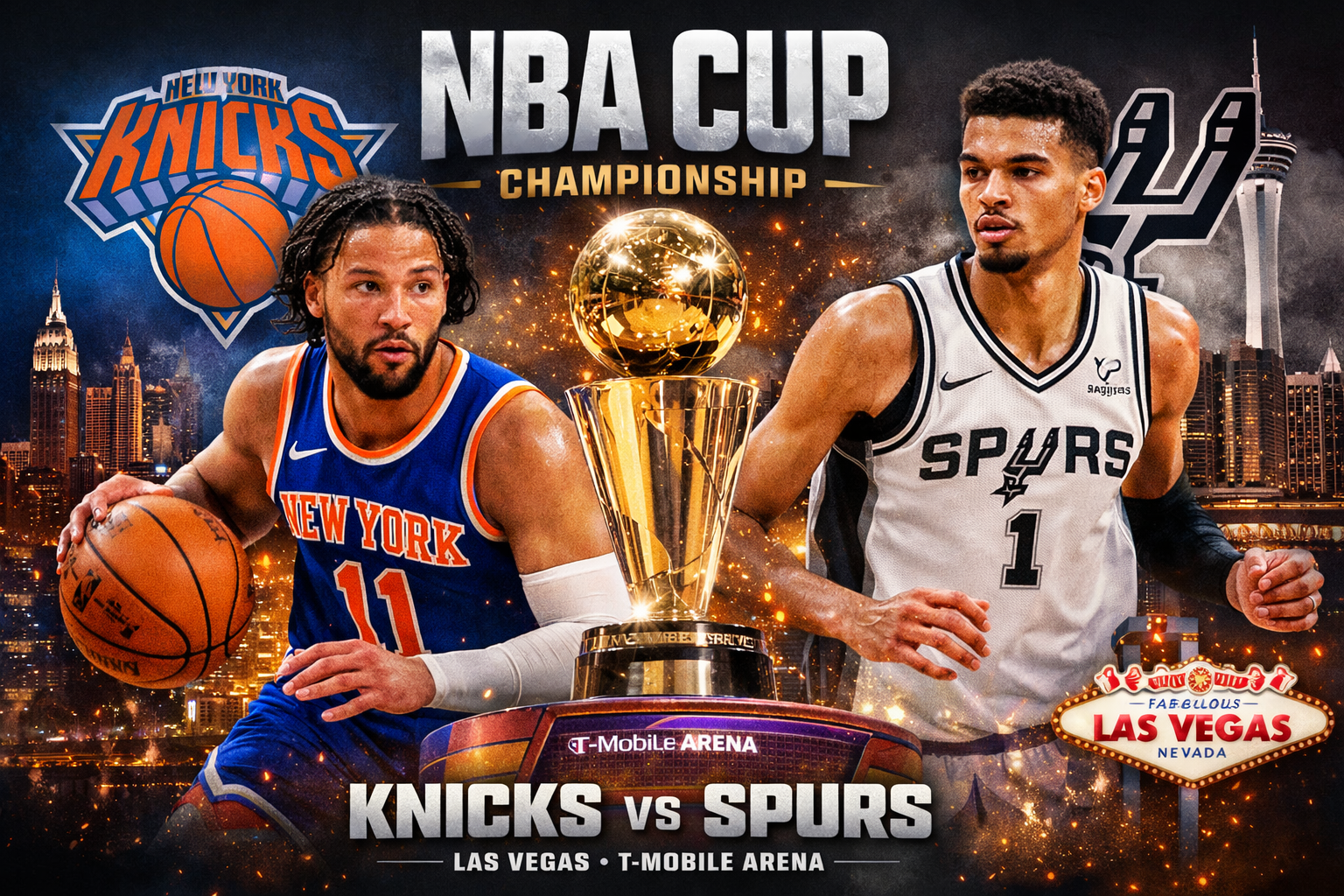
The NBA schedule is about as simple as it gets tonight: one game, one trophy, and a whole lot of attention on Las Vegas as the New York Knicks and San Antonio Spurs meet in the Emirates NBA Cup Championship at T-Mobile Arena, both coming in at 18–7 and treating this mid-season tournament like a very real piece of hardware and a statement about where they sit in the league hierarchy. For anyone who cares about the betting angles, the storylines, and how a single matchup can tilt how we think about two rising contenders, this is the kind of night where the details really matter, and it’s exactly the kind of slate people lean on ATSwins.ai for.
Why tonight matters more than a normal Tuesday
The NBA Cup is still relatively new, but by year three it has clearly found a lane. It runs alongside the regular season, but the knockout games in Las Vegas have a different energy: neutral court, single elimination, and a championship banner that lives forever even if it doesn’t show up in the standard standings.
Players aren’t treating it like a preseason showcase, either. Between the pride of being the third-ever Cup champion and roughly half a million dollars per player on the winning roster, there’s real incentive for both teams to treat this like a mini–Finals. On top of that, both franchises see this as a stepping stone. For New York, it’s a chance to validate the front office’s aggressive retooling and signal that this new core is actually good enough to chase a title. For San Antonio, it’s proof that the rebuild around Victor Wembanyama has already flipped the switch from “patient development” to “we’re back in the mix.”
This is also the only NBA game on the board tonight. The league cleared the main schedule and gave the Cup final its own national window in prime time, with tipoff set for 8:30 p.m. ET. That means every fan, analyst, and bettor scrolling through the slate is staring at one line, one total, and one box score to follow all night.
Knicks: a new era that already looks very real
The Knicks enter the Cup final at 18–7, sitting first in the Atlantic Division and second in the Eastern Conference, which is exactly where you want to be in mid-December if you’ve been talking about contention since training camp. This season opened with a huge organizational shift: Tom Thibodeau is out, Mike Brown is in, and the roster has been reshaped around a core of Jalen Brunson, Karl-Anthony Towns, Mikal Bridges, OG Anunoby, and Josh Hart.
Brunson has taken another step even after last season’s breakout. He’s averaging 28.8 points and 6.4 assists per game, the clear engine of the offense and one of the league’s most efficient high-usage guards. Towns, now fully integrated as a Knick, is putting up 24 points and 11.9 boards per night, giving New York a true stretch big who can punish switches inside and drag opposing centers out to the perimeter.
Around them, the Knicks lean heavily on length and versatility. Bridges and Anunoby give Brown two high-level wings who can space the floor, attack closeouts, and guard up or down a position. Josh Hart is doing Josh Hart things: rebounding like a big, defending like a guard, and filling in every gap in between. Off the bench, veteran scoring from Jordan Clarkson and energy minutes from Mitchell Robinson give New York the ability to mix looks without completely changing its identity.
The recent form matches the season-long numbers. The Knicks have won five straight and nine of their last ten heading into tonight, including a 132–120 Cup semifinal win over the Orlando Magic where Brunson dropped 40, Towns added 29, and Anunoby chipped in 24. They shot over 60% from the field in that game and dominated the paint, which fits the broader pattern: when their spacing is clean and Brunson is comfortable probing, this offense can look borderline unguardable.
Spurs: the Wembanyama era is officially here
On the other side, San Antonio is sitting at 18–7 as well, riding its best start in franchise history and sitting near the top of the Western Conference. This is the first season in decades without Gregg Popovich on the sideline in a coaching role; Mitch Johnson has stepped in after years as an assistant and acting head coach, and so far the results are hard to question.
The Spurs’ entire identity revolves around Victor Wembanyama, and he has been every bit the centerpiece they hoped for. In his second season, he’s averaging 25.8 points, 12.6 rebounds, and 3.8 assists, with more than three blocks per game and efficient shooting across the board. At 7-foot-4 with guard skills, he changes both ends of the floor: defensively as a roving shot blocker who shrinks the paint, and offensively as a pick-and-pop threat, lob finisher, and occasional bring-the-ball-up-the-floor creator.
Around him, the Spurs have quietly built a very modern supporting cast. De’Aaron Fox, acquired to stabilize the backcourt, is having one of the most efficient scoring years of his career, averaging around 24 points and six assists on strong shooting splits. Stephon Castle, last season’s Rookie of the Year, has slid into the top guard defender / secondary playmaker role, leading the team in assists at close to seven per night while taking tough perimeter assignments. Devin Vassell and Harrison Barnes round out the starting five as spacing wings who can hit threes, attack closeouts, and take turns guarding bigger scorers.
The big variable is Wembanyama’s health and workload. He just returned from a calf strain that cost him 12 games. In the semifinal win over Oklahoma City, he came off the bench, played 21 minutes, and still put up 22 points, nine boards, and a +21 in a two-point win that snapped OKC’s 16-game streak. Johnson has been noncommittal about whether Wemby starts tonight or how many minutes he’ll play, stressing that they are still trying to balance his desire to go full throttle with long-term caution.
How they got to Las Vegas: two very different roads
New York’s road to the Cup final has looked like a confirmation of everything they believed about this roster. They’ve handled group play and knockouts with a blend of balanced scoring and defensive toughness, but the semifinal against Orlando is where it really popped. Brunson’s 40 came on 16-of-27 shooting with eight assists, and it was his fourth straight 30+ point game. Towns and Anunoby both cleared 20, and the Knicks outscored the Magic 70–62 in the paint while shooting over 60% overall. That’s the blueprint: force switches, create mismatches with Brunson in pick-and-roll, and rely on Towns’ ability to stretch bigs out of their comfort zones.
San Antonio’s path, meanwhile, has been more about resilience and timing. For much of the group stage and quarterfinals, they were navigating life without Wembanyama, leaning heavily on Fox, Castle, and Vassell. When Wemby came back for the semifinal against the Thunder, it felt like a jolt of electricity. Even in limited minutes, his presence shifted the geometry of the game, especially in the fourth quarter when he scored 15 of his 22.
That semifinal result did more than just punch their ticket to tonight. It reminded everyone that this team now has a very real big-game ceiling. Ending a 24–2 Thunder team’s 16-game win streak on a neutral floor, with your franchise star just returning from injury, says a lot about both the roster and the moment not feeling too big.
The headline matchup: Wembanyama vs the Knicks’ wall of wings and bigs
The single biggest question of the night is how New York chooses to deal with Wembanyama. He’s a matchup problem for pretty much everyone, but the Knicks are better equipped than most teams to throw varied looks at him.
Reports out of New York indicate that OG Anunoby is the first name on the board as a primary defender on Wembanyama, especially in lineups where Towns is at the five and Mitchell Robinson is on the bench. Anunoby is strong enough to absorb contact, mobile enough to stay with Wemby on face-up drives, and long enough to contest jumpers better than most wings.
When Towns or Robinson are matched up with him, the dynamic changes. Towns can body him more in the post but risks being pulled out to the perimeter, where Wembanyama’s step-back threes and straight-line drives become a problem. Robinson can protect the rim but might be stretched into uncomfortable spacing if San Antonio runs five-out or uses Wemby as a ball handler in pick-and-roll.
From San Antonio’s side, the way they use Wembanyama will be just as interesting. In the semifinal, they often used him as a screener who then popped or slipped into space, letting Fox and Castle force help before looping the ball back to Wemby for either a shot or a quick decision. If the Knicks over-help, the Spurs have shooters like Vassell and Barnes ready to punish rotations.
The cat-and-mouse game here is all about how often New York is willing to send double teams and who they’re willing to leave open to do it.
Brunson vs. Fox: two engines, two styles
On the perimeter, Jalen Brunson and De’Aaron Fox represent very different kinds of offensive engines.
Brunson is more methodical. One of the themes coming out of Knicks camp this week has been his ability to “play off two feet,” meaning he loves to jump stop, stay balanced, and keep all his passing and finishing options alive even in tight spaces. That skill matters against Wembanyama’s shot-blocking; he can’t just drive blindly into length, so the ability to pump, pivot, and find shooters when the defense collapses is crucial. We’ve already seen Brunson torch San Antonio once with a 61-point game in a previous matchup, and the Spurs know exactly how dangerous he is when he finds a rhythm.
Fox is the opposite in terms of pace. He thrives in transition and semi-transition, using his speed to put pressure on defenses before they’re fully set. This season, he’s pairing that speed with a more consistent jumper, flirting with 39% from three while maintaining near-49% from the field and mid-80s at the line. That efficiency forces defenders to go over screens and respect him at all three levels, which opens up lanes not only for his own drives but also for drop-offs to Wembanyama and kickouts to shooters.
How well each guard can dictate tempo will go a long way toward shaping what this game actually looks like. Brunson wants controlled half-court chess. Fox wants flow, pace, and quick decisions.
Supporting casts and X-factors
You don’t get to 18–7 in either conference with just a couple of stars.
For New York, the role players feel very “playoff-ready” for a Cup environment. Bridges brings length, shooting, and secondary playmaking, while Hart is essentially a Swiss Army knife who attacks the glass, guards power wings, and cuts hard when defenses load up on Brunson and Towns. Robinson’s rim protection and offensive rebounding could be massive in a one-game setting, especially if he can generate extra possessions against a Spurs front line that sometimes leans smaller when Wemby sits.
Tyler Kolek has given them another steady hand at guard in limited minutes, and Jordan Clarkson provides instant offense off the bench when they need a burst of scoring without overtaxing Brunson. If this turns into a foul-heavy game or if San Antonio throws traps at Brunson, those bench contributions matter even more.
San Antonio’s supporting cast has its own flavor. Vassell is a smooth scoring wing who can operate as a secondary pick-and-roll creator and spot-up shooter. Barnes adds toughness, veteran savvy, and big-game experience, plus the ability to guard larger forwards and stretch the floor as a corner or trail-three threat. Castle is the glue between them and the backcourt, functioning as both a point-of-attack defender and a secondary playmaker who can slide up and down positions.
One wild-card factor: the environment. The Spurs literally flew 50 members of their “Jackals” ultra fan group to Las Vegas, turning a neutral-floor Cup final into something closer to a pseudo-home atmosphere on at least one side of the arena. Knicks fans travel too, of course, but the Spurs have been intentional about manufacturing energy on the road all season, and you can feel that in how they talk about the Cup.
The tactical pieces to watch
A few specific on-court themes are likely to shape how this game plays out:
1. Pace and transition defense
If San Antonio can turn misses into runouts for Fox and Castle, they can avoid constantly trying to score against a set New York defense stocked with long wings. For the Knicks, that means shot selection and floor balance are key. Bad pull-up threes and long rebounds are exactly what the Spurs want.
2. Three-point variance
Both teams have enough shooting talent that a hot or cold night can swing things. Towns, Vassell, Barnes, Bridges, Hart, and even Castle can all get going from deep. The Cup setting, with the extra adrenaline, can sometimes lead to tighter shoulders early; whichever team relaxes into its normal percentages first gets a built-in advantage.
3. Whistle and physicality inside
With high-profile stars and a neutral site, officiating can go a couple of ways. If the whistle is tight, Wembanyama and Towns’ ability to stay on the floor will be a huge storyline. If the refs let more contact go, the game becomes a grind where offensive rebounding, strength on post seals, and verticality at the rim take center stage.
4. Wembanyama’s minutes and rotations
Because the Spurs are still managing his calf, subtle choices about when he’s on or off the floor matter a ton. Do they pair his minutes with Brunson’s to try to deter drives? Do they steal rest for him when Towns sits, gambling that they can win those non-star minutes anyway? These are the kinds of small decisions that can change a one-game sample.
5. End-of-game execution
Both teams have multiple ball handlers, but Brunson and Fox will almost certainly dominate late-game touches if this stays close. New York’s late offense has often been Brunson in high pick-and-roll with Towns, surrounded by three shooters. San Antonio has more variety, sometimes using Fox-Wemby actions, sometimes leaning into Castle’s playmaking, and sometimes spreading it around to Vassell and Barnes.
Market context (without making a call)
Because this is the only NBA game tonight and it comes with a trophy, it has drawn a lot of betting interest. The market has settled with New York as a slight favorite, around -2.5, and a total sitting in the low 230s, roughly 233.5. That pricing basically says: these teams are viewed as roughly equal on a neutral court, with a tiny lean toward the Knicks’ current form and offensive balance, and an expectation of a fairly high-scoring, back-and-forth game.
From a numbers perspective, that makes sense. Both teams are top-end offenses right now, and both have star scorers who can carry stretches almost by themselves. At the same time, each side has enough size and defensive talent that you could see stretches where everything slows down into a half-court grind. That’s what makes the total especially interesting: it’s basically a tug-of-war between San Antonio’s desire for pace and New York’s comfort in more controlled possessions.
Big-picture stakes
Beyond the trophy, the prize money, and the mid-December buzz, this game is a snapshot of where the NBA could be headed over the next few years.
On one side, you have Wembanyama, the 7-foot-4 unicorn around whom an entire franchise and, frankly, a big chunk of league marketing has been built. On the other, you have Brunson, a 6-foot-1 point guard who has proven that craft, patience, and incredible decision-making can still carry an offense even in an era dominated by length and athleticism.
Both organizations are also trying to set a new standard for themselves. San Antonio wants to prove the post-Duncan/Popovich era isn’t a prolonged rebuild but a quick reload into sustained relevance. New York wants to reframe its identity entirely: not the big-market team that talks about making a leap every summer, but the one that actually does it and then backs it up on big stages like this.
If you’re watching this with a betting lens, the focus isn’t on some wild parlay or long-shot narrative. It’s on the basic building blocks that always matter: who controls tempo, who wins the glass, how the whistle is called on the stars, and whether role players keep their composure when the arena gets loud and the legs get heavy in the fourth.
However it unfolds on the scoreboard, tonight’s Cup final gives you a ton to learn about both the Knicks and Spurs as serious factors for the rest of the 2025–26 season, and it’s exactly the kind of single-game, high-leverage environment where digging into advanced numbers and matchup details at ATSwins.ai can really sharpen how you see the board going forward.