
NCAAF Rivalry Game Prediction Model - 4 Ways To Model Rivals
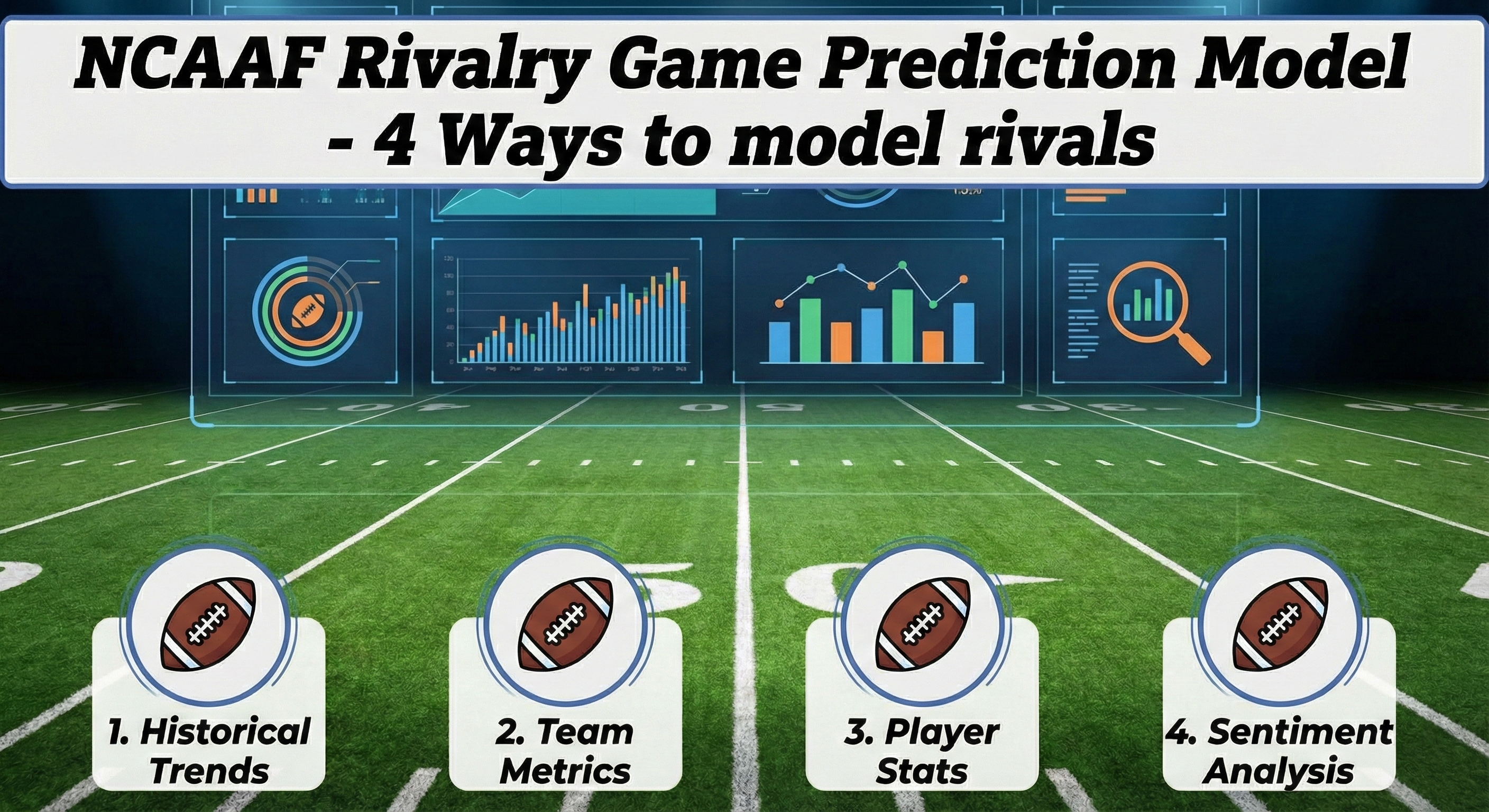
Rivalry games don’t behave like normal matchups, and my models treat them that way. As a sports analyst who lives in data and film, I’ll show how emotion, travel, weather, and coordinator shifts get converted into features, then into probabilities you can trust. Expect transparent methods, reproducible tools, and clear steps you can follow.
Key Takeaways
Rivalry games aren’t normal, so you have to build a rivalry-only layer on top of team strength that factors in coaching ties, scheme familiarity, travel, fans, and weather. You need to engineer context that moves the number, which means looking closely at early-down success versus defensive havoc, trench wins, finishing drives, special teams, tempo, and rest days. It is crucial to train with time-aware splits to ensure there is no leakage. I recommend starting with calibrated logistic regression and then testing gradient boosting while handling class imbalance, tuning with cross-validation, and checking Brier and log loss plus calibration curves.
You should use trusted data and tools like CollegeFootballData for play-by-play and NCAA team stats, Winsipedia for series history, and scikit-learn for modeling. You need to run quick EDA, scenario sims, and sanity checks on injuries before you recalibrate. Our team at ATSwins.ai runs an AI-powered sports prediction platform offering data-driven picks, player props, betting splits, and profit tracking across NFL, NBA, MLB, NHL, and NCAA. Free and paid plans give bettors insights and guides to make smarter, more informed decisions.
A Rivalry-Ready NCAAF Game Prediction Model That Bets With Context
Why rivalry games need their own model
Rivalry games simply do not behave like normal NCAAF matchups. Teams play through history, emotion, and context that standard power rankings tend to miss completely. When I build models for ATSwins.ai, I design a separate lane for rivalry weeks because the variance structure is different. You are predicting football within a social event, not just a game.
Here is what sets rivalry weeks apart from the rest of the schedule. First, you have the element of familiarity. Coordinators know each other’s calls and tells, plus they have scouted the same recruiting footprints for years, which changes the strategic baseline. Then there is the coaching history to consider. Staff crossover and old assistants ramp up the information advantage and motivation, meaning scheme adjustments come much faster than in a standard week. Geographic proximity also plays a massive role. Shorter travel and local familiarity lower the noise in travel fatigue and game-day routines, which typically disrupts road teams.
Fan travel is another huge factor. Road teams bring noise in these matchups. The crowd-field edge compresses and swings in strange pockets, especially in neutral venues with split stands. Finally, you have to account for situational chaos. Trophy games, streak narratives, and bulletin-board quotes add pressure that makes players treat mistakes differently. Public search doesn’t yield a single comprehensive framework for this exact use case, so we lean on established data science practice, team-quality modeling, and known football KPIs to purpose-build a rivalry-specific layer. Our north star is a simple idea where we use a normal pregame number as a baseline, then tilt the features toward rivalry-specific signals, and recalibrate the probabilities.
There are key signals I treat as first-class features in rivalry weeks. Series history deltas are vital, specifically the multi-year point differential trends and how they change with coaching eras. Recent form versus common opponents is another big one, where I look at opponent-adjusted EPA and Success Rate comps weighted by recency. Returning production matters significantly too because stability in QB, OL, and DB rooms matters more when opponents know your scheme. You also have to look at tempo and pace splits because tempo misreads get punished in rivalries, and drive-level consistency beats raw pace.
Turnover luck regression is another interesting signal. Fumble recovery luck tends to mean-revert, and while rivalry nerves can heighten ball security variance, the mean still pulls you back eventually. Weather and kickoff time are critical inputs as well because cold, wind, and odd kick times change pass rates and special teams risk. Home-field asymmetry is something to watch because the classic host advantage may compress or even invert when alumni travel well. Finally, special teams leverage is massive. Field position is stickier in emotional games, and hidden yards often decide outcomes. If you only do one thing, you should treat rivalry flags as a segmentation layer in feature prep and validation and evaluate on rivalry-only slates rather than just the full season.
Data pipeline and feature engineering
I emphasize transparent and reproducible data work so ATS and moneyline probabilities can be audited. Here is a practical pipeline you can stand up in a day and harden over a week.
What to pull and where to pull it
For play-by-play and drives, I use the CollegeFootballData API and the cfbd Python client for play-by-play, drives, and advanced team metrics. It covers EPA, explosiveness, and situational filters well enough for feature creation. For team season stats, I pull official team stats, splits, and leaderboards from the NCAA stats portal. I treat these as ground-truth aggregates for QA checks against computed values. For rivalry history and streaks, Winsipedia is the fastest high-level source for series-level context like all-time records, streaks, dates, and locations. You should validate date and location versus your internal schedule feed. For weather and surface data, I scrape or query NOAA-like sources or stadium-level feeds. At a minimum, you want to capture temperature, wind, precipitation probability, surface type, and roof status. Finally, for kickoff and travel, you need to derive kickoff local time and travel distance from stadium coordinates plus the team campus location.
Create a Rivalry Intensity Index (RII)
You need a compact number to quantify rivalry context. I recommend engineering an index that feeds feature interactions and segmentation. Start with years played, which you can min-max scale based on the historical meetings count. Next, look at the trophy or brand marker. This can be a binary or categorical variable indicating if there is a trophy and if there is national brand relevance. The distance bucket is another component, which I calculate on a 0 to 1 scale using haversine distance where closer means higher intensity. You also need to factor in streak and drought data, looking at the current streak length and “last win” recency for each team, capped to reduce outlier pull. Fan travel proxy is the final piece, which is a ratio of stadium capacity to combined alumni base estimates or social mentions. Keep it simple and consistent. You then blend these components with weights learned during model training or set initial weights by domain priors. For example, history and distance should outweigh trophy presence early on, and then you let the model learn the interactions.
Style-match metrics that travel well
You should exploit opponent-adjusted metrics that describe how teams win rather than just how much. This includes Success Rate for both offense and defense, as well as EPA per play and the split between EPA per rush and EPA per pass. Explosiveness is key, so look at EPA per explosive play or a standard isoPPP-like rate. You need to compare early-down success versus passing downs efficiency. Finishing drives is another major metric, measured by points per trip inside the 40. Special teams EPA and field position delta are often overlooked but critical. Havoc rate for both sides, including TFL, passes defended, and forced fumbles, tells a big story. Line yards, stuff rate, and power success for short-yardage conversion round out the physical profile. Create relative features such as Team A’s offense versus Team B’s defense and vice versa. Also, compute matchup deltas versus each team’s schedule baseline, not just raw season means.
Trench wins and QB stability
Offensive and defensive line composites are essential, specifically line yards and pressure rate allowed or created. QB continuity flags are also vital, including returning starter status, games missed, in-game injury exits, and practice reports if you can ingest them cleanly. Coordinator changes are another layer. OC and DC tenure and same-system flags matter because rivalry-week trick plays and counters often map to coordinator experience.
Schedule, rest, and travel context
Rest days are a simple but effective feature. Count the days since the last game and flag short-rest scenarios and post-bye effects. Travel load is calculated by miles, time zones crossed, and typical charter windows, along with a neutral site label. Consecutive road games act as a fatigue indicator. Kick time effects also matter, specifically the morning versus prime-time splits, so apply those where data shows stable patterns.
Turnover luck and penalties
Fumble luck is calculated by taking the actual fumble recovery share versus the 50 percent expectation. Interception volatility is measured by turnover-worthy play rate if charting data is available, otherwise, use INT rate regressed to team and league means. Penalty discipline is tracked by penalties per play and drive-killing penalty rate.
Weather features that matter most
Wind speed is huge. I use binary and scaled features because passing EPA craters above certain thresholds. Temperature is important to establish a cold-weather floor for pass-heavy teams with shallow WR depth. Precipitation should be probabilistic and game-time focused because moisture interacts with fumbles and kicking.
Feature scaling and leak checks
Use season-to-date rolling windows with cutoffs that respect the game date. For the rivalry feature subset, compute both “global season” and “rivalry-only” aggregates when the sample exists, but don’t overfit. Keep it conservative. Always validate that no postgame data bleeds into pregame features.
Light EDA in Colab and simple dashboards
Profile features versus outcome with partial plots and correlations. Build a rivalry versus non-rivalry filter and compare distributions for home-field edge, turnover variance, and special teams EPA volatility. Use a simple notebook plus a lightweight Tableau sheet for sanity checks. I keep a running list of model surprises and confirm with film notes or expert reports.
Modeling approach and training
My approach is layered. I start with a baseline form score that behaves like an Elo rating, then add a supervised learner trained on rivalry-tagged samples and time-aware validation. Finally, I calibrate probabilities.
Baseline form score
I compute a rolling Elo-like rating that updates weekly using margin of victory with a cap, opponent rating, and home-field advantage. I shrink early-season ratings toward preseason priors built from returning production and recruiting composites. I also add rivalry decay. If a team historically outperforms their rating in a specific rivalry, I include a small rivalry adjustment with strong regularization.
Supervised learning model
The options here are usually gradient boosting like LightGBM or XGBoost, or a calibrated logistic regression with strong feature engineering. The reason for boosting is that it captures non-linear interactions like wind multiplied by pass rate multiplied by QB depth multiplied by RII. The reason for logistic regression is that it is easier to calibrate and audit, and it plays nicely with small rivalry samples. I often train both and choose based on log loss and calibration on a rivalry-only validation set. Then I stack or blend them using a simple weighted average tuned on a separate holdout.
Seasonality and time-series CV
There are no random splits allowed here. You must use rolling-origin cross-validation. Train on Weeks 1 through 8 to predict Weeks 9 and 10, then roll forward. Keep rivalries stratified within folds to ensure variety. Freeze features at the game date to ensure no look-ahead and no postgame stats.
Handling class imbalance and noisy upsets
The target is usually home win versus road win or cover versus not cover. Rivalry upsets happen more often than the model would like. To handle this, I use class weights inversely proportional to outcome frequency. You can also use focal loss if your framework supports it, otherwise reweight hard examples. Data augmentation is risky, so I prefer smarter weighting over synthetic samples.
Coordinator changes and interactions
Build interaction terms like coordinator tenure times RII, returning QB times wind, and OL health times power success rate. Let the model learn when these matter most under rivalry pressure.
Style clustering to improve out-of-sample generalization
Cluster teams by offensive and defensive style, looking at tempo, rush and pass mix, explosive reliance, havoc created, and trench profile. Use cluster labels as features and as a basis for stratified validation. This helps when rivalry opponents mirror stylistic archetypes you have seen before.
Hyperparameter search and early stopping
Keep it modest and time-aware. For boosting, look at learning rate, max depth, min child weight, subsample, and colsample by tree. For logistic regression, focus on L1 and L2 strengths and feature standardization choices. Use early stopping on a rivalry-aware validation set to avoid overtuning to non-rivalry games.
Probability calibration and uncertainty
Calibrate using isotonic regression on a rivalry holdout. Platt scaling can also work, but isotonic handles non-linearity better in my experience. Produce probability intervals using bootstrap resampling across seasons and folds to estimate predictive variance. Report a 68 percent interval and a 90 percent interval for ATS and moneyline probabilities.
Interpretability for decision-making
Use permutation importance at the game level to see which features moved the probability. Use SHAP values to visualize individual game explanations when a number surprises you. Maintain a playbook of “red flags” that frequently appear before rivalry upsets, such as wind spikes, a backup QB thrust into a start, OL injuries, or a weather-driven tempo collapse.
Evaluation and deployment
I separate rivalry evaluation from general-season evaluation. The base model may look excellent over the full slate but underperform during rivalry weeks if not tuned.
Metrics to focus on
Focus on log loss and Brier score on rivalry-only samples. Look at calibration curves segmented by high versus low Rivalry Intensity Index, close spreads under 6.5 versus wide spreads, and weather-neutral versus weather-impacted games. Also track ATS hit rate and closing-line value, or CLV, but interpret with caution due to sample sizes.
Rivalry-only backtests vs non-rivalry weeks
Compare calibration and log loss directly. Measure the delta in model confidence versus realized volatility. Track how home-field edge shifts by rivalry type and stadium.
Stability across eras
Rivalries with coaching turnovers and scheme flips can look like new matchups. Use era segmentation such as Pre-2016, 2016 to 2020, and 2021 to present as a basic cut. Ensure the model does not overfit to a single era’s style, like the spread boom.
Sensitivity to injury and late news
Compute a “late-news sensitivity” score by re-running the model with and without the last 48 hours of inputs, such as injury status and weather updates, and record the swing size. If the swing is greater than your threshold, label the pick as “news-sensitive” and reduce stake or widen intervals on ATSwins.
Scenario simulations and guardrails
Run what-ifs for weather changes like wind adding 5 mph or temperature dropping 10 degrees. Check QB status scenarios for starter out versus limited versus full go. Test tempo adjustments of plus or minus 3 seconds per play. Set guardrails so you don’t auto-bet high RII games at extreme edges if intervals are wide. Flag games with contradictory signals for manual review, such as a trench mismatch favoring Team A but explosive plays favoring Team B.
Deployment targets
Use notebooks and scripts to predict weekly slates with configs for rivalry versus non-rivalry toggles. Build a lightweight API using a simple Flask or FastAPI endpoint that returns moneyline probability, ATS probability, probability intervals, top SHAP contributors, and risk flags. Maintain experiment tracking and versioning to track data version, feature set hash, model params, calibration method, and backtest metrics. Keep an audit trail across seasons.
A note on data sources and references
We didn’t find a dedicated public model tailored only to rivalry games in a quick search, so we prioritize neutral and trustworthy sources that cover the core football data we need. We use CollegeFootballData, the NCAA stats portal, and Winsipedia rivalry histories. Then we apply standard modeling best practices and domain heuristics.
Step-by-step: from raw data to rivalry-ready probabilities
I use this checklist every rivalry week to push clean picks to ATSwins.ai. The first step is to build the slate. You need to identify rivalry games by program listing and historical series. Assign a Rivalry Intensity Index and validate manually for oddball cases. Next, you ingest and validate data. Pull the last 4 to 6 weeks of play-by-play, drives, and season-to-date aggregates. Cross-check team season stats versus NCAA values for sanity, looking at yards per play and points per game. Pull weather forecasts twice, once initially and again 24 to 48 hours out.
Then comes feature engineering. Create style-match metrics like offense versus defense deltas for EPA, Success Rate, and explosiveness. Add trench metrics, finishing drives, and special teams EPA. Compute travel load, rest days, and kickoff local time. Generate turnover luck and penalty discipline measures. Roll everything to respect the game date so there is no postgame bleed.
After that, you calculate the baseline score. Update the Elo-like team form with margin cap and home-field advantage. Add a small rivalry overperformance prior if historically justified and not overfit. Now you train and select the model. Use the last 3 to 6 seasons with time-series CV. Train gradient boosting and calibrated logistic regression and compare them on rivalry-only validation. Select the model or blend, then calibrate with isotonic regression on the rivalry holdout. Once trained, produce predictions. Output moneyline and ATS probabilities with 68 percent and 90 percent intervals. Attach SHAP-based top contributors and a confidence tag labeled stable, moderate, or news-sensitive.
It is crucial to run scenarios. Test weather up and down. Toggle QB status if in question. Adjust tempo up and down. Rerun and note the probability swing, then update the confidence tag. Finally, do a human review and publish. Cross-check with film notes and injury reports from trusted beat sources. Publish to ATSwins.ai with betting splits overlay and unit sizing rules.
Tools and templates that help
For data ingestion, I use scheduled pull scripts for CFBD endpoints with retry and caching. I also maintain a simple “feature registry” CSV that documents variable names, definitions, and the data source. For modeling notebooks, I use one notebook per step, covering feature prep, model training, calibration, and scenario analysis. My QA dashboards focus on a rivalry-specific board that tracks home-field shift, expected versus actual turnover differential, and special teams swing plays. For the hand-off template for picks, each game gets the ML prob, ATS prob, intervals, key features and SHAP summary, news-sensitive label, and the suggested unit range and CLV target.
Example rivalry-week workflow in Colab
My morning pass starts by pulling data, running the feature script, and generating initial probabilities. I print a ranked list of “largest discrepancies” between the rivalry model and the base model. During the midday check, I update the weather and rerun scenario toggles for the top five edges. I investigate any team with greater than a 3 percent probability swing. In the afternoon validation phase, I calibrate with the freshest holdout week if enough games have been completed this season, otherwise I confirm with the last stable calibration set. I produce final intervals and label high-volatility games. The evening post involves publishing to ATSwins with optional write-ups, noting confidence and likely game scripts. I also set alerts for late quarterback status and wind changes.
Turning model output into ATSwins decisions
At ATSwins.ai, the rivalries flow into the same unified presentation that bettors see for NFL, NBA, MLB, NHL, and NCAA, but the decision logic is rivalry-aware.
For edges and thresholds, I use a higher threshold for staking when intervals are wide. For example, I require a 4 to 5 percent edge over fair on ML, not 2 to 3 percent, unless the confidence is “stable.” For betting splits, I overlay market splits and line moves to check for overreaction to narratives. If the public is lopsided but our probability interval spans the market number, I shrink exposure. For props, I map pace and weather to QB pass attempts, rush attempts for both teams, and kicker attempts. Rivalry pressure often boosts field goal attempts in wind-neutral conditions. For bankroll and profit tracking, I use a one unit framework with dynamic scaling by confidence label. I track CLV and unit yield by rivalry versus non-rivalry for ongoing calibration feedback.
Rivalry-specific feature notes worth bookmarking
Regarding RII interactions, high RII plus short rest tends to compress pace because teams play not to make the first mistake. High RII plus strong wind tilts to trench performance and field position more than usual. For home-field asymmetry, remember that some rivalries neutralize home-field, so mark those in a dictionary keyed by matchup and era. On special teams, hidden yards are often the tiebreaker. Value stable punting and reliable kickers higher.
Practical guardrails that save you money
Don’t chase series streaks without context because coaching flips can erase old patterns quickly. Beware clean injury reports that hide offensive line shuffles or snap-count limits. Limit exposure on weather-volatile totals unless intervals are tight and corroborated by matchup data. Fade narratives that ignore style match. “Team X wants it more” is not a metric. If it matters, you’ll see it reflected in tempo, finishing drives, and discipline features.
How to add the rivalry layer to an existing NCAAF model?
Start by adding a rivalry flag and Rivalry Intensity Index. Segment your training and validation by fitting the same model but reporting metrics separately for rivalry games. If calibration is worse, add rivalry-specific interactions and recalibrate. Introduce style clustering and coordinator tenure features as they help stabilize out-of-sample rivalry predictions. Build a minimal scenario simulator for wind and QB status. Put intervals on every output and create a “news-sensitive” tag. Use this tag in your staking logic.
Maintenance, monitoring, and mid-season adjustments
Perform weekly checks for drift detection on key features like EPA distributions, pace, and penalties. Rivalry environments sometimes shift with new rules or coaching trends. Do monthly or per-quarter checks to re-validate calibration on rivalry-only cohorts and re-run isotonic fitting if drift is evident. In the postseason audit, compare rivalry-only log loss and Brier score to non-rivalry weeks. Review the top 10 best and worst predictions and document common characteristics. Update feature registry and guardrails with those lessons.
Worked example structure (no team names needed)
Let's look at a hypothetical scenario. The preline model says Team A is minus 3.5 with a 55 percent Moneyline chance. The rivalry features push the probability because the RII is high due to history and location, the weather is windy and cold, Team A has a trench advantage while Team B is explosive but inconsistent, and there is a special teams edge to Team A. The calibrated model then outputs Team A at 58 percent Moneyline with a 68 percent interval between 54 and 62, and an ATS cover probability of 54 percent with an interval between 51 and 57.
We then run scenarios. If wind drops by 5 mph, Team A Moneyline drops to 56 percent, with the interval unchanged. If QB1 for Team B has an 80 percent probability to start, Team A Moneyline drops to 55 percent and the interval widens to between 51 and 60. The decision is a small edge versus fair with moderate intervals. The call would be to stake light or pass if the market drifts toward Team A. For props, lean toward Team A RB attempts over, and kicker attempts up in a neutral wind scenario.
Common pitfalls and how to dodge them
Overfitting series history is a major issue. You fix this by capping the weight of series deltas and interacting them with era and coordinator tenure. Misreading weather is another trap. Fix this by always running scenario toggles and using wind at kick plus gusts, not just average. Treating returning production as linear is a mistake. Instead, emphasize continuity at QB, OL, and DB more than raw returning snaps. Ignoring special teams variance can burn you. Fix this by creating a dedicated special teams composite and increasing its weight in high RII games.
Minimal checklist before you hit publish
Make sure the rivalry flag and RII are verified. ensure there is no leakage in features by locking season-to-date windows. Check probability calibration on rivalry holdout. Compute probability intervals. Run scenario sims for wind and QB status. Apply the confidence label. Compare ATS and ML edges to the market and set the CLV plan. Finally, add notes for trench and special teams keys.
Roadmap for incremental improvements
You can add player-level participation probabilities from reliable reporting and convert them to unit-level impact via EPA deltas. Incorporate in-game win probability models to study late-game performance under pressure and roll those insights into finishing drives features. Expand neutral-site modeling with crowd-split estimates using ticket markets and alumni concentration data. Add semi-automated film tagging for pass pro adjustments and run-fit integrity in rivalry weeks.
Why this matters for ATSwins users?
Rivalry games deliver opportunity because the market can overweight storylines and underweight style and trench realities. By leaning on rivalry-specific features, time-aware validation, and calibrated probabilities with intervals, we can surface edges that are real, not just loud. Then we align those edges with ATSwins’ betting splits, props, and profit tracking so users see what’s actionable, where the risk sits, and when to pass.
The process isn’t fancy. It’s careful. A clean rivalry model respects chaos without surrendering to it, and it turns Saturday emotion into disciplined numbers you can actually use.
Conclusion
Rivalry games behave differently, so build models that weight form, tempo and travel, weather and coaching signals. Key takeaways are that clean data matters, and time-aware training and calibration beat hot takes. ATSwins's expertise in ATSwins is an AI-powered sports prediction platform offering data-driven picks, player props, betting splits, and profit tracking across NFL, NBA, MLB, NHL, and NCAA. Free and paid plans give bettors insights and guides to make smarter, more informed decisions.
Frequently Asked Questions (FAQs)
What is an NCAAF rivalry game prediction model, and why does it behave differently?
An NCAAF rivalry game prediction model is a data-driven way to estimate win probabilities and spread outcomes for rivalry matchups. It blends normal team strength metrics with rivalry-specific inputs like series history, coaching familiarity, travel distance, student section impact, and weather at kickoff. Rivalry games behave differently because the teams know each other well, intensity spikes, game plans get weird, and variance goes up. That combo shifts how pace, field position, and 4th-down choices look—so a standard model can underperform here.
Which data should I collect to build an NCAAF rivalry game prediction model?
Keep the inputs simple, but rich. You need to gather team form metrics like success rate, EPA/play, line yards, havoc, explosive plays, and finishing drives. You also need context data such as rest days, travel load, altitude, kickoff time, weather, injuries, especially at QB, and coordinator changes. Rivalry factors are critical, so collect data on years played, trophy status, series run, distance between campuses, and neutral versus home designations. Market signals like closing spread and total are useful to benchmark, but don’t train on future info. Finally, get special teams data including field position wins, net punting, and kick efficiency. Good sources include CollegeFootballData for play-by-play, NOAA for weather, and simple modeling libraries like scikit-learn. You don’t need everything; start with 15 to 25 features and prune.
How should I train and validate an NCAAF rivalry game prediction model?
Use time-aware splits with seasonal rolling windows to avoid leakage. Ensure no future games are in the training fold. Start with calibrated logistic regression, then try gradient boosting. Keep it honest. Class weights help when you predict upsets because rivalry weeks have fatter tails. Validate with log loss and Brier score and also plot calibration. A 62 percent edge should land near 0.62 over time. Backtest rivalry games separately from non-rival games. If your calibration worsens only on rivalries, add rivalry-specific interactions like tempo times familiarity. A small tip is to refit calibration using Platt or isotonic methods after you finalize the model as it often matters more than one extra fancy feature.
What factors move the needle most in an NCAAF rivalry game prediction model?
From experience, several factors punch above their weight. QB health and continuity matters far more than usual. Early down success rate versus opponent’s defensive havoc is crucial because sustaining drives matters when nerves are high. Field position and special teams are huge since hidden yards swing tight games. Coaching trees and coordinator familiarity are key because blitz pick-up and route spacing tend to be “known” quantities. Weather plus tempo and substitutions are the final big movers. Wind and extreme cold suppress explosive pass plays, but tempo can still create volume. You’ll see turnover luck regress, but not fully in late-season rivalry weeks. A couple of bounces can still decide it, which is fine—just price the uncertainty.
How does ATSwins.ai enhance an NCAAF rivalry game prediction model for bettors?
ATSwins.ai is an AI-powered sports prediction platform offering data-driven picks, player props, betting splits, and profit tracking across NFL, NBA, MLB, NHL, and NCAA. Free and paid plans give bettors insights and guides to make smarter, more informed decisions. In rivalry weeks, that means calibrated probabilities you can compare to the book, transparent splits and context so you see why a number moved, prop edges that align with rivalry pace and usage changes, and simple bankroll and unit tracking, so results aren’t fuzzy. I use ATSwins.ai to cross-check rivalry projections, monitor market drift, and keep my risk neat—no hero bets, just repeatable process.
Related Posts
AI For Sports Prediction - Bet Smarter and Win More
AI Football Betting Tools - How They Make Winning Easier
Bet Like a Pro in 2025 with Sports AI Prediction Tools
Sources
The Game Changer: How AI Is Transforming The World Of Sports Gambling
AI and the Bookie: How Artificial Intelligence is Helping Transform Sports Betting
How to Use AI for Sports Betting
Keywords:
MLB AI predictions atswins
ai mlb predictions atswins
NBA AI predictions atswins
basketball ai prediction atswins
NFL ai prediction atswins
ai betting analysis