
NBA Predictions AI - How To Make Smarter NBA Picks
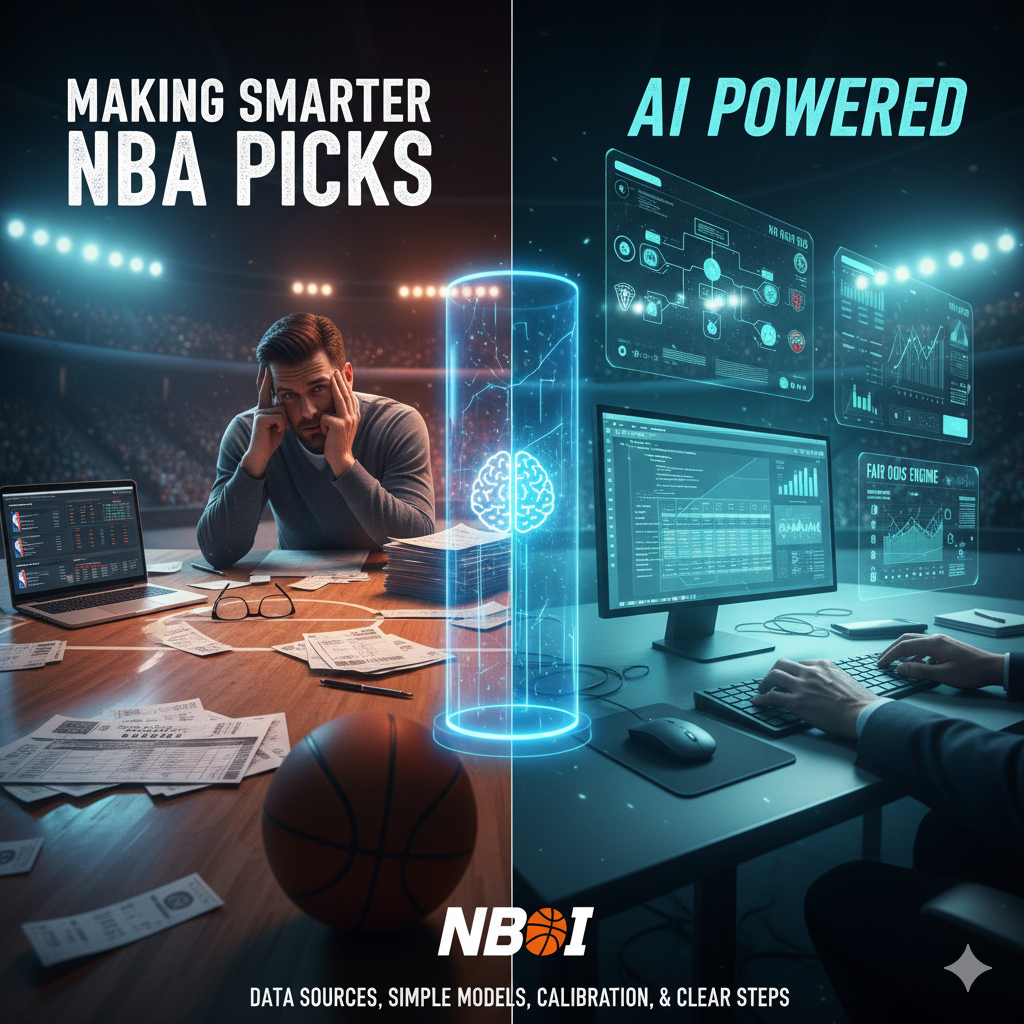
Curious about how NBA predictions AI really works—and more importantly, how you can actually use it without getting burned? You’re in the right place. I’ve spent a lot of time digging into this space, and what I’ve found is that most people either overcomplicate the process or they blindly trust numbers without understanding what’s going on behind the curtain. Neither of those approaches will help you long-term. This post is going to break down the whole pipeline: the data, the models, the backtesting, and even the daily workflow that makes it all usable.
And yes, we’ll talk about where AI shines, where it struggles, and how you can set yourself up so you’re not just chasing numbers but actually building a consistent process. The cool part is that it’s not just theory—you’ll walk away with something practical you can use right now.
Table Of Contents
- NBA predictions AI that actually helps you bet smarter
- Understanding “nba predictions ai”
- Data sources and wrangling
- Modeling and training
- Evaluation, calibration, and backtesting
- Deployment, ethics and workflow
- Conclusion
- Frequently Asked Questions (FAQs)
NBA predictions AI that actually helps you bet smarter
If you’ve ever tried to pick NBA games just by “feel” or even by scanning box scores, you know how hard it is to stay consistent. One night you’re hot, the next you’re chasing losses. What AI brings to the table is structure. It doesn’t guarantee wins (nothing does), but it makes the process more disciplined.
The basic idea is this: take clean data, feed it into models that are calibrated, and then test those models honestly against reality. When done right, this gives you probabilities you can trust and edges that actually last. When done wrong, it just spits out noise.
That’s why I want to walk you through how it works step by step—from data collection all the way to making a pick.
Understanding “NBA Predictions AI”
When people hear “NBA predictions AI,” they often imagine some robot that just spits out winners. That’s not the case. It’s really a mix of statistics, machine learning, and sports context that gets packaged into probabilities and projections.
Most people using NBA AI want a few things: win probabilities before the game starts, fair spreads and totals, and projections for player props like points, rebounds, assists, or threes. The good systems also give you confidence levels and uncertainty ranges so you know when to bet and when to pass.
This is where ATSwins comes in. They show you picks, player props, and betting splits in a way that’s quick to understand. You get a view of what the models are saying, what the public is betting, and how everything performs over time. That kind of transparency is rare, and it helps you trust the numbers instead of feeling like you’re guessing in the dark.
Data sources and wrangling
The foundation of any NBA AI system is data. Garbage in, garbage out. Clean, time-aware data is everything. That means only using information that was available before tip-off and avoiding any kind of “leakage” where you accidentally include future results in your training.
The data you want to focus on includes official box scores, lineups, schedules, injury logs, and odds. You want each game tied to a clean team-game identifier so you can merge everything together without creating duplicates. You also need to tag travel spots like back-to-backs, road trips, and time zone shifts because those actually impact performance.
Raw stats like points per game won’t cut it. You need to convert everything to per-possession rates so it’s apples to apples. That’s where advanced metrics like effective field goal percentage, turnover rate, offensive rebounding percentage, and free-throw rate come into play. Layer in rolling averages (like last 7, 15, or 30 games) with time decay so that recent games weigh more heavily, and you start to get something meaningful.
Travel, rest, lineup continuity, and injuries matter a ton, too. And when you add market data—like opening and closing lines—you can see how your numbers compare to the betting market. That’s how you identify real edges.
Modeling and training
Once the data is clean, you can start modeling. A simple baseline is logistic regression, which predicts the probability of the home team winning. It’s surprisingly effective when paired with features like Elo ratings, recent efficiency, rest, and market moves.
From there, tree-based models like XGBoost or LightGBM can capture more complex interactions. For example, how a fast-paced team on the second night of a back-to-back might perform against a slow-paced team with strong defensive rebounding. These models can uncover edges you might never notice manually.
Calibration is key, though. Raw model outputs aren’t always trustworthy. You need to run calibration methods like Platt scaling or isotonic regression so that when your model says there’s a 60 percent chance of something happening, it actually happens about 60 percent of the time in reality.
For live in-game updates, you can even use state-space models or Bayesian updates that factor in score margin, time remaining, foul trouble, and current lineups. That’s what creates smooth win probability graphs that aren’t just random jumps.
The whole point is that the models aren’t just spitting out numbers. They’re providing calibrated probabilities and edges that you can compare to the market.
Evaluation, calibration, and backtesting
This is the part most people skip, and it’s why they get burned. It’s not enough to train a model—you have to test it honestly. That means using rolling-origin backtests where you train on past seasons and validate on the next one. You can’t just shuffle data randomly or you’ll accidentally leak future information into your training.
The key metrics here are log loss and Brier score, which evaluate how well your probabilities match reality. Accuracy doesn’t really matter in betting; calibration does. If your model says 55 percent and it actually hits 55 percent of the time, that’s gold.
You also need to compare your results against benchmarks like the closing line. If you can’t beat the market after accounting for vig, your model isn’t good enough. And you should always audit performance in specific segments, like back-to-backs, injury-driven games, or blowouts, to see where your model struggles.
Backtesting like this forces you to stay honest. It’s what separates the serious players from the hobbyists.
Deployment, ethics and workflow
Now let’s talk about the daily grind. A solid NBA AI workflow looks something like this: ingest the data, validate it, build features, train or refresh your model, score games, publish predictions, and then monitor everything for drift.
That means you’re pulling schedules, injuries, and lines every day, validating that everything lines up, then running your models to get new probabilities. You push those predictions out in a readable format and flag any games where news just broke. Then you archive everything so you can track results over time.
This is where ATSwins really makes life easier. Instead of building all of this from scratch, you can view daily picks, props, and splits in one place. You get accountability, performance tracking, and a clear explanation of why a pick makes sense.
Ethically, it’s important to remember that betting always carries risk. Even the best AI won’t win every night. The goal is long-term discipline and consistency, not quick riches. That’s why transparency, calibration, and clear disclaimers matter.
Conclusion
So there you have it. NBA predictions AI isn’t magic, but when done right, it’s insanely powerful. The process is all about clean data, smart modeling, honest backtesting, and disciplined daily workflow. If you stick to that, you’ll find small edges that compound over time.
And if you don’t want to reinvent the wheel, that’s where ATSwins comes in. They’ve built a system that blends NBA AI with clear outputs you can actually use: data-driven picks, player props, betting splits, and profit tracking across multiple sports. Whether you’re just starting out or already deep into betting, it’s a tool that gives you structure, speed, and clarity in a space that can otherwise feel overwhelming.
Frequently Asked Questions (FAQs)
What is NBA predictions AI, in plain words?
It’s basically software that uses stats and machine learning to estimate outcomes like win probability, spreads, totals, and player props. It factors in team form, injuries, travel, pace, and matchups, then turns all that into numbers you can compare with the betting market. It’s not perfect—late injury news can still catch you—but it helps you stay consistent.
Which data matters most for NBA predictions AI?
The biggest drivers are team efficiency on a per-possession basis, player availability, lineup continuity, rest, travel, and shot quality. Most models lean heavily on rolling windows, on/off impact, and pace. And honestly, clean data matters more than massive amounts of messy data.
How do I use NBA predictions AI without overthinking it?
Keep it simple. Compare the model’s fair odds to the posted line and only act when the edge is meaningful. Track your results, set rules for bankroll management, and avoid betting when injury news is uncertain. A few small improvements to your process—like avoiding tilt or keeping honest logs—compound into huge differences over time.
Are NBA predictions AI more reliable than the betting market?
The market is sharp by tip-off, no doubt. But good AI isn’t about beating the market on every game—it’s about calibration and consistency. If your model probabilities line up with reality and you can beat the market in certain pockets, you’ve got something valuable.
How does ATSwins.ai use NBA predictions AI to help me decide?
ATSwins.ai packages NBA AI into something practical. They offer data-driven picks, props, betting splits, and profit tracking, not just for NBA but also for NFL, MLB, NHL, and NCAA. You get edges, confidence levels, and clear context so you know why a pick stands out. It’s built to give you clarity, not noise.
Related Posts
AI For Sports Prediction - Bet Smarter and Win More
AI Football Betting Tools - How They Make Winning Easier
Bet Like a Pro in 2025 with Sports AI Prediction Tools
Sources
The Game Changer: How AI Is Transforming The World Of Sports Gambling
AI and the Bookie: How Artificial Intelligence is Helping Transform Sports Betting
How to Use AI for Sports Betting
Keywords:
MLB AI predictions atswins
ai mlb predictions atswins
NBA AI predictions atswins
basketball ai prediction atswins
NFL ai prediction atswins