
Nba Playoff Ai Historical Data Modeling - How to model odds
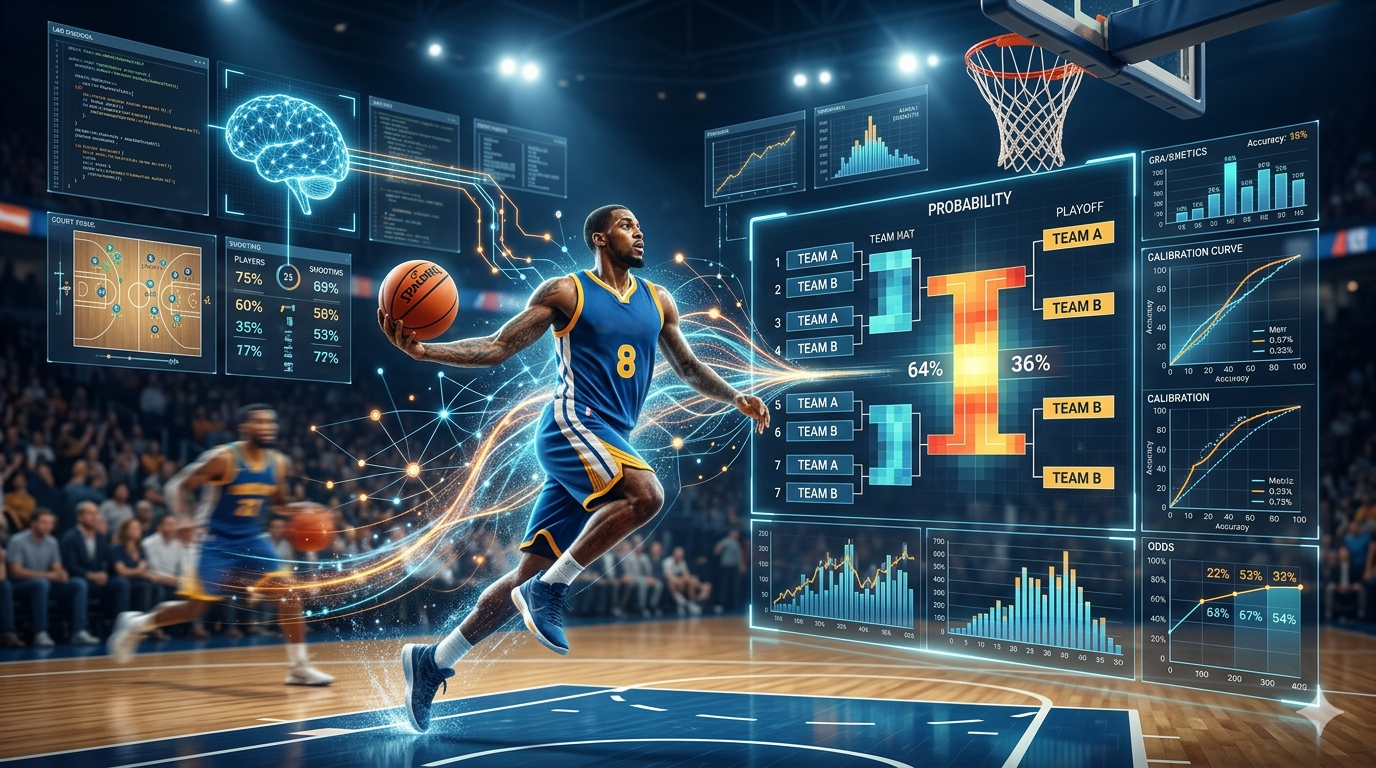
Big games are where models meet nerve. That is the whole vibe of the NBA playoffs. It is not just about numbers on a spreadsheet anymore. It is about pressure, rotations tightening, stars playing 42 minutes, and coaches making adjustments every single possession. As someone who builds AI systems for sports, I am always trying to bridge that gap between raw data and what actually happens on the court when everything is on the line. The goal is simple but not easy. Turn chaos into clarity. Turn thousands of data points into something you can actually trust when money is involved.
In this post, we are going deep into how to build playoff-level models that actually hold up. Not just something that looks good in the regular season, but something that survives a seven-game series where everything changes from game to game. We will walk through how to structure your data, what features actually matter in the playoffs, how to validate your models properly, and how to turn all of that into actionable outputs like win probabilities, projected margins, and betting angles. This is where concepts like an nba playoff ai win probability model start to make sense because we are not guessing anymore, we are quantifying.
We will also talk about how to make these models usable in real life. That includes reporting, scenario simulations, and how to think about risk with an
nba playoff ai bankroll management strategy
so you are not just firing blindly. There is a difference between having a model and actually using it correctly. By the end of this, you should have a clear framework for building, validating, and deploying an nba playoff ai daily picks system that is grounded in reality and tested through proper nba playoff ai betting model backtesting.
Table Of Contents
- Building Trustworthy NBA Playoff Models From Historical Data
- Foundation: historical data assembly and provenance
- Feature engineering for playoff context
- Modeling approaches that hold up in playoffs
- Validation and calibration you can trust
- Operationalization and reporting for ATS bettors
- Conclusion
- Frequently Asked Questions (FAQs)
Building Trustworthy NBA Playoff Models From Historical Data
If you skip this part, everything else falls apart. There is no shortcut here. You need clean, structured, and reliable historical data before you even think about modeling. Playoff basketball is not just a continuation of the regular season. It is a different environment entirely. Pace slows down, rotations shrink, and matchups become extremely targeted.
To build something that works, you need multiple seasons of both regular season and playoff data. The regular season gives you stability and sample size. The playoffs give you context and realism. You combine both to create something that actually reflects how teams perform when it matters.
This is also where most people mess up. They try to find a perfect playoff-only dataset, which usually does not exist in a clean format. Instead, you build your own structured pipeline using official box scores, play-by-play logs, lineup data, and game metadata. Everything has to be aligned properly. If your timestamps are off or your player IDs do not match, your model will quietly break and you will not even realize it until it is too late.
Foundation: historical data assembly and provenance
The foundation is all about structure. You want to collect data in a way that is consistent and easy to scale. That includes game-level data, team-level stats, and player-level events. You also want to track things that people often ignore like rest days, travel distance, and altitude. These things matter more in the playoffs because the margins are tighter.
Your schema should stay simple at the raw level. Do not overcomplicate it early. Keep clean tables for games, teams, players, and play-by-play events. Then build derived features on top of that. This keeps your pipeline flexible and prevents you from locking in bad assumptions too early.
Another key part here is identity management. You need consistent team and player IDs across all sources. If you are pulling from multiple datasets, build a crosswalk once and lock it in. Also normalize all timestamps to UTC. It sounds boring, but it prevents a lot of subtle bugs, especially when dealing with rest days and travel.
Roster tracking is another underrated piece. Late-season trades and injuries can completely distort your data if you are not careful. You should maintain a daily roster snapshot so your model always knows who was actually available at any point in time.
Feature engineering for playoff context
This is where things start to get interesting. Raw data is not enough. You need features that actually reflect how teams play in the playoffs. That means building opponent-adjusted offensive and defensive ratings, tracking pace differences, and understanding how styles interact in a series.
One of the most important concepts is opponent adjustment. A team that looks great offensively in the regular season might struggle against a top defensive team in the playoffs. Your model needs to account for that. You can do this through iterative methods or simpler strength-of-schedule adjustments, but you cannot ignore it.
Pace is another huge factor. Playoff games are usually slower, and that affects scoring, efficiency, and variance. You want to track both regular season pace and playoff-adjusted pace, then measure how teams differ from each other.
Style also matters a lot more in a series. Things like transition frequency, shot selection, and rebounding become more predictable because teams see each other multiple times. You can create features that capture these tendencies and how they interact. For example, a team that relies heavily on transition might struggle against a team that excels in half-court defense.
Injuries and rotation tightening are also critical. In the playoffs, the top 7 players often play the majority of the minutes. That means losing even one key player can have a bigger impact than in the regular season. You should translate injury reports into expected minutes lost and adjust your features accordingly.
All of this feeds into your nba playoff ai win probability model , which should reflect not just overall team strength but how that strength changes based on matchup, pace, and context.
Modeling approaches that hold up in playoffs
Once your features are solid, you can start modeling. The key here is not to overcomplicate things too early. Start with simple baselines like seed-based predictions and ELO ratings. These give you a reference point and help you understand how much value your more complex models are adding.
Logistic regression is a great starting point. It is simple, transparent, and easy to debug. You can include key features like efficiency differences, home court, rest, and injuries. Add a few interaction terms, but do not go overboard.
From there, you can move to more advanced models like gradient-boosted trees. These models are great at capturing non-linear relationships and interactions between features. However, they can overfit if you are not careful, so you need to use constraints and proper validation.
For series predictions, Bayesian models can be useful. They allow you to incorporate prior information and update your beliefs as the series progresses. You can also simulate entire series using game-level probabilities, which helps you understand the range of possible outcomes.
All of this ties into building a reliable nba playoff ai daily picks system . The goal is not just to predict winners, but to generate consistent, repeatable outputs that you can use every day during the playoffs.
Validation and calibration you can trust
This is where most models fail. It is not enough to have a model that looks good on paper. You need to validate it properly and make sure the probabilities actually mean what they say.
Time-based splits are essential. You should train on past seasons and test on future playoffs . Never mix data across time because that creates leakage. Also, make sure you are validating on playoff games specifically, not just regular season data.
Metrics like Brier score and log loss are more important than simple accuracy. They tell you how well your probabilities are calibrated. A model that predicts 60 percent outcomes should be right about 60 percent of the time. If not, you have a calibration problem.
Calibration methods like isotonic regression or Platt scaling can help fix this. You should apply them on validation data and then test again to make sure they are working.
This entire process is what defines proper nba playoff ai betting model backtesting. You are not just checking if the model wins, you are checking if it is trustworthy over time.
Operationalization and reporting for ATS bettors
Now we get into the part that actually matters for real-world use. A model is only useful if you can turn it into actionable insights. That means converting win probabilities into betting angles like spreads and totals.
To estimate cover probability, you need a model for expected margin and its variance. From there, you can calculate the probability of covering a given spread. This is where things like distribution assumptions and variance control come into play.
You should also provide outputs in a clear format. That includes win probability, cover probability, expected margin, and confidence intervals. Do not overcomplicate the presentation. Keep it simple and readable.
Scenario simulations are another powerful tool. You can adjust for injuries, rest, or pace and see how the probabilities change. This helps you understand how sensitive your model is to different factors.
All of this feeds into your overall nba playoff ai bankroll management strategy . Even the best model will have variance, so you need to manage risk properly. That means sizing bets based on edge and confidence, not just going all-in on every pick.
Conclusion
At the end of the day, building a playoff-ready model is about discipline. Clean data, smart features, honest validation, and clear reporting. There is no magic trick. It is just a process that you refine over time.
The biggest takeaway is that you need to respect the differences between the regular season and the playoffs. If your model does not account for those differences, it will break when it matters most.
If you follow this framework, you can build something that is not just accurate, but reliable. Something that gives you an edge without overpromising. That is the goal. Not perfection, but consistency.
Frequently Asked Questions (FAQs)
What is NBA playoff AI historical data modeling?
It is the process of using historical playoff and regular season data to train machine learning models that predict game and series outcomes. The focus is on creating probabilities that reflect real playoff conditions, not just regular season trends.
Which data matters most?
Team efficiency, pace, matchup context, injuries, and rest are all critical. The key is not just collecting this data, but aligning it properly in time so your model only uses information available before each game.
How do I avoid leakage?
Use strict time splits, build features using only past data, and validate on future playoffs. Never allow your model to see information from the future, even indirectly.
Where do calibrated probabilities fit in?
They are essential. A model is only useful if its probabilities are accurate. Calibration ensures that predicted probabilities match real-world outcomes over time.
How does ATSwins help?
ATSwins provides a structured platform for applying these concepts in real time, offering data-driven picks, player props, and tracking tools to help bettors make more informed decisions.
Related Posts
AI For Sports Prediction - Bet Smarter and Win More
AI Football Betting Tools - How They Make Winning Easier
Bet Like a Pro in 2025 with Sports AI Prediction Tools
Sources
The Game Changer: How AI Is Transforming The World Of Sports Gambling
AI and the Bookie: How Artificial Intelligence is Helping Transform Sports Betting
How to Use AI for Sports Betting
Keywords:
MLB AI predictions atswins
AI MLB predictions atswins
NBA AI predictions atswins
basketball ai prediction atswins
NFL ai prediction atswins