
Nba Expected Value Betting Strategy - How to win with EV
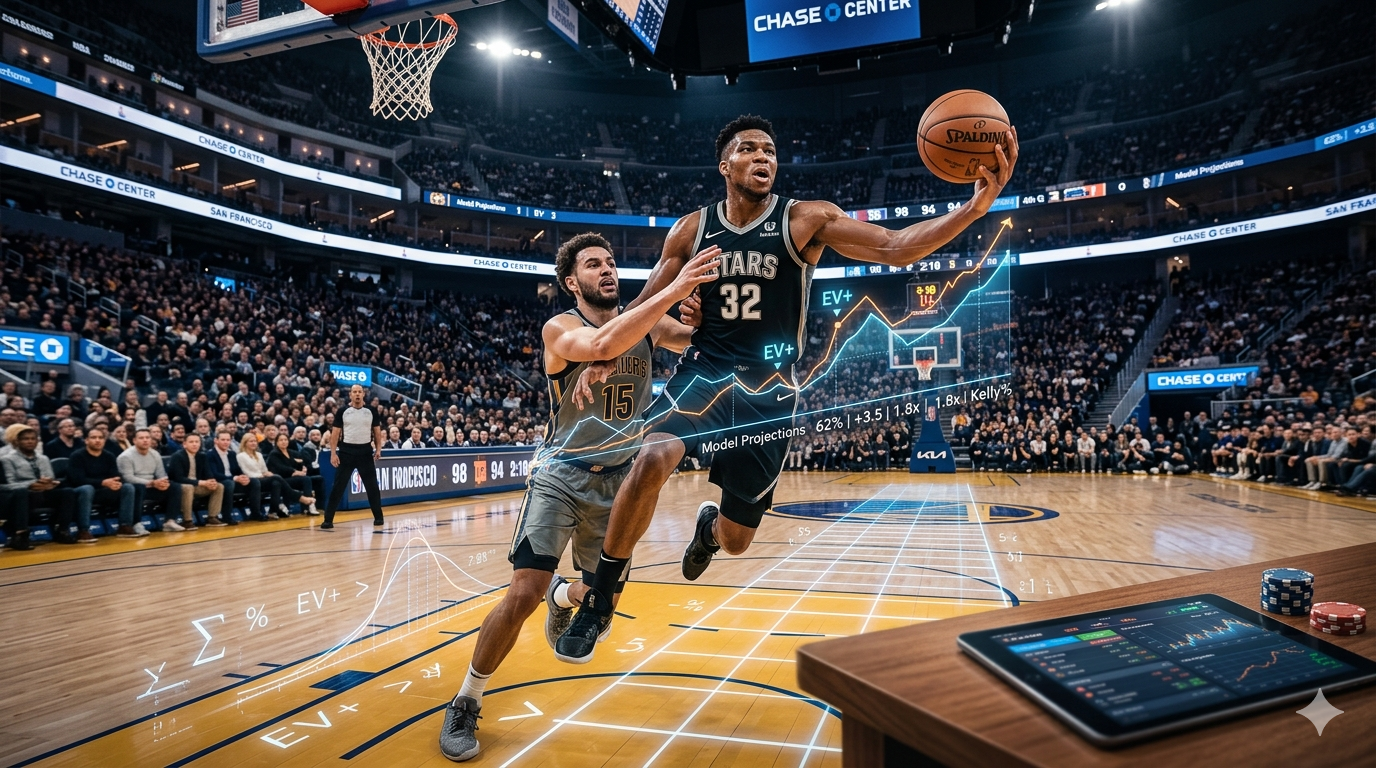
When people first get into NBA betting, they usually focus on picks. They want winners, locks, guaranteed plays, or “sure things.” The reality is that long term sports betting is less about predicting winners perfectly and more about understanding price, probability, and value. That’s the difference between recreational betting and building an actual strategy that can survive an entire NBA season.
The NBA market moves fast. Injuries break minutes before tipoff. Lineups change constantly. Rest spots matter. Pace swings totals. Role players suddenly become stars for one night because of matchup advantages. Because of all this chaos, smart bettors now rely on AI models, projections, and probability-driven systems instead of guessing based on vibes.
That is where concepts like nba betting probability vs implied odds become incredibly important. If you do not understand how sportsbooks price lines compared to your own projected probabilities, you are basically betting blind. The edge comes from identifying spots where the market is slightly wrong and exploiting those mistakes consistently over time.
Modern bettors are also leaning heavily into tools powered by machine learning. A lot of successful NBA bettors now use some version of a best ai sport predictor to speed up injury analysis, pace projections, lineup changes, and player prop simulations. Instead of manually crunching numbers for hours every day, AI can help organize the information faster so bettors can focus on finding edges.
The NBA is also one of the best sports for data-driven betting because the season is long, player tracking data is deep, and lineup combinations matter heavily. That is why systems like an nba pace based betting model or an nba lineup efficiency prediction algorithm have become so popular among sharp bettors. Pace impacts possessions, possessions impact scoring opportunities, and lineup efficiency determines how effective those possessions become. Once you understand those relationships, the betting market starts looking much more predictable.
This guide breaks down the complete framework behind expected value betting in the NBA. We are going to cover implied probability, removing sportsbook vig, finding positive EV opportunities, building better models, bankroll management, tracking performance, and how AI tools like ATSwins fit into the process.
If your goal is to stop making emotional bets and start approaching NBA betting like a long term investment strategy, this is the foundation you need.
Table Of Contents
- Foundations of NBA Expected Value Betting Strategy
- Modeling Win Probability and Player Impact
- Finding Edges vs the Market
- Bankroll Management and Risk
- Tracking, Evaluation, and Iteration
- Modeling Win Probability and Player Impact: Practical Paths with ATSwins Context
- Finding Edges vs the Market: Applied Mechanics
- Bankroll Management and Risk: Practical Guardrails
- Tracking, Evaluation & Iteration: Staying Organized
- Useful Resources and Data
- Conclusion
- Frequently Asked Questions (FAQs)
Foundations of NBA Expected Value Betting Strategy
Expected value is the core concept behind profitable sports betting. It tells you whether a bet is mathematically profitable over the long run instead of emotionally appealing in the short term.
A lot of bettors make the mistake of assuming a bet is good simply because they think a team will win. That is not enough. A team can win and still be a terrible bet if the odds are overpriced.
This is where nba betting probability vs implied odds becomes the foundation of everything.
Expected value connects your projected probability to the sportsbook’s price. If your projected probability is higher than the probability implied by the betting odds, you potentially have a positive EV bet.
Think about it like buying stocks. You are not just asking whether a company will succeed. You are asking whether the stock price is undervalued relative to future expectations. Sports betting works the exact same way.
A simple mental framework looks like this:
If the sportsbook undervalues a team’s chances, you buy the number.
If the sportsbook overvalues a team’s chances, you avoid the bet or potentially take the other side.
That sounds simple, but the execution requires discipline.
American odds are the most common format in NBA betting.
Positive odds like +150 mean you win $150 profit for every $100 risked.
Negative odds like -150 mean you risk $150 to win $100 profit.
Decimal odds are cleaner mathematically because they show total return including your stake.
For example:
2.50 decimal odds means every $1 returns $2.50 total.
To convert odds into implied probability:
Positive odds:
100 / (odds + 100)
Negative odds:
odds magnitude / (odds magnitude + 100)
Examples:
+150 becomes:
100 / 250 = 40%
-150 becomes:
150 / 250 = 60%
Understanding implied probability is massive because sportsbooks are not pricing teams randomly. Every line already contains a probability expectation.
The problem is sportsbooks also include vig, which is their built-in profit margin.
For example, if both sides of a spread are listed at -110, the implied probabilities add up to more than 100%. That extra percentage is the sportsbook’s edge.
Sharp bettors remove vig before evaluating whether a bet has value.
Suppose two teams are both listed at -110.
Each side implies 52.38%.
Combined, that equals 104.76%.
To remove the vig, divide each implied probability by the total.
52.38 / 104.76 = 50%.
Now you have the fair probability estimate without sportsbook margin.
This process matters because a lot of beginner bettors compare their model directly to sportsbook odds without removing vig first. That creates fake edges that do not actually exist.
Expected value calculations become much easier once probabilities are normalized.
Using decimal odds:
EV = (win probability × net payout) − loss probability
Example:
You project Team A wins 47% of the time.
The sportsbook offers +120 odds.
Net payout equals 1.20.
EV becomes:
0.47 × 1.20 − 0.53
= 0.564 − 0.53
= +0.034
That means you are earning 3.4 cents per dollar wagered in expected value over the long run.
The same concept applies to spreads and props.
Suppose your nba pace based betting model projects an over to hit 55% of the time at -110 odds.
At -110, the break-even probability is 52.38%.
If your model truly projects 55%, you potentially have positive expected value.
The edge may seem small, but small edges compound over thousands of bets.
That is how professional bettors think.
They are not trying to win every night.
They are trying to consistently place wagers where the mathematical expectation favors them over time.
Modeling Win Probability and Player Impact
The hardest part of NBA betting is generating accurate probabilities.
Anybody can calculate EV once probabilities exist. The challenge is producing better projections than the market.
This is where AI models and data systems become valuable.
A modern best ai sport predictor usually combines team ratings, pace metrics, injury adjustments, lineup data, player efficiency, and market movement into one predictive framework.
One of the simplest starting points is Elo ratings.
Elo systems update team strength after every game based on expected outcomes versus actual outcomes.
If a strong team loses badly to a weak team, their rating drops significantly.
If a weak team performs well against elite competition, their rating improves.
Elo systems work surprisingly well for baseline NBA projections because the season is large enough for team strength to stabilize.
However, NBA betting requires deeper context than simple win-loss records.
Pace matters heavily.
An nba pace based betting model focuses on possessions rather than raw points.
This is critical because NBA totals are driven largely by possession volume.
Fast teams create more scoring opportunities.
Slow teams reduce variance and lower totals.
A team averaging 103 possessions per game will naturally generate more points than a team averaging 95 possessions even if efficiency stays constant.
Sharp bettors track:
Pace factor
Transition frequency
Offensive rebound rates
Shot clock usage
Half-court efficiency
These metrics influence totals, team totals, and player props significantly.
Lineups also matter far more in the NBA than most sports.
One bench-heavy lineup can completely change offensive efficiency for six-minute stretches.
That is why an nba lineup efficiency prediction algorithm can become such a powerful betting tool.
Lineup efficiency models analyze how groups of players perform together instead of evaluating players individually.
Some lineups generate elite spacing.
Others struggle defensively.
Some rotations dominate transition offense.
Others collapse without a primary ball handler.
Sportsbooks often adjust slowly to subtle lineup changes outside of superstar injury news.
That creates opportunities.
Suppose a backup center unexpectedly starts because of injury. Casual bettors may not care. But if your lineup efficiency data shows the replacement lineup performs dramatically worse in rim protection and rebounding, you may find hidden value on opposing player props or team totals.
Injury modeling is another massive component.
Sharp bettors do not simply ask whether a player is active.
They ask:
How many minutes will he play?
Will usage increase?
Will pace change?
Will the rotation shorten?
Will defensive assignments shift?
For example, if a star player returns from injury under a minutes restriction, sportsbooks may overreact by pricing the team as fully healthy even though the player may only contribute 20 minutes.
Machine learning systems help process these adjustments faster.
That is where AI tools provide value.
ATSwins helps bettors organize projections, props, betting splits, and tracking so they can react faster to market movement instead of manually rebuilding spreadsheets all day.
The closing line is another underrated benchmark.
A lot of smart bettors judge model quality based on closing line value instead of short-term results.
If your bets consistently beat the closing number, your process is probably strong even if short-term variance hurts results temporarily.
That is because closing lines absorb massive amounts of information from sharp bettors, syndicates, injury reports, and market corrections.
Consistently beating the close is one of the strongest signs that your projections are accurate.
Finding Edges vs the Market
The entire goal of NBA betting is identifying differences between your projected probabilities and the sportsbook’s implied probabilities.
That difference is your edge.
The process usually looks like this:
First, collect the best available odds across sportsbooks.
Second, convert odds into implied probabilities.
Third, remove vig.
Fourth, compare your model probabilities against the fair market probabilities.
Fifth, calculate expected value.
If the EV is positive and clears your minimum threshold, you consider placing the bet.
A lot of bettors skip steps and jump directly into betting because a number “feels wrong.” That approach usually fails long term.
Professional bettors trust structured workflows instead.
Player props are often softer markets than sides or totals.
That is because sportsbooks spend most of their resources shaping primary markets first.
Props move quickly once limits increase, but early numbers can contain exploitable mistakes.
This is especially true when lineup changes happen late.
A strong nba lineup efficiency prediction algorithm becomes extremely useful here because it can identify hidden usage boosts and matchup advantages before sportsbooks fully adjust.
For example, if a high-usage guard gets ruled out, sportsbooks may adjust the replacement player’s scoring prop slightly while underestimating assist opportunities for secondary ball handlers.
That creates edge opportunities.
Execution timing matters too.
Some bettors specialize in overnight openers.
Others wait for injury confirmations near tipoff.
There is no universal approach.
The key is understanding why your edge exists.
If your edge depends on uncertain injury information, you may want to bet earlier before the market moves.
If your model consistently identifies inflated public favorites closer to tipoff, waiting may produce better numbers.
Line shopping is critical.
A difference between -110 and -115 may not seem important, but over hundreds or thousands of wagers, it drastically impacts profitability.
Serious bettors maintain multiple sportsbook accounts because price differences create hidden EV.
Correlated bets are another important consideration.
Suppose you bet:
Team over
Star player over assists
Star player over points
Fast pace over
All of these bets depend on similar game scripts.
If the game unexpectedly slows down, multiple bets lose together.
Correlation is not automatically bad, but exposure should be managed carefully.
Bankroll Management and Risk
Most bettors lose because of bankroll mistakes, not because they cannot predict games.
Even strong models fail if bet sizing becomes emotional.
The Kelly Criterion is one of the most popular bankroll management systems.
It determines optimal stake size based on edge and payout odds.
The formula looks complicated at first, but the concept is simple:
Bigger edge equals larger bet size.
Smaller edge equals smaller bet size.
Most professional bettors use fractional Kelly instead of full Kelly because full Kelly produces aggressive volatility.
Half Kelly or quarter Kelly is more practical.
Suppose your model projects a 54.5% win probability at -110 odds.
The full Kelly stake may suggest risking around 4.4% of bankroll.
Many bettors would reduce that to around 1% to 2%.
This protects against variance and model uncertainty.
Exposure caps matter too.
Sharp bettors often limit:
Daily bankroll exposure
Per-game exposure
Prop exposure
Correlation exposure
This prevents one bad night from destroying weeks of progress.
Variance simulations are incredibly useful for emotional preparation.
Even profitable bettors experience brutal losing streaks.
A bettor with legitimate positive EV may still lose 12 straight bets purely because of variance.
That reality destroys emotionally driven gamblers.
Professionals expect it.
They simulate potential drawdowns in advance so losing streaks do not trigger panic adjustments.
Unit sizing should stay stable.
One of the biggest mistakes recreational bettors make is doubling stakes after losses to “win it back.”
That usually accelerates bankroll destruction.
Consistent unit sizing is boring, but boring is profitable long term.
Tracking, Evaluation, and Iteration
If you are not tracking your bets properly, you are basically guessing about your own performance.
Every wager should include:
Date
Market
Odds
Stake
Model probability
Closing line
Result
Notes
Tracking allows you to evaluate where your edge actually exists.
A lot of bettors assume they are strong at player props when their long-term data shows better performance on totals or first halves.
Data removes ego from the process.
Closing line value is one of the most important metrics.
If you consistently beat closing lines, your process is probably profitable even during temporary downswings.
Calibration also matters.
Suppose your model predicts 60% win probability frequently.
Over large samples, those bets should win around 60% of the time.
If they win only 52%, your model is overconfident.
Brier scores help measure this.
Walk-forward testing is another major concept.
Instead of testing a model against all historical data simultaneously, you simulate how the model would have performed in real time.
Train on older seasons.
Test on newer seasons.
Roll forward gradually.
This prevents overfitting.
Overfitting destroys many NBA betting models because the NBA evolves constantly.
Three-point volume changes.
Pace changes.
Rotations change.
Offensive styles change.
A model that dominated five years ago may become obsolete today.
That is why weekly review systems are important.
Professional bettors constantly review:
Largest wins
Largest losses
Market disagreements
Execution mistakes
Feature drift
Injury assumptions
Line-shopping efficiency
ATSwins simplifies part of this process by organizing projections, splits, tracking, and betting data into one system so bettors can spend more time improving decisions instead of manually organizing information.
Modeling Win Probability and Player Impact: Practical Paths with ATSwins Context
Building a profitable NBA betting workflow does not require an insanely complicated model immediately.
A lot of successful bettors begin with simple systems and gradually improve them.
One approach combines Elo ratings with injury adjustments.
Another uses logistic regression with pace, rest, and efficiency variables.
More advanced bettors move into machine learning and gradient boosting models.
No matter which route you choose, consistency matters more than complexity.
A lightweight nba pace based betting model can outperform a fancy overfit neural network if the simple model remains disciplined and calibrated properly.
Player impact calculations are especially important during the NBA regular season because rotations shift constantly.
Some teams play deep benches.
Others rely heavily on starters.
Some coaches stagger stars.
Others keep lineups rigid.
These differences impact betting markets more than casual fans realize.
On/off metrics help estimate player impact.
These stats measure how teams perform when a player is on the court compared to when they sit.
However, raw on/off numbers can become noisy.
Small samples distort results.
That is why many bettors regress those numbers toward team averages.
A good nba lineup efficiency prediction algorithm also accounts for lineup synergy.
Two players may individually grade well but perform poorly together because of spacing overlap or defensive limitations.
That nuance matters in betting.
Live betting models introduce another layer.
In-game betting relies heavily on pace adjustments, fatigue projections, and Bayesian updating.
Suppose a pregame total opened at 228.
The first quarter produces extreme shooting variance but normal shot quality.
A smart live bettor recognizes that hot shooting alone does not necessarily justify massive total increases.
Regression matters.
This is where machine learning models can react faster than emotional bettors.
Finding Edges vs the Market: Applied Mechanics
Removing vig remains one of the most overlooked skills among casual bettors.
Suppose a moneyline market shows:
Favorite -145
Underdog +130
The implied probabilities add up above 100%.
After normalizing the probabilities, you identify the sportsbook’s actual fair expectation.
Then you compare your projection.
Suppose your best ai sport predictor projects the favorite at 60.5% win probability while the vig-free market probability sits at 57.7%.
That difference represents your edge.
But edge alone is not enough.
You still calculate expected value relative to the actual price available.
Some bettors also prioritize softer markets like:
First-half totals
Bench player props
Alternate spreads
Rebound props
Assist props
These markets often react slower to rotation news.
Line shopping becomes increasingly important here because small pricing inefficiencies matter heavily in high-volume betting.
Execution discipline separates profitable bettors from emotional bettors.
If a prop moves from -105 to -125 before you bet, the edge may disappear completely.
Chasing steam blindly is dangerous.
The number matters just as much as the pick itself.
Bankroll Management and Risk: Practical Guardrails
The biggest edge in sports betting is survival.
A profitable bettor who manages bankroll correctly stays in the game long enough for edges to compound.
An undisciplined bettor eventually blows up even with strong predictions.
Fractional Kelly sizing remains one of the safest long-term approaches.
Many sharp NBA bettors risk:
0.5% to 1% units
Quarter Kelly sizing
Lower exposure on volatile props
Higher exposure on efficient main markets
Diversification matters too.
If your entire card depends on one high-scoring game environment, a single pace collapse can ruin the night.
Spreading exposure across different games and markets reduces volatility.
Variance simulations help emotionally prepare bettors for inevitable losing stretches.
Even a genuinely profitable bettor may experience weeks of negative results.
That does not automatically mean the model is broken.
That is simply probability.
This is another reason why tracking CLV matters so much.
If you consistently beat closing lines but lose temporarily, variance is probably the culprit.
If you consistently lose CLV, the process likely needs adjustment.
Tracking, Evaluation & Iteration: Staying Organized
Professional bettors operate like investors.
They track data relentlessly.
Every edge, mistake, adjustment, and market move gets documented.
This process feels tedious initially, but it becomes incredibly valuable over time.
A strong betting ledger helps answer critical questions:
Which markets perform best?
Are props outperforming totals?
Are injury assumptions accurate?
Are late bets worse than early bets?
Are certain sportsbooks consistently offering better value?
Without tracking, bettors usually rely on memory, and memory is unreliable.
Weekly reviews help prevent emotional overreactions.
Instead of changing a model after two bad nights, smart bettors review larger samples methodically.
A lot of bettors sabotage themselves by constantly tweaking systems after short-term variance.
Consistency matters more than chasing perfection.
ATSwins helps streamline the organizational side by consolidating betting splits, props, projections, and tracking into one workflow.
That efficiency matters because NBA betting moves quickly, especially during heavy slate nights.
Useful Resources and Data
Reliable data sources matter heavily when building NBA betting systems.
NBA Advanced Stats provides lineup data, pace metrics, player tracking, and on/off statistics.
Basketball-Reference offers historical ratings, schedules, rest data, and box score archives.
Kaggle datasets help bettors experiment with modeling systems and simulations.
Expected value theory and Kelly Criterion research provide foundational mathematical frameworks for long-term betting strategies.
Most importantly, bettors should focus on building clean workflows.
A simple, organized system usually outperforms a chaotic complicated one.
The daily workflow for many sharp NBA bettors looks something like this:
Morning line scan
Injury updates
Model refresh
Pace adjustments
Lineup review
Line shopping
Pre-tip confirmations
Post-game tracking
That repetition creates consistency.
And consistency creates long-term profitability.
Conclusion
The reality of profitable NBA betting is much less glamorous than social media makes it look. It is not about hitting miracle parlays every night or chasing viral picks. Sustainable success comes from understanding nba betting probability vs implied odds and treating betting like a probability game instead of entertainment.
Expected value is the foundation. You project probabilities, remove vig, compare prices, and only bet when the math supports the wager. Everything else builds on top of that.
Modern AI systems have also changed the landscape dramatically. Tools powered by a best ai sport predictor can process injuries, lineup changes, pace adjustments, and player prop data far faster than manual research alone. That speed matters in modern betting markets where lines move quickly.
Systems like an nba pace based betting model help bettors understand possession volume and scoring environments more accurately, while an nba lineup efficiency prediction algorithm helps identify hidden lineup edges sportsbooks may not fully adjust for immediately.
The key is discipline.
Discipline with pricing.
Discipline with bankroll management.
Discipline with tracking.
Discipline with execution.
That is ultimately what separates long-term profitable bettors from emotional gamblers.
ATSwins fits naturally into that process by providing AI-driven projections, betting splits, player props, and tracking tools that help bettors stay organized and data-focused across the NBA season.
If you consistently focus on expected value, probability edges, line shopping, and disciplined bankroll management, you give yourself a legitimate chance to survive the variance and build a profitable NBA betting process over time.
Frequently Asked Questions (FAQs)
What does nba betting probability vs implied odds actually mean?
It refers to comparing your projected probability for an outcome against the sportsbook’s implied probability based on betting odds. If your projected probability is higher than the sportsbook’s implied probability after removing vig, the bet may have positive expected value.
Why is expected value important in NBA betting?
Expected value helps bettors determine whether a wager is mathematically profitable long term. Instead of focusing on individual wins and losses, EV focuses on whether your betting decisions consistently beat market pricing over large samples.
What is the best ai sport predictor for NBA betting?
There is no perfect universal predictor, but strong AI betting systems combine pace, lineup efficiency, injury data, player usage, rest, and market movement into one predictive framework. ATSwins helps bettors organize many of these factors through AI-powered projections and tracking tools.
How does an nba pace based betting model work?
An nba pace based betting model projects the number of possessions in a game. Since possessions drive scoring opportunities, pace models help bettors evaluate totals, team totals, and player props more accurately.
What is an nba lineup efficiency prediction algorithm?
An nba lineup efficiency prediction algorithm evaluates how specific player combinations perform together offensively and defensively. These systems help bettors identify matchup advantages, rotation weaknesses, and hidden lineup impacts that sportsbooks may undervalue.
Why do professional bettors remove vig before calculating EV?
Sportsbooks include built-in profit margins inside betting lines. Removing vig creates a fair probability estimate so bettors can accurately compare their own projections against the market.
What is closing line value in NBA betting?
Closing line value measures whether your bet beat the final market number before tipoff. Consistently beating the closing line is considered one of the strongest indicators of long-term betting skill.
How should beginners manage bankroll in NBA betting?
Most experienced bettors recommend small consistent unit sizes, often around 0.5% to 1% of bankroll per wager. Fractional Kelly sizing is also popular because it balances growth with variance protection.
Why are player props often softer than sides and totals?
Sportsbooks dedicate most resources toward shaping major markets first. Props, especially bench player props and niche stats, can react slower to injury updates and lineup changes, creating potential value opportunities.
How often should betting models be adjusted?
Models should be reviewed regularly but not changed emotionally after short-term losses. Most successful bettors make gradual improvements through weekly or monthly reviews rather than constant daily overreactions.
Related Posts
AI For Sports Prediction - Bet Smarter and Win More
AI Football Betting Tools - How They Make Winning Easier
Bet Like a Pro in 2025 with Sports AI Prediction Tools
Sources
The Game Changer: How AI Is Transforming The World Of Sports Gambling
AI and the Bookie: How Artificial Intelligence is Helping Transform Sports Betting
How to Use AI for Sports Betting
Keywords:
MLB AI predictions atswins
ai mlb predictions atswins
NBA AI predictions atswins
basketball ai prediction atswins
NFL ai prediction atswins