
Mastering the Super Bowl Win Probability Model: Calibration, Priors, and Real-Time Logic
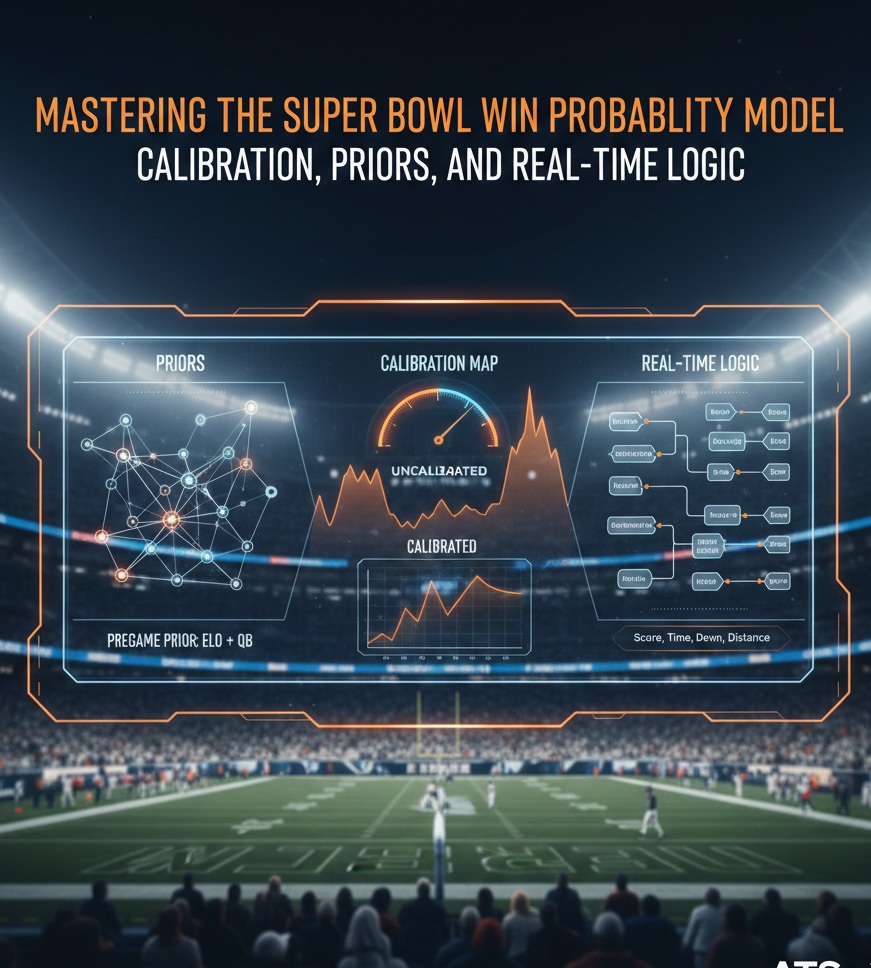
Super Bowls are legendary because they swing on absolute inches and fractions of seconds. If you are watching a game and want to know exactly where you stand, you need a live win probability model that evolves from the opening kickoff until the confetti falls. I built this model because I wanted to see how we could blend pregame strength with the chaos of play-by-play context. That means looking at the score, the clock, field position, and those precious timeouts, then feeding it all through calibrated AI. When you use a model like this, you should expect clear percentages and honest uncertainty. It is not just about a single number but about a step-by-step method you can replicate and stress test yourself.
If we want to define the in-game target, we have to look at the probability that a team wins the Super Bowl at every single moment. The granularity has to be sharp. We need to update at least once per play, from the pre-snap alignment to the post-play results. We also look at drive starts, clock stoppages, and even the impact of penalties or coaching challenges. The final output is a calibrated probability between zero and one, accompanied by uncertainty bands and a summary of the game state.
Before the game even starts, we have to establish a pregame prior. This reflects the season-long quality of the teams and the status of the quarterbacks. Whether you use Elo ratings or a hierarchical model, this prior is your starting point. As the game moves along, the live updates start to take over. We blend the initial prior with live likelihood features like score differential and down and distance. As time passes, the weight of the pregame prior shrinks toward zero, and the reality on the field dominates the model.
Good models need to be reliable. If the model says a team has a sixty percent chance to win a hundred different times, the favorite should actually win close to sixty of those times. We also want discrimination, which is just a fancy way of saying the model should get "sharp" when a game is being decided but pull back toward fifty-fifty during high-variance moments. We track things like the Brier score and log loss to make sure we aren't being overconfident. There is no reason to reinvent the wheel when communities like nflverse already provide incredible play-by-play data and metrics like Expected Points Added.
Building the Pipeline: Data and Features
To get this right, you need a data pipeline you can actually trust. I lean heavily on nflfastR and the broader nflverse community for play-by-play information. For pregame priors, you can find inspiration in the classic Elo methodologies. Once the data is flowing, we have to look at the core in-game features that move the needle. The game clock and the score differential are the most obvious, but you also have to consider down, distance, and field position. Timeouts remaining are huge, especially in the fourth quarter when their value grows exponentially.
We also have to look at possession and drive state. Is this the start of a drive or a two-minute drill? Are there high turnover risks based on the specific quarterback or running back involved? Even the penalty environment matters, though Super Bowl officiating crews can be a bit more conservative than regular season crews. Beyond the live game, we look at team ratings and unit-level splits. Offense and defense efficiency in the pass and run game are essential. While travel and rest are usually equal in the Super Bowl because of the extra week off, we still look at things like the stadium surface and whether the roof is open or closed.
Engineering these features requires a bit of math. For time features, we compute the seconds remaining in each half and create splines to handle the pressure of the two-minute warning. For score features, we look at the lead and the sign of that lead to keep things symmetrical. We also use one-hot encoding for the downs and bin the field position every five yards. We even look at the "timeouts value basis," which is basically an estimate of how much clock you can salvage if you have a timeout in your pocket.
We also have to think about win state through Markov chains. This involves looking at a state consisting of the down, distance, yard line, and time. We estimate the transitions between these states based on years of play-by-play data. This helps us handle transitions for scores, turnovers, and the end of the game. It is especially important for overtime, where the rules have changed recently to give both teams a chance to possess the ball unless there is a touchdown on the opening drive.
The Logic Behind the Live Modeling Framework
The pregame prior model is where it all begins. I usually start with an Elo-style rating initialized on multi-season rolling form. If a quarterback gets hurt or a backup starts, the prior has to shift immediately. Early in the first quarter, the prior might carry eighty percent of the weight, but by the third quarter, it is barely a factor. The live likelihood model is where the real action is. This is usually a logistic regression that predicts a win based on the current state.
We look for key interactions, like how the lead interacts with the time remaining or how the possession interacts with being in the red zone. We fit this model on massive datasets of regular season and playoff games, but we always validate it on past Super Bowls to see if the neutral-site vibe changes anything. We also use gradient boosting like XGBoost because it is great at handling non-linear relationships. We can even add monotonic constraints to make sure the model stays logical. For instance, if a team's lead increases while the time decreases, their win probability should never go down.
Neural nets are another option, though I tend to keep them compact for the sake of speed and interpretability. We can use Bayesian filtering to treat every play as new evidence. This creates a smoother curve over time and helps keep the model stable after a weird outlier play. A drive-level Markov chain is also great for precomputing the value of a drive based on the yard line and timeouts. This is where you find those situational boosts that can change the odds by several percentage points in the final minutes.
The two-minute warning and fourth-down decisions are where games are truly won or lost. We model two-minute pressure by looking at higher pass rates and quicker clock stops. For fourth downs, we include the expected value of going for it, punting, or kicking a field goal. We calibrate field goal success based on distance and whether the game is being played in a dome. Everything is processed through a real-time computation graph that handles the state, runs the inference, and applies the calibration map in under fifty milliseconds.
Validation and the Search for Truth
You cannot just build a model and hope for the best. You need a strict backtesting protocol. We use multiple seasons of data and hold out recent Super Bowls for the final test. We simulate live evaluations to make sure the model isn't using any information it wouldn't have had at that specific moment in time. We also tag special plays like fake punts or big injuries to see if the model struggled in those specific clusters.
Cross-validation is the next step. We train on almost every season and then test on the one we left out. This keeps us from "leaking" information from one team's specific season into our general model. We also have to be very careful that we aren't using look-ahead data, like knowing an injury happened before the model would have actually known. Calibration is how we turn raw model outputs into real-world probabilities. Methods like isotonic regression or Platt scaling are perfect for this.
We use diagnostic plots to see how we are doing. A calibration plot bins our predictions and compares them to actual win rates. If we are consistently overconfident, the reliability bins will show us exactly where the drift is happening. We also run thousands of Monte Carlo simulations to extract uncertainty bands. This gives us a fifth and ninety-fifth percentile range for the win probability, which we show as a shaded ribbon on our charts. If the model isn't beating a simple "lead and time" baseline, then it isn't ready for primetime.
Real-Time Workflow and Tooling Strategies
Everything has to be reproducible. We version our data and our code so we can always look back at why a specific prediction was made. We use stateless prediction services in the cloud to keep latency low. If the main model ever goes down, we have a heuristic fallback ready to take over. We also put a lot of work into the presentation. A smooth win probability curve with annotations for big plays helps tell the story of the game.
When a play results in a win probability shift of more than ten percentage points, we auto-label it. This helps people understand the "why" behind the numbers. We also have to be honest about the limitations. Trick plays and mid-game injuries to star players are always going to be hard for an AI to handle instantly. We apply a conservative uncertainty widening in those moments. Our deployment checklist is long, covering everything from data prep and training to live monitoring and anomaly alerts.
For anyone looking to start, there are plenty of templates you can reuse. A simple logistic regression pipeline with splines is a great baseline. You can also find Elo calculators that are already seeded with historical data. The goal is to build a workflow that allows for constant iteration. After every game, we do a postmortem to see what moved the needle and where we fell short.
The ATSwins Implementation Approach
At ATSwins , the focus is always on transparent and calibrated probabilities. We want bettors to understand the shifts without being distracted by noise. Our pregame models are designed to find edges in the moneyline and spread, while the live win probability model provides the context for hedging or finding middle opportunities. We also integrate these team-level probabilities with player props to see how game script might change things, like a team passing more because they are trailing late.
For practical betting, win probability is a game changer for hedging. If your pregame position is losing value, you can use the live model to price out a hedge. It also helps with live totals. If the Markov chain shows a slower pace than expected, the total might be inflated. ATSwins is an AI powered sports prediction platform offering data driven picks, player props, betting splits, and profit tracking across NFL, NBA, MLB, NHL, and NCAA. Free and paid plans give bettors insights and guides to make smarter, more informed decisions.
A Step-by-Step Walkthrough for Implementation
If you want to do this yourself, step one is building a data ingestion and state builder. Use nflfastR to get the raw play-by-play and normalize it so you know exactly who has the ball and how much time is left. Step two is constructing your prior. Build that Elo rating and adjust for the quarterbacks. Step three is engineering those features. Get your splines for the clock and your indicators for two-point tries ready.
Step four is where you build the baseline model and the calibration map. Step five is moving into advanced learners like XGBoost where you can enforce those monotonic constraints. Step six is the Bayesian smoother to make sure the curve doesn't look like a jagged mess. Step seven is handling the edge cases like overtime rules and the choice between a PAT and a two-point conversion. Step eight is the backtesting phase where you find your error clusters. Finally, step nine is serving the model in a container and monitoring it for drift.
Managing Analyst Workflows at ATSwins
Our live dashboard is the heart of the operation. It has the curve, the uncertainty bands, and the play-by-play list. But we also have a human analyst loop. Before the game, an analyst checks the priors and the stadium context. During the game, they watch for coaching outliers. If a coach is being way more aggressive than the model expects, the analyst can tag that. After the game, the residuals are reviewed. If a specific type of play caused an error, we patch it for the next cycle.
We make sure to communicate the limitations to the people using our tools. The model doesn't know the play call before it happens. It is inferring from history. Replay reversals can cause brief wobbles in the data. And injuries to elite players cause a shock to the system. We respond to these by widening the uncertainty first, then letting the data stabilize the new reality.
Reusable Templates for Developers
I like to have a checklist for everything. Before kickoff, I make sure the Elo adjustments are loaded and the stadium weather is confirmed. During the game, the update sequence has to be flawless. Parse the event, update the state, compute the probability, blend it, calibrate it, and log it. After the game, the evaluation pack helps us see the Brier score by quarter and the top ten WPA plays. This structured approach keeps us from making the same mistake twice.
The Neutral-Site Factor in Championship Games
The Super Bowl is unique because it is played at a neutral site. This means we have to strip away the standard home-field edge. But we also have to look at the surface. Kicking is usually more reliable indoors or under a closed roof. This shifts the expected field goal curve and can actually make coaches more aggressive near the forty-yard line.
The pace of the game is also different. The halftime show is longer, and there are more commercial timeouts. This gives players more rest, which means we have to dampen our fatigue penalties. Officiating is another variable. While we don't overfit to a single crew, we generally expect the flags to stay in the pockets a bit more during the biggest game of the year.
Quality Governance and Performance Bars
We set high targets for every Super Bowl cycle. We aim for a five to ten percent improvement in our Brier score compared to the previous year. We want our calibration to stay within two percentage points of the truth in every single probability bin. Governance is also key. Every update to our priors or calibration is documented. We never do "hot fixes" in the middle of a game unless something is fundamentally broken, because we want an audit log of exactly how the model performed.
Recommended Reading and Further Study
If you want to dive deeper, you have to check out the nflverse documentation. It is the gold standard for football data. The Pro-Football-Reference glossary is also essential for keeping your terminology straight. For the math behind ratings, the FiveThirtyEight Elo methodology is a classic for a reason. And if you want to see how the best in the world handle data science, the Kaggle NFL Big Data Bowl pages are full of brilliant strategies.
Solving Common Technical Hurdles
One common issue is rapid oscillation after penalties. The fix is usually to buffer the input feed and collapse the penalty and the result into one state change. If your log loss spikes during an injury, you need a "switch" that widens uncertainty immediately. Sometimes fourth-down edges look too aggressive in a dome, which means you need to refit your success curves for stadium types. If your calibration drifts, it is usually because you are training on too small of a window.
Another weird bug is when win probability dips during a kneel-down. You have to add a specific kneel-down state to your Markov chain to make sure the model understands the game is effectively over. If the live totals and win probability disagree, check your timeout counts. A single missing timeout in the data can throw off the entire pace-driven logic of the model.
Future-Proofing for Upcoming Seasons
In the future, we are looking at player-level integration. Imagine tying a quarterback's pressure propensity directly to the live win odds. We are also looking at coach tendency embeddings to learn who is likely to go for it on fourth-and-short. Ensemble strategies that average different types of models can also help prevent drift. We are even looking at human-in-the-loop enhancements where an analyst can flag a backup kicker or a sudden weather front.
The Final Countdown: A Pre-Game Checklist
Before Sunday arrives, you need to verify your data feed health. Your priors must be locked and your versioning must be final. Confirm the stadium roof status and make sure your calibration is validated on the current season's playoffs. Run monotonicity tests on synthetic cases to make sure the logic is sound. Once the anomaly alerts are configured and your fallback plans are ready, you are good to go.
The Big Finish
Building these models is about being honest with the data. You need smart priors, rich context, and a commitment to constant validation. Engineer your clock and score features carefully, backtest until you are tired of it, and always show your work. ATSwins is an AI powered sports prediction platform offering data driven picks, player props, betting splits, and profit tracking across NFL, NBA, MLB, NHL, and NCAA. Free and paid plans give bettors insights and guides to make smarter, more informed decisions. By following these steps, you can create a tool that turns the chaos of the Super Bowl into actionable insight.
Frequently Asked Questions
What is a Super Bowl win probability model in simple terms?
A Super Bowl win probability model is an estimation tool that works in real time to show the chance each team has to win. It takes into account the score, the time remaining, where the ball is on the field, the down and distance, and how many timeouts each team has left. It also looks at how strong the teams were before the game even started. You can think of it as a live percentage that updates after every single snap to give you a clearer picture of who is actually in control.
Which inputs matter most in a Super Bowl win probability model?
The two most important things are always the score differential and the time remaining. After that, you have to look at the down and distance, field position, and timeouts. The game state is also vital, meaning whether we are in the two-minute warning or overtime. Beyond the live game, having good pregame context about team quality and quarterback health helps the model stay grounded when the game is still early.
Why do win odds in a Super Bowl swing so fast?
Odds swing quickly because a few plays can drastically change how many points are expected to be scored in the rest of the game. Things like going for it on fourth down, turnovers in the red zone, or big special teams returns change the chain of expected outcomes. Plays late in the game are naturally worth more because there is less time for the other team to recover. Penalties and replay reversals also play a huge role in shifting the momentum and the probability.
Can I build a simple Super Bowl win probability model myself?
You definitely can. You should start by getting play-by-play data from nflfastR. You can build features for the score, the clock, and the situation on the field. Then, you can use a library like scikit-learn in Python to fit a logistic regression. Adding a pregame prior like an Elo rating will make it much more accurate. It won't be as complex as the pro models right away, but it will help you understand exactly what drives the win odds during a game.
How does ATSwins.ai use a Super Bowl win probability model for bettors?
ATSwins is an AI powered sports prediction platform offering data driven picks, player props, betting splits, and profit tracking across NFL, NBA, MLB, NHL, and NCAA. We take pregame strength and combine it with live play-by-play data to keep the odds sharp and reliable. Our goal is to give users actionable edges and context notes so they can make informed decisions rather than just looking at a random number. With free and paid plans, you can track your results and see what works best for your strategy.
Related Posts
AI For Sports Prediction - Bet Smarter and Win More
AI Football Betting Tools - How They Make Winning Easier
Bet Like a Pro in 2025 with Sports AI Prediction Tools
Sources
The Game Changer: How AI Is Transforming The World Of Sports Gambling
AI and the Bookie: How Artificial Intelligence is Helping Transform Sports Betting
How to Use AI for Sports Betting
Keywords:
MLB AI predictions atswins
ai mlb predictions atswins
NBA AI predictions atswins
basketball ai prediction atswins
NFL ai prediction atswins
ai betting analysis