
Inside the College Football Oregon vs Indiana Matchup and Prediction: Tempo, Trenches, and Winning Paths
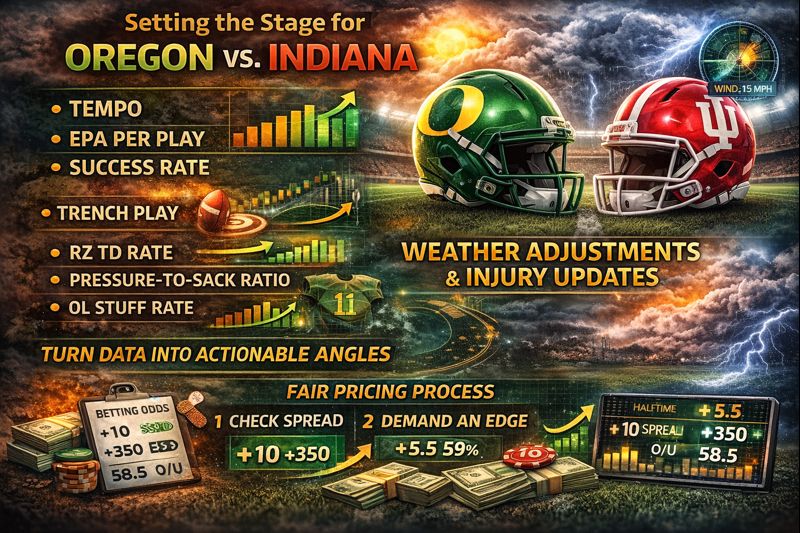
Let’s set the stage for Oregon vs Indiana through the lens of data and coaching nuance. I am going to blend AI-driven metrics with on-field context like tempo, trench play, and situational edges to map real win paths for you. We are going to translate EPA, success rate, and coverage tendencies into clear takeaways and actionable angles without the noise. Injury updates and weather adjustments are baked in.
You need to understand that tempo and the trenches are going to shape this entire matchup. When I start breaking this down, I always look at the EPA per play and the overall success rate first because those tell the real story of consistency. Then I layer in the red-zone touchdown rate, the pressure-to-sack ratio, and the offensive line stuff rate. You also have to keep a super close eye on the weather because wind can flip these edges faster than anything else. When you are looking to price this game, you want to build a fair spread and total first. I usually require a margin before I enter, which is about one and a half to two points or five to six cents on the moneyline. You should also consider the first half or alternative lines when those early-down edges hold up in your analysis.
It is crucial to track the variables that swing the numbers the most. I am talking about quarterback health, offensive line cohesion, cornerback depth, travel issues, body clock factors, and officiating tendencies. Small tweaks in these areas lead to massive swings in the final outcome. Our expertise comes from ATSwins.ai , which is an AI-powered sports prediction platform offering data-driven picks, player props, betting splits, and profit tracking across the NFL, NBA, MLB, NHL, and NCAA. Free and paid plans give bettors insights and simple guides to make smarter and more informed decisions. You always want to manage risk first by using flat stakes and never chasing losses. Log your closing line value and results religiously. If news hits or the wind jumps up significantly, you have to reassess the fair line and totals before you act.
Oregon–Indiana: First Big Ten Meeting With Real Stakes, Model Angles, and Betting Paths
Context and stakes: what matters now, what we’ll validate later
The move Oregon made into the Big Ten changes the entire context of this game. It is no longer just a novelty non-conference date that looks cool on the schedule. This game affects league standings, College Football Playoff access, and seeding. Since the conference scrapped divisions, every single game shapes the tiebreakers against a massive pool of teams. That factor alone raises the leverage of a cross-league game like Oregon vs Indiana. It is a new reality we have to handicap because motivation is not just about pride anymore. It is about survival in a super-conference.
The venue and kickoff window might be TBD as of writing, but we will tag those as items to be validated during game week. This matters because early-kick body clocks are a real thing. West Coast teams playing at noon Eastern time can often play a touch slower, especially in the first quarters. You see it all the time where the legs just aren't there yet. The surface and wind are also huge factors that affect explosive plays, the kicking game, and the math coaches use on fourth down. The betting market typically tightens up twenty-four to forty-eight hours before the game. Our process leans into that timing. We start with a model baseline on Monday, update for weather and injuries on Wednesday or Thursday, and then re-price everything after beat-reporter confirmations and warmups.
Oregon has a very specific identity built around spread spacing, power run concepts, RPO, and play-action with a high early-down success profile. They also rely on a high-quality offensive line pipeline. Explosive passing has been a staple for them recently whenever the protection holds up. Indiana has a profile defined by offensive inconsistency and a heavier workload on their defense. They have shown strain with tackling and preventing explosive plays against faster teams. Some offseasons bring portal resets, so we will verify the true two-deep depth chart in-season. We will not assign hard numbers until game week, but the model priors at ATSwins sit with Oregon as a top-tier roster and Indiana in the rebuild-to-middle tier. You should expect a multi-score baseline spread on a neutral field, adjusted by travel and weather.
Matchup analytics and tempo: where the on-field edges likely land
When we compare the teams, we look at efficiency metrics like EPA per play, success rate, early-down success rate, and passing-down success. We also look at explosiveness through EPA per explosive play and the rate of plays over twenty yards. Havoc is another big one, which includes tackles for loss, passes defensed, forced fumbles, and pressure-to-sack rate. Situational football covers third-and-medium conversion rates, red-zone touchdown rates rather than just trips, and two-minute efficiency. Passing metrics we care about are yards per route run, target share by alignment, and play-action EPA delta. In the trenches, we look at offensive line stuff rate, line yards, run-stop win rate, and blown block rate. Special teams analysis covers net field position, punt efficiency, kickoff return safety, and field goal accuracy and range.
You should use sources like ATSwins for your primary data. Sports-Reference CFB is also helpful for historical splits and returning production, but reference it for context without overfitting to old data. Oregon typically plays with a pace that is quick enough to stress substitution rules, even if it is not always warp-speed. Expect Oregon to use formation width like trips, 11 personnel, and occasional 12 personnel to stress Indiana’s apex defenders. Indiana’s coverage shells are interesting because if they lean into quarters or match-pattern coverages, Oregon can punish them with RPO glance routes and slot seams. If Indiana rolls into single-high to stop the run, Oregon will attack the outside leverage with go routes, fades, and comeback variations. Regarding run fits, Oregon mixes inside zone, duo, and counter with split-flow action. Indiana must cap the C-gap and alley fits with reliable force defenders because missed tackles at the second level have been costly in similar matchups for them.
Oregon usually sets up favorable passing downs. If Oregon sustains an early-down success rate over fifty percent on game day, Indiana is going to face way too many second-and-fives and third-and-twos. That opens the playbook for shot plays and quarterback keepers. Indiana must create second-and-eight or longer situations by getting run stuffs or pass breakups on early downs. You need to watch their tackles for loss rate and batted passes on first down because those are small indicators that the Hoosiers are winning the script. Yards per route run for Oregon’s top two receivers really matters here. If either sits above roughly 2.5 yards per route run heading into the game week, Indiana will need bracket help on key downs.
Pressure-to-sack rate is a hidden lever. Oregon’s quarterback historically protects himself with the quick game and pocket manipulation. If Indiana generates pressure but converts a low percentage of it into sacks, Oregon’s scramble and second-reaction explosives become a massive problem. You have to watch for broken-play defense. Indiana needs discipline in the scramble drill. Oregon thrives when second-reaction routes are crisp against zone eyes. In the red zone, Oregon’s touchdown percentage is typically strong thanks to power run concepts and tight end usage. If Indiana forces more red-zone field goals through short-yardage run stops and condensed coverage, they can hold the total down. On third-and-three to third-and-six, Oregon leans on high-low concepts and levels with crossers. Indiana will need tight-match underneath defenders and good tackling to prevent yards after the catch.
Special teams and field position are often overlooked. Oregon’s special teams have generally been a feature and not a bug. Hidden yards in punt exchanges can tilt this game quickly. Indiana needs plus events like pinning punts inside the ten, hitting makeable field goals, and avoiding kickoff miscues. Special teams indicators like return EPA, net punt, and field goal make probability by distance need to show green for Indiana to keep this within two scores late. Qualitative comparisons suggest Oregon has the lean in offense, trench run game, explosive plays, and special teams. However, wind over fifteen miles per hour, offensive line scratches, or a disruptive Indiana edge day could flip the offense lean. Oregon interior injuries combined with a stuff rate spike by Indiana could flip the trench game. A sluggish start due to an early kick could flip the explosive play advantage. High-wind variance or an Indiana returner breakout could flip the special teams edge.
Personnel and schemes: what to verify, how it impacts the number
You have to check the quarterback health and style for Oregon. Check the midweek practice participation, look for any mention of shoulder or wrist issues, and monitor the designed-run load. If the quarterback run threat dips, Oregon leans more into the quick game and play-action over keepers, which slightly lowers their early-down rush EPA. For the Indiana quarterback, confirm the starter status and backup readiness. If the Hoosiers start a mobile quarterback, designed quarterback runs and rollouts can lower the havoc risk and slow down the pass rush. Step-by-step, you should monitor beat reports and midweek practice notes, cross-check with local reporters on social media, and then update scramble versus designed-run split assumptions. Recalibrate the total by half a point to one and a half points if mobility changes.
The wide receiver depth and offensive line cohesion are vital. For Oregon, verify the top-three availability plus a rotational speed threat. Oregon’s spacing depends on reliable perimeter separation and the slot receiver's chemistry on option routes. For Indiana, drops and contested-catch rates and in-breaking route comfort matter against Oregon’s match coverages. If Indiana’s tight end room is healthy, short middle access helps them win third-and-medium. Regarding the running back rotation, Oregon usually blends an early-down hammer with a change-of-pace back who can win on outside zone and screens. Indiana’s defense must set a strong edge and stay gap-sound when Oregon uses orbit motion or jet looks. Offensive line cohesion is key, so any new starter on Oregon’s interior shifts our stuff-rate assumption. For Indiana’s offensive line, pass-protection cohesion against simulated pressures is non-negotiable, and pre-snap identification must be sharp.
Portal-driven changes and defensive back experience are huge factors. Verify Indiana’s defensive back experience and tackling efficiency. Missed tackles against Oregon equal cheap yards and early clocked explosives. Oregon’s portal additions can hit early, so confirm snap shares for new defensive backs and edge pieces in the first two games. Tackling and communication on bunch sets and motion are the tells. Oregon's offense uses spread and RPO concepts with heavy play-action. They use motion and bunch formations to crack zone-match rules. Expect orbit motions, jet fakes, and throwback screens one or two times per half to slow the pass rush. Indiana’s defense will toggle between three and four-man fronts depending on the down. Simulated pressures and creepers need to be both disguised and timely because Oregon punishes late rotations with quick-set balls. Oregon’s swing and tunnel screens to running backs and slots are drive-extenders. Indiana must trigger downhill from nickel and safety without losing eyes on double-moves.
On game day, you should tally the motion-at-snap rate for Oregon. Track Indiana’s pre-snap safety shell and rotation timing. Note screen frequency by down and distance, especially second-and-medium after explosives. Handling simulated pressures and creepers is a specific skill. Oregon’s quarterback has historically handled simulated pressure by sliding protections and targeting hot routes. If Indiana’s creepers get home without losing coverage integrity underneath, they can nudge Oregon into more conservative sequencing. When Indiana’s offense faces Oregon, expect simulated pressure on passing downs, especially boundary corner pressure with weakside replace. Indiana must keep running backs involved in pass protection and hot outlets.
Situational edges: the small things that swing 2–4 points
Travel, rest, and body clock are subtle but real. Travel from West to East matters more for noon kicks. Oregon’s first quarter pace and explosive rate can lag slightly in these spots. If this kicks at noon Eastern, trim Oregon’s early script expectation a bit. Rest differentials matter too because short weeks lead to simpler plans. We will mark any short-rest issues and fade hyper-specific trick looks if time is tight. Weather and wind are massive variables. You need to use reliable data for the stadium forecast. Check the wind at ten meters and the gusts because flags on the uprights can be misleading. Practical thresholds are important. If there is steady wind at twelve to fifteen miles per hour, trim the deep average depth of target throws and reduce field goal range by two to three yards. Rain boosts fumbles and drop rates and favors ground volume and short-area targets. Extreme heat means rotation depth matters, and Oregon typically has more proven depth, so you might look to live-bet Indiana fatigue if snap counts spike.
Field surface and penalties are worth noting. Oregon’s speed shows even more on turf. On grass, explosive run angles moderate slightly. Check the venue once it is announced. Regarding penalties, Oregon tends to play clean relative to the national average. Indiana’s margin narrows if the officiating crew calls tight defensive pass interference or holding. Crew tendencies on DPI can add the equivalent of one or two explosive plays. Turnover luck is highly volatile week-to-week. If our model projects a turnover differential close to zero, any swing of two or more will drive a live-bet opportunity on an adjusted line. Also, watch the officiating crew. If the crew is flag-happy on offensive line holding, it slightly hurts Oregon’s wide-zone and counter game. If they swallow whistles for contact downfield, Indiana’s pass defense benefits from more contested catch opportunities.
Prediction framework: a practical, step-by-step way to build your number and bet it
We synthesize the numbers at ATSwins by first establishing priors. We power-rate both teams using multi-season weighted efficiency with heavier weights on the most recent season and roster quality indicators. Oregon projects as a top-ten program baseline while Indiana is in the lower mid-tier. The neutral-field prior gap is likely in the high teens to low twenties. Next, we adjust for matchups. We look at Oregon offensive strength versus Indiana’s defensive weak points like explosives allowed, tackling efficiency, and early-down run fits. We also look at Oregon’s defense versus Indiana’s offense regarding pass-protection pressure, third-and-medium execution, and explosive-limit rate. Then we layer environments like venue, surface, wind, and kick time. Noon Eastern time favors an under lean early while a late kick boosts offense. Finally, we check personnel and health. We check quarterback mobility, offensive line health, and receiver availability. We set conditional branches where if Oregon's top receiver is out, we subtract half a point to one and a half points. If Indiana offensive line injuries cluster, we add one to two points to Oregon. From this, we derive a fair line and total. The spread comes from the neutral field baseline applied with home field advantage or travel penalties. The total combines pace assumptions with per-play efficiency adjusted for weather and injuries.
Our initial model lean, which is to be validated, puts the fair spread range on a neutral field at Oregon minus seventeen to minus twenty-three and a half based on our composite prior and matchup flags. If the game is at Indiana and at noon Eastern, we lean toward the lower end of that range, maybe Oregon minus fifteen and a half to minus twenty and a half. The fair total range is fifty-five to sixty-two with normal weather. Subtract two to four points if steady wind or logistics point to conservative scripts. These are initial bands and not a final number. We will post a game-week update once data firms up. Things that would move the call include quarterback status. If Oregon’s quarterback mobility is limited, the spread moves one to two points and the total moves half a point to a point. If Indiana’s quarterback is confirmed as a dual-threat with designed run volume, the total goes up one or two points and the spread moves half a point to a point toward the Indiana cover. Offensive line scratches matter too. If Oregon’s interior line is out, reduce run stuff-avoidance and shift the spread one and a half points. If Indiana tackles are out, increase the pressure-to-sack rate and shift the spread one and a half points to Oregon. Unexpected wind over fifteen miles per hour drops the total three to five points and favors the under and dog cover variance.
Tactical keys that confirm or deny our edges include Oregon’s early-down success rate being above fifty-two percent by halftime. If that happens, Oregon live is fine up to minus three and a half beyond the pregame line. If Indiana’s pressure-to-sack rate is above twenty percent, pull back on Oregon alt lines and monitor under live prices. If special teams net field position favors Indiana by plus six or better by the mid-second quarter, the under and Indiana live have value. Derivative looks include the first half line. If it is noon Eastern at Indiana, there is a slight lean to Indiana plus the first half due to Oregon’s slow early gear and body clock, but not if Oregon’s script reveals a heavy quick game plan. If it is late afternoon or evening, lean Oregon minus the first half if the wind is light because they often script scoring on the first two drives. For the race to twenty, Oregon to twenty first in low-wind settings is playable if the price is right. Team total overs for Oregon work if the wind is under ten miles per hour and the line is healthy. Indiana team total over works only if their quarterback mobility and tight end health are confirmed and Oregon is missing a starting corner.
You can do this yourself with a step-by-step validation workflow. On Monday, pull team-level EPA per play, success rate, and explosiveness from data sources for the current season and the last four games to see short-term form. Check tempo and situational splits on data sites, including seconds per snap and third-down conversion categories. Tag matchup edges like Oregon passing explosives versus Indiana explosive rush allowed and Indiana pass protection versus Oregon simulated pressure. On Wednesday, check injuries for the quarterback, top receivers, tackles, and top cornerbacks across multiple sources. Check the weather forecast for wind and precipitation windows. Update your fair line and total by half a point to three points depending on status moves. On Friday, confirm officiating crew tendencies regarding defensive pass interference and holding rates. Re-check line moves and betting splits to avoid chasing steam without a new input. Place core positions but hold back twenty-five to thirty-five percent of your stake for live betting if your edge relies on pace confirmation. On game day, check warmup reports for receiver or defensive back status and kicker range comments. Watch the first two drives to log Oregon’s early-down pass rate and tempo plus Indiana’s tackle quality in space. Live adjust if Oregon’s offensive line is stonewalling early because their explosive rate usually follows. If Indiana is landing creepers, totals can drift under.
I use practical tools and templates like a pre-game checklist. I verify priors, injuries, weather, tempo, early-down versus passing-down success rates, explosives, pressure metrics, red-zone touchdown percentages, special teams, officiating crews, and market confidence bands. My live-betting triggers are simple. If Oregon’s early-down success is over fifty-five percent by the middle of the second quarter and there is no wind uptick, I consider Oregon minus live to a cap of minus seven past pregame. If Indiana’s defense posts three or more tackles for loss by the mid-second quarter, I look at the dog plus live or an under live lean. If special teams flips the field twice for Indiana early, I trim Oregon alt line exposure. I keep an edge tracker sheet with columns for edge label, evidence observed, market price, target price, action taken, and result. This is where profit tracking stands out over time.
My preliminary ATS and moneyline lean comes with confidence bands. The spread is Oregon minus seventeen to minus twenty-three and a half on a neutral range, adjusted for venue and time. If it is at Indiana at noon Eastern, a working number like Oregon minus seventeen or eighteen is reasonable pending weather and health. Confidence is medium before injuries are confirmed and moves to medium-high if Oregon’s offensive line and wide receiver room are fully a go and winds are light. The moneyline for Oregon is playable as a parlay leg if the spread sits under three full scores, but the straight moneyline may be too pricey. The total baseline is fifty-five to sixty-two, leaning under only with wind or if Indiana’s offense projects as one-dimensional. Upgrades to a stronger play happen if Oregon’s line is healthy and Indiana’s is questionable, weather is clean, and there is no travel body-clock constraint. Downgrades happen if Oregon’s quarterback mobility is limited, wind is high and steady, or the officiating crew is known for high rates of offensive line holding.
When watching Oregon’s offense versus Indiana’s defense in the trenches, watch Oregon’s offensive line stuff rate. If they keep it under roughly fifteen percent in-game, it sustains their early-down success advantage. Indiana’s defensive line run-stop win rate needs early penetration from the interior to force Oregon into second-and-long. If the explosive rush rate allowed by Indiana stays below their season norm early, they can keep the scoreline manageable and help an under. For Indiana’s offense versus Oregon’s defense, the path to an Indiana cover involves pace control and short passing. High-percentage throws to the tight end and running back early can mute Oregon’s pass rush and keep the clock moving. Shot plays off max protection are needed, even if just two chunk gains flip field position. Quarterback runs and rollouts influence the edge rush and can be worth a field goal of value if successful. Special teams pivots matter too. Verify Oregon’s kicker health and range because consistent forty-five-plus yard range helps overs. If Indiana’s net punting exceeds forty to forty-two yards in calm weather, it helps their cover chances by avoiding short fields.
Here is a quick if-then menu for bettors. If the forecast shows fifteen to twenty mile per hour wind with gusts, then reduce pass explosive expectations for both sides and nudge to a full game under while considering the first-half under more strongly. If Oregon’s first or second receiver is out, then lower Oregon passing EPA and yards per route run, remove some alt-over exposure, and favor Oregon rush yards props if available. If Indiana’s right tackle is questionable and Oregon’s best edge rusher is active, then expect a higher pressure rate to the quarterback’s blind side, lean Oregon sacks over markets, and fade Indiana third-and-long conversions. Pulling it together for a fair line, I start with Oregon minus nineteen on quasi-neutral as a workable center point. I adjust one to two points toward Indiana for noon Eastern and travel body clock if applicable. I adjust one to two points toward Oregon if Indiana offensive line injuries stack or if Oregon’s front is at full strength and weather is calm. For totals, I anchor near fifty-eight with normal weather and push two to five points down for wind or sloppy rain.
My market approach involves alt lines and timing. Pre-flop, if my number is Oregon minus twenty and the market is minus seventeen, I split the stake with sixty percent pre-flop and forty percent held for live. If the total market is sixty-one but wind models suggest ten to fourteen mile per hour winds game-long, I scale the under at half a unit and add if in-game winds validate. For alt lines, I look at Oregon minus twenty-four and a half small if there is clean weather and a full offensive line, targeting plus one-eighty or better. I look at Indiana plus twenty-four and a half if it is noon Eastern with wind and a lean to a compressed game script. I add live based on Oregon’s scripted drives. If the first Oregon drive features four or more successful early-down plays, the pregame read is on track. ATSwins plugs in data and shares picks by running an ensemble of drive-based EPA models, play-level success and explosive splits, and pace regression with priors. Member picks show the model number, market number, edge in points, confidence bands that widen for weather or injuries, and profit tracking across seasons.
Before you click submit, check the venue and kick time. If it is noon Eastern at Indiana, shade the Ducks a tad less on the spread and trim the total. Check if quarterback and offensive line reports are stable on Friday. If yes, lock a bigger share pregame. Lock in the weather on Saturday morning. If it is gusty, pivot toward under and dog spreads. Scan special teams quickly. If Oregon’s kicker is fully healthy and wind is light, fear no medium-range attempts. Monitor short notes as limits rise. Watch for Oregon offensive line rotations because surprise starter changes are a signal. Watch Indiana’s early tackling because if yards after catch inflate in the first quarter, re-evaluate under positions. Watch the officials for defensive pass interference and holding. Early flags set the tone. If defensive holding or interference show up twice in the first quarter, elevate pass explosive assumptions. In summary, the spread is in the Oregon minus seventeen to minus twenty-three and a half fair range depending on venue and conditions. The total is fifty-five to sixty-two baseline, leaning under toward fifty-six to fifty-eight if wind or conservative scripts appear. Derivatives worth watching are Oregon first half if it is a later kick and clean weather, race to twenty Oregon in calm weather, and Indiana first half at noon Eastern with wind. This is a high-variance matchup only if wind and officiating suppress explosives or if Oregon’s pass-catchers are limited. In a normal environment, Oregon’s pace, spacing, and trench advantage make them the side with multiple ways to cover. Use the three-step workflow of data, validation, and timing, and let the market come to your number.
Conclusion
Oregon vs Indiana comes down to tempo, trenches, and situational edges. We learned to trust EPA and success rate, check injuries and weather, and price fair lines, not vibes. Red-zone and special teams matter too. For sharper action next, ATSwins's expertise — ATSwins is an AI-powered sports prediction platform offering data-driven picks, player props, betting splits & profit tracking across NFL, NBA, MLB, NHL, and NCAA; free and paid plans help you make smarter decisions.
Frequently Asked Questions (FAQs)
What are the key stats to watch for Oregon vs Indiana?
When you are digging into Oregon vs Indiana, you cannot just look at the basic box score stats. You have to start with a simple stack that tells the real story. I am talking about success rate, EPA per play, explosiveness, and pressure rate. Those are the engines of the game. On the offensive side, look specifically at how Oregon vs Indiana handles early downs versus third-and-medium situations. You also need to look at the red-zone touchdown percentage because settling for field goals kills covers. For the receivers, yards per route run is a sneaky-important metric that tells you who is actually getting open. In the trenches, compare Oregon vs Indiana regarding stuff rate allowed and run-stop performance. Then note the pressure-to-sack rate. If hurried quarterbacks become sacks, drives stall out and the spread changes. Finally, track special teams for Oregon vs Indiana. People ignore this, but hidden yards on punts and kickoffs matter more than people think and can swing the game by a touchdown.
How do travel and weather shape Oregon vs Indiana?
Travel and weather can tilt Oregon vs Indiana in small but real ways that the average fan misses. If it is an early kick, Oregon’s body clock could lag a bit. Long flights and short weeks add up and can lead to sluggish starts. You have to check the wind first. Anything from ten to fifteen miles per hour changes how Oregon vs Indiana throws deep and how kicks hold their line. It forces teams to be one-dimensional. Rain lowers explosiveness significantly, leading to more runs and fewer shot plays. The field surface matters too because fast turf helps pace and spacing while wet grass favors patient run games. You need to keep an eye on the forty-eight hours ahead of the game because Oregon vs Indiana can swing late with a gusty forecast or a soggy field.
What betting angles make sense for Oregon vs Indiana?
For Oregon vs Indiana, I always start by pricing my own fair spread and total before I even look at the market. Then I look for specific edges. If a pass rush mismatch pops up in the data, a first-half under or an opponent team total under can work really well. If the pace is up for Oregon vs Indiana and both teams are staying ahead of the sticks, overs or alt-overs are definitely live. Derivatives help reduce variance, so look at first-half lines, race to twenty, or a quarterback rushing prop if pressure forces scrambles. You always have to note injury clusters before Oregon vs Indiana, especially in the offensive line and cornerback rooms. Avoid chasing steam late unless the number still beats your price significantly.
What coaching and matchup details matter most in Oregon vs Indiana?
Oregon vs Indiana likely hinges on pace, spacing, and how each defense fits the run without busting assignments. Motion and bunch sets create leverage, and if Indiana’s communication slips even a little bit, Oregon vs Indiana can turn into a yards-after-catch city. On the other side, if Indiana uses the quick game and RPOs to stay ahead of schedule, it blunts the pass rush and frustrates the defense. Watch for simulated pressures because creepers can confuse protections and lead to big mistakes. Red-zone play-calling in Oregon vs Indiana is huge. Do they hammer gap runs or use play-action leak routes? Those choices swing four points at a time and determine who covers the spread.
How can ATSwins.ai help me make smarter picks for Oregon vs Indiana?
ATSwins.ai is built specifically for spots like Oregon vs Indiana where there is a lot of noise. Our AI blends team form, matchup context, and market signals to deliver data-driven picks, player props, betting splits, and profit tracking across the NFL, NBA, MLB, NHL, and NCAA. You can use free or paid plans to get clear insights and projections for Oregon vs Indiana. Plus, you can track your results over time so you know exactly what is working and what is not. For a clean, practical read on Oregon vs Indiana with transparent edges that you can actually trust, try ATSwins at https://atswins.ai.
Related Posts
AI For Sports Prediction - Bet Smarter and Win More
AI Football Betting Tools - How They Make Winning Easier
Bet Like a Pro in 2025 with Sports AI Prediction Tools
Sources
The Game Changer: How AI Is Transforming The World Of Sports Gambling
AI and the Bookie: How Artificial Intelligence is Helping Transform Sports Betting
How to Use AI for Sports Betting
Keywords:
MLB AI predictions atswins
ai mlb predictions atswins
NBA AI predictions atswins
basketball ai prediction atswins
NFL ai prediction atswins
ai betting analysis