
How AI Predicts MLB Totals: A Data-Driven Guide to Betting Smarter on Runs
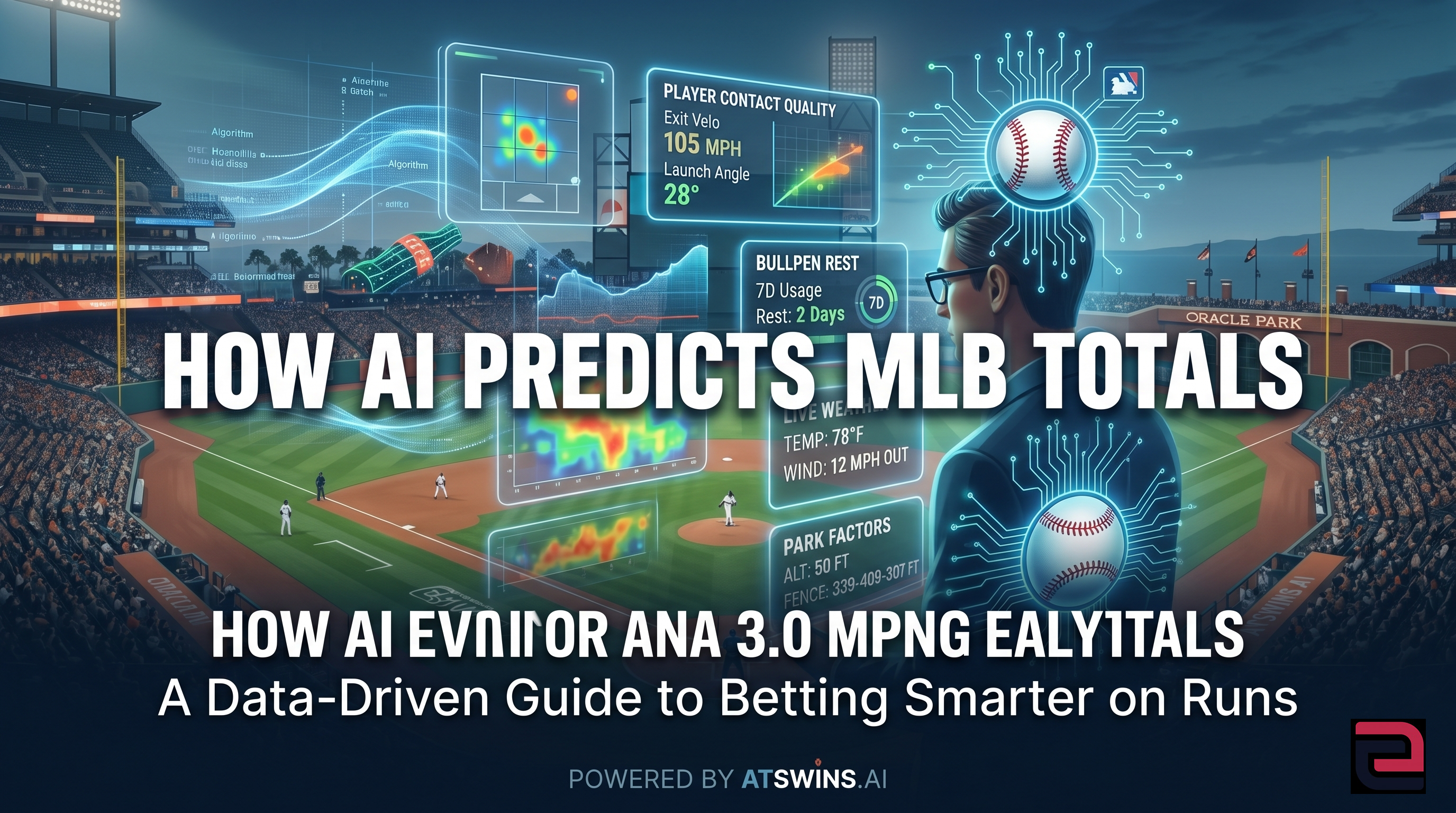
Totals markets reward nuance. As a sports analyst who builds and audits AI models, I will show you how I translate contact quality, weather, and bullpen context into reliable run projections you can trust. We will keep it practical with clean data, transparent features, and calibrated simulations, and I will highlight tools I actually use with clear steps you can repeat. By leveraging how ai predicts baseball scoring , you move beyond gut feelings into the realm of statistical probability.
Data that drives totals predictions
Totals models live or die by the input data. We lean on proven signals that explain run scoring such as pitch-level Statcast contact quality including exit velocity, launch angle, hard-hit rate, and barrel rate. We also prioritize park dimensions and run factors including foul territory, wall height, and altitude. Real-time weather is critical, specifically temperature, wind speed and direction, humidity, and pressure. We also monitor bullpen fatigue and rest days, plus recent usage and leverage. Projected lineups with handedness splits and platoon strengths are vital, as are umpire strike-zone tendencies such as called-strike rates up or down and zone width or height bias. We also factor in travel and schedule density like back-to-back games, cross-country flights, and getaway-day effects. Injury news is essential to understand active or inactive status and nagging issues that cap pitch counts or power. Finally, we look at defensive alignment, catcher framing, and base-out state run expectancy for context. The core idea is that runs come from contact quality and baserunners, and both are mediated by park and weather, while umpires and bullpens shape the tail risk.
Totals are sensitive to stale or misaligned data. A practical cleaning pass involves deduplicating multiple feeds for the same event and picking an authority hierarchy such as the official MLB feed over team PR. We time-align weather to first pitch and the likely in-game window by blending hourly forecasts into innings one through nine. We normalize team names, player IDs, and positions across sources. If late scratches occur, they overwrite projections, and we document the change with a timestamp. We build leakage-safe train and validation splits by splitting by game date so we never mix future information into training. We lock lineups and umpire assignments as of a pregame decision time and use rolling windows, such as the last two seasons with a thirty-day holdout, so the validation set mimics live deployment. To build the daily dataset, we pull starting pitchers, projected pitch counts, and recent velocities. We import Statcast pitch and batted-ball metrics for all relevant players and load park factors, park geometry, and any in-season changes like new wall installations. We ingest weather nowcasts and compute park-adjusted wind vectors. We add catcher framing grades and recent receiving performance. We compute bullpen availability based on three-day and seven-day usage, rest, and left or right mix. We confirm the umpire assignment and, if pending, use a prior for that park and crew pool. We generate platoon-aware projected lineups with pinch-hit probabilities and stamp data with a decision-time version tag to freeze it for modeling.
Modeling runs, not winners
We model team runs directly by building features that have real signal for run scoring. These include expected wOBA on contact for each hitter versus projected pitch types and handedness. We use xERA and Stuff plus style indicators for starters and relievers. We track the groundball, flyball, and line drive mix, pop-up rate, and pull versus opposite-field power. We calculate home runs per fly ball by park and weather-adjusted carry for temperature and wind lift. We measure platoon deltas at the batter and pitcher level. We calculate batter-pitcher run value deltas when samples are meaningful, otherwise shrinking to player priors. We include catcher framing runs saved above average weighted by likely innings. We factor in base-out state run expectancy features tied to team tendencies like aggressiveness on steals or hit-and-run plays. We include defense and positioning adjustments like infield outs above average and outfield arm run values. We look at umpire zone wideness or tightness and high or low bias mapped to starter and lineup swing paths. We also include travel fatigue flags and schedule density indicators. Simple transforms help here, such as park and weather standardization using z-scores by month, interaction terms like platoon multiplied by park or wind multiplied by fly-ball rate, and recency weighting with exponential decay for the last fourteen to thirty days and season-to-date.
Team runs per game are count data with overdispersion, so a layered approach works well. We use Poisson or negative binomial regressions as a baseline for team runs with a log-link to features, as negative binomial handles overdispersion better. We use zero-inflated variants sparingly, perhaps for extreme pitcher matchups or weather. Hierarchical Bayes helps with shrinkage across teams and parks to avoid overfitting small samples by using partial pooling for team offense and bullpen quality and park-level random effects for dimensions and altitude. Tree ensembles like XGBoost or LightGBM-style models capture nonlinearities and interactions like wind and launch angle. We control leakage by pinning features to the pregame time and use monotonic constraints where domain knowledge is clear, such as higher wind out leading to more runs. We ensemble them because a weighted blend of negative binomial GLM, hierarchical Bayes partial pooling, and tree ensembles often outperforms any single model. Weights are set by out-of-time validation and updated with Bayesian model averaging or stacked generalization.
Totals need both sides and bullpen shares, so we predict team A runs and team B runs independently. We split starter versus bullpen innings share with uncertainty bands and adjust for pinch-hitting likelihoods and platoon penalties after the sixth inning. We account for league rules if relevant, such as designated hitter status and park. For the game total, the expected total is the sum of expected runs for both teams. We derive the distribution from Monte Carlo or convolution of team distributions, including correlation via shared weather, park, and umpire effects. On a typical day, we pull weather nowcasts and compute wind vectors between 8:00 and 10:00 a.m. local time to run initial totals. After lineups drop, we recompute platoon adjustments and update stolen base and pinch-hit assumptions. Once the umpire is confirmed, we swap the umpire prior for the actual and rerun plate discipline and called-strike effects. In the final sixty minutes, we perform a quick drift check on model inputs and ensure bullpen statuses are still valid before publishing the total, fair price range, and confidence interval. When you use a high-end ai mlb run projection model , you start to see the hidden correlations between pitching depth and late-inning scoring variance. On ATSwins, we incorporate these steps into our daily models so the total you see reflects live inputs rather than yesterday’s assumptions.
Simulation, calibration, and evaluation
To get a robust distribution rather than just a mean, we use Monte Carlo at the plate-appearance level. We start with team-level expected plate appearances per inning and initialize with starter versus lineup matchups. For each simulated plate appearance, we draw an outcome based on expected wOBA on contact, strikeout and walk rates, and contact-type probabilities adjusted by park and weather. We use park-specific home run per fly ball and gap dimensions for doubles and triples, modulated by wind and outdoor temperature. We update the base-out state using run expectancy tables. We transition starters to bullpens by pitch count or times-through-the-order penalties and swap in pinch-hitters against unfavorable relievers based on historical manager tendencies. We sum runs across nine innings and extras with league-average reliever adjustments and repeat this twenty thousand plus times to get a stable total-run distribution. We layer in umpire priors because more called strikes lead to fewer walks and lower baserunners, catcher framing that nudges strike probability on edges, and weather uncertainty by sampling from forecast intervals.
Raw model scores need calibration so probabilities match observed frequencies. We use isotonic regression for nonparametric monotonic mapping from model output to calibrated probabilities, which is good when you have enough data. We use Platt scaling for logistic calibration for thresholded outcomes, which is quicker when samples are small. We use quantile calibration to align predicted percentiles with observed distributions via isotonic on quantiles. We calibrate over and under probabilities at key market anchors like 7.5, 8.0, 8.5, and 9.0. We also calibrate team totals and alternate totals and the correlation between teams due to shared conditions. Diagnostics help us catch trouble early, such as residual checks by bins for parks, umpire tendencies, and weather. We perform backtests with rolling windows by training on the last two seasons and validating on the next two weeks while rolling forward daily. We guard against lookahead by ensuring there are no postgame or end-of-day adjustments in training data and locking lineups as of an exact timestamp. If no lineup is available, we mark it as projected and model the uncertainty.
We optimize for prediction quality that matches the betting decision. We track the Continuous Ranked Probability Score, which measures the accuracy of the full predicted distribution of total runs. We track Brier scores for over totals like over 7.5, which is good for thresholded market decisions. We look at log loss for binary over or under at listed totals. We analyze calibration curves by looking at predicted probability versus observed frequency. We also look at profitability after vig by simulating bets at negative 110 and measuring return on investment and drawdown with Kelly-fraction staking. We segment by total bands to see where the edge persists.
Workflow, tools, and automation
Our daily pipeline does not overtrain. We ingest overnight and morning data and store versioned snapshots. Feature generation runs on a directed acyclic graph scheduler with clear dependencies where weather is calculated last. We train only when data drift exceeds thresholds, such as when population stability index flags key features or KL divergence on predicted totals versus last week occurs. Otherwise, we score daily with the current model and update calibration only. For tooling, we use scikit-learn for preprocessing and calibration and gradient boosting libraries for ensembles. Our data processing relies on a SQL warehouse plus a lightweight feature store keyed by game ID and decision time. We maintain a validation harness that auto-reports metrics.
Weather nowcasts refresh hourly, and we only refit if wind or temperature move past impact thresholds, such as a five-mile-per-hour wind swing. We perform sanity checks by flagging totals beyond park or weather historical ninety-ninth percentile. We ensure bullpen usage constraints are logical, such as no reliever working three straight days unless it is a true necessity. We compare model versus market deltas and investigate outliers rather than auto-chasing. We keep a human in the loop to verify lineup scratches and emergency catcher duties, confirm umpiring crew changes, and annotate injuries that cap pitch counts. Our outputs respect uncertainty by providing a point estimate for the full-game total along with fifty percent and eighty percent intervals. We provide an over or under pricing ladder for 7.5, 8.0, 8.5, and 9.0 with fair prices and provide notations of key drivers. On ATSwins, these feed into picks, player props, betting splits, and profit tracking so you can see how model calls perform over time on your dashboard.
Limits, edge cases, and transparency
Spring volatility is real, so we use stronger priors for hitters and pitchers and shrink to multi-year talent levels. We rely more on physical metrics like velocity and spin than outcomes, and park factors start at historical baselines and update cautiously. We track changing park and ball environments. When teams alter dimensions or humidor settings, we reset park run factors and run a change-point test to detect regime shifts mid-season. We track league-wide home run per fly ball and drag coefficients via observed carry versus launch parameters, adding a league-level random effect and recalibrating home run distance expectations. For bullpen chains, we model innings distributions with uncertainty and simulate reliever trees by handedness. If a high-leverage arm is down, we widen the tail to account for more big-inning risk. For late umpire assignments, we maintain a park and league prior and swap as soon as the crew posts while logging the delta. We never backfill historical models with future umpire info and always lock decision-time. We ensure explainability by using SHAP values to rank which features pushed the total up or down and partial dependence to show how wind or temperature shifts totals while holding other factors steady. We log the source, timestamp, and version for each variable to maintain data provenance and keep an audit trail linking the published projection to the exact data snapshot. We communicate movement by attaching a note if our total jumps significantly, such as due to a lineup change or weather shift.
How to use ATSwins totals projections in practice
To use these projections, start with the market by noting the opener and current total and recording the price on each side. Pull our projection to grab the point estimate, intervals, and fair prices on various totals. Read the key drivers to decide if you agree with the assumptions. If our fair price on an over is significantly better than the book, that is a positive expected value. If the prices are within a few cents, pass, as edges tighten quickly. Size your bet responsibly using a fractional Kelly or flat staking. Favor books with low hold on totals to improve your return on investment. Time the market because weather moves can come late, and if you are on an over with rising temperatures and wind blowing out, early is often better. If betting an under in a public matchup, the number can tick up near first pitch. Re-check lineups and umpires because a late lineup swap can flip an edge. Use ATSwins profit tracking to see if your totals strategy is adding value week by week. Segment by park, weather bins, and your bet timing to find where your edge is real. You can use ATSwins tools to stay organized by viewing today’s projections, pick confidence, and movement on the MLB games page. Monitor market pressure through betting splits and correlate run environment with hitter and pitcher props. Tag your wagers by totals and specific buckets, and review return on investment after fifty plus bets per segment. Keep a pregame checklist and postgame, mark whether the edge came from the expected drivers. Incorporating high-quality ai baseball over under predictions into your daily process helps filter the noise of the public betting market.
Resources and templates
Our core data sources include Baseball Savant for Statcast data, FanGraphs for projections and advanced splits, Retrosheet for play-by-play and umpire logs, and the NOAA National Weather Service for hourly and point forecasts. We use scikit-learn for modeling utilities and calibration. Our feature matrix template includes game identifiers, starter metrics like strikeout and walk percentages and exit velocity trends, bullpen data including rest days and leverage, lineup data including expected wOBA and power indices, defensive ratings, and park, weather, umpire, and schedule variables. Our evaluation and deployment checklist involves pre-deployment testing of CRPS and Brier scores, daily runs that confirm lineup locks, and postgame logging of actuals to refit calibration. Practical tips that save time include not chasing tiny edges, segmenting bets by start time, and recognizing that bullpen exhaustion can be worth more than a two-mile-per-hour wind shift. If you cannot verify an umpire, widen your uncertainty band. Use a lightweight troubleshooting flow by checking lineups, weather, umpires, and bullpens if the model versus market gap is large. Conduct small, repeatable experiments like A/B testing pinch-hit logic or weather uncertainty sampling. These building blocks are the backbone of how we at ATSwins translate noisy, real-world baseball inputs into totals projections that bettors can trust. They are not magic. They are disciplined data, leakage-safe modeling, and honest calibration stitched together with automation and a little healthy skepticism.
Conclusion
We tracked how AI turns context into MLB totals by focusing on contact quality, weather, parks, lineups, and bullpens, followed by simulation, calibration, and backtests. The key takeaways are to model runs rather than winners, measure uncertainty, and block data leakage. For faster picks, ATSwins is an AI-powered sports prediction platform offering data-driven picks, player props, betting splits, and profit tracking across the NFL, NBA, MLB, NHL, and NCAA. Our free and paid plans give bettors insights and guides to make smarter, more informed decisions.
Frequently Asked Questions (FAQs)
What does how AI predicts MLB totals actually mean for my Over or Under bets?
When we say how AI predicts MLB totals, we are talking about modeling the number of runs likely to be scored in a game, not guessing vibes. The model blends contact quality from Statcast, park effects, weather, starting pitchers, and bullpen usage into one run-scoring outlook. I translate those inputs into expected team runs, then into totals, so you see why an over or under is fair or not. In practice, how AI predicts MLB totals gives you a mean projection and a range because variance matters in baseball. If the edge versus the market is bigger than the juice, it is a play; if not, pass. That is the core of how AI predicts MLB totals helping you bet smarter on runs.
Which data sources power how AI predicts MLB totals, and how fresh is the info?
How AI predicts MLB totals leans on trusted, public datasets that update daily and even hourly on game days. I use Statcast contact and pitch data via Baseball Savant, park metrics and projections from FanGraphs, historical play-by-play from Retrosheet , and real-time forecasts from the NOAA National Weather Service. Umpire tendencies like zone size and called-strike bias come from resources like Umpire Scorecards. Lineups and scratches are ingested close to first pitch, and bullpen rest is tracked game to game. With that feed, how AI predicts MLB totals can refresh projections quickly when the wind shifts or a lineup changes last minute.
How do I use how AI predicts MLB totals on game day without overthinking it?
Keep it simple and systematic. First, check the model’s full-game total and distribution; if the fiftieth to sixtieth percentile is above a certain number and the book is dealing a lower one, that leans over. Second, scan weather such as temperatures and wind direction; how AI predicts MLB totals adjusts run environment with those inputs, so do not override it unless there is breaking news. Third, confirm starting lineups because a star bat sitting can swing the mean by a significant margin. Fourth, review bullpen rest because a taxed pen often nudges late scoring higher. Fifth, bet early when you have a clear edge or wait if the market is likely to move toward your number. It is okay to pass because how AI predicts MLB totals is there to filter noise, not force action.
What mistakes should I avoid when trusting how AI predicts MLB totals?
There are two big ones: chasing steam and ignoring uncertainty. If a total moved because of wind or a lineup change the model already captured, do not re-bet a worse number. Also, how AI predicts MLB totals gives a distribution, not a promise, so betting unders at hitter-friendly parks with warm temperatures needs extra caution. Be careful with tiny samples like rookie pitchers or call-ups, ballpark renovations, or ball changes, as calibration may lag a week or two. Do not double-count information; if how AI predicts MLB totals already bakes in an umpire with a tight zone, you do not need to manually boost the under again. Please track closing line value, and if your numbers beat the close consistently, you are on the right track even after a few bad beats.
How does ATSwins.ai use how AI predicts MLB totals to help me bet smarter on runs?
ATSwins.ai is an AI-powered sports prediction platform offering data-driven picks, player props, betting splits, and profit tracking across the NFL, NBA, MLB, NHL, and NCAA. For MLB, our totals workflow turns Statcast quality, park, and weather signals into calibrated run projections with confidence bands, so you see the number and the why. You will get context like bullpen fatigue and lineup platoon edges, plus transparent tracking so you can measure results over time. We also surface betting splits and trend tags to frame market behavior, then pair that with clear risk management notes. It is all designed to make how AI predicts MLB totals practical with faster reads, smarter tickets, and better bankroll outcomes. You can explore plans at ATSwins.ai .