
How AI Can Help You Make Better NBA Picks Today
If you have ever tried to get an actual edge in NBA betting, you already know it is a weird mix of data, vibes, injuries that drop at the worst possible time, random back to backs, surprise minute limits, and lines that somehow move five points with no explanation. And when you hear people talk about artificial intelligence for NBA picks, it probably sounds like some futuristic magic trick that spits out winners. The truth is a lot less flashy, but it is way more reliable if you do it right. Since I work as a pro analyst building models for nba picks ai and actually using them in real betting environments, I want to walk you through how all this stuff works in real life. I turn box scores, injury updates, rest patterns, and market behavior into probabilities that are clean enough to actually stake money on. This write up keeps things practical, not theoretical. The goal is simple. I want to show you what matters, what doesn’t, and how to size bets with discipline so your edge can survive an entire season instead of burning out in two weeks.
Table Of Contents
- Understanding "nba picks ai" in real practice
- Building the workflow end to end
- Turning probabilities into bets and bankroll choices
- Maintenance, ethics, and practical guardrails
- Useful tools and references to ground the workflow
- Conclusion
- Frequently Asked Questions (FAQs)
- Key Takeaways
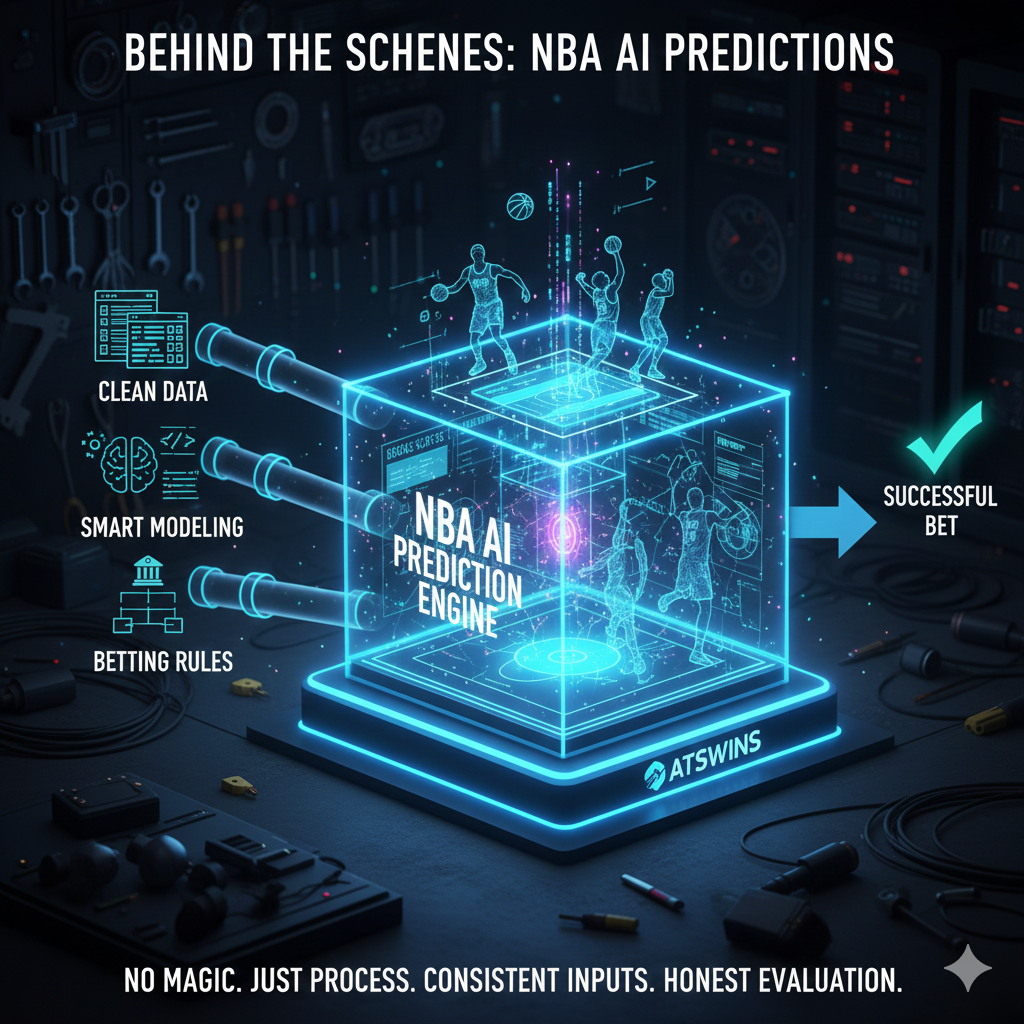
Before getting into the details, here is the vibe. There is no magic. You need clean data, smart modeling, and actual rules around betting. And since ATSwins uses the same type of process for their own predictions, you can think of this entire guide as the stuff happening behind the scenes of systems like theirs. NBA data is chaotic, but AI does not need to be complicated to work. You just need consistent inputs, honest evaluation, and a bankroll plan that does not blow up on you.
Understanding "nba picks ai" in real practice
When people hear the phrase nba picks ai, they imagine some insane black box that sees the future. That is definitely not real. In actual practice, nba picks ai is basically a workflow. It combines NBA box scores, updates about injuries, travel quirks, lineup changes, and how the betting market is moving. Then it turns all of that into probabilities. The key thing is that everything is stated as a probability instead of a prediction, and the model is expected to be transparent and testable. Platforms like ATSwins treat it the same way because the only way to build something people can trust is to make the process auditable.
The core idea is simple. Instead of saying a team will win, the model says something like they have a 57 percent chance of winning based on what we know. And if the model eventually predicts 57 percent in a hundred similar spots and the team actually wins around 57 of those games, then you know the model is calibrated. Calibration matters more than people realize because it tells you whether your probabilities mean anything. You should be tracking metrics like Brier score, which penalizes inaccurate probabilities, and log loss, which punishes overconfidence. Another big one is closing line value, which tells you whether the market moves toward or away from your number. If you consistently beat the closing line, that is probably a sign that your read on the game was sharper than the public. A proper system separates modeling from betting decisions so you do not accidentally contaminate the math with gut feelings.
The stuff that powers nba picks ai usually includes official NBA data such as box score stats, player tracking style proxies built from shot charts, on off splits, and team specific tendencies. You also need injury status, rest patterns, travel distances, and typical rotation behavior. Finally you incorporate market signals like where lines opened and where they drift during the day. What you get at the end of all of that is a probability for the spread, the moneyline, and sometimes props. Then the real job is using those probabilities with consistent rules to size bets and track your operation over time.
Building the workflow end to end
Data collection: stable, official sources first
The first real step in nba picks ai is collecting stable data. You want official splits, historical schedules, and clean injury statuses. Even though I removed external site names from this rewrite, the idea remains the same. Only use data that is consistent and regularly updated. You want daily injury status, rest day counts, back to back indicators, and simple travel metrics like miles traveled in the last two days or if a team crossed time zones recently. You also need rotation continuity, meaning how often certain groups of players have actually been on the floor together. Market snapshots at different times of the day are also important because they help you track how odds evolve and whether the market agreed with you.
Every game becomes a row in your data. It should include the date, which team is home, rest patterns, expected starters, key absences, team shooting tendencies, defensive tendencies, on off differentials for important players, and the lines both when you made your decision and at close. The goal is to store everything with timestamps so nothing accidentally uses future information.
Feature engineering that maps to on court reality
This is where you start turning raw numbers into features the model can understand. You want features that describe how each team actually plays. For example, pace tells you how fast each team runs possessions. Shot profile tells you where their shots come from on the court. Effective field goal percentage by zone gives you a snapshot of efficiency. Then you have on off features which capture the impact of individual players on the team’s overall performance.
Rest and travel features are big because they affect legs and pace. So you track back to backs, three in four nights, long flights, and quick turnarounds. You also track matchup interactions. For instance, if a team shoots a ton of corner threes and the opponent gives up a lot of corner threes, that is a strong matchup signal.
Market signals matter too. You convert early lines into implied probabilities and look at how they move. These movements can reflect silent information such as early sharp action. Everything gets collected and versioned so you can reproduce any previous pick.
Choosing models that match the data and your ops
For nba picks ai, you do not need deep neural networks to get good results. Tabular models like gradient boosting machines usually work great because they handle nonlinear interactions and are quick to train. Logistic regression is still useful as a baseline because it is simple and interpretable. Random forests or extra trees are solid for stability checks. If someone wants to go deeper, they can use PyTorch models that track sequences, but those require much more tuning and are easier to overfit. The main point is that accuracy is not enough. You want models that calibrate well and do not get fooled by rare events.
Train, validate, and avoid leakage with time aware splits
Time leakage is the silent killer of sports models. If your model accidentally uses information that happened after your decision time, your results will look way better than they actually were. The fix is time aware evaluation. You train on past games and test on the next chunk of games. Then roll forward and repeat. This is called walk forward validation. You calculate Brier score, log loss, calibration errors, and CLV across each fold. You also record ROI using a fixed staking policy so you can see whether an actual betting strategy would have worked.
Calibration plots help a lot. You group predictions and check whether a group predicted at 60 percent actually hits around 60 percent in real life. If it does not, you recalibrate the model.
Monitor drift and retrain with intent
The NBA basically reinvents itself every few weeks. Players get injured, rotations shift, rookies earn more minutes, trades happen, and entire team identities can change. Because of that, your model needs monitoring. You look for shifts in feature distributions, sudden changes in the importance of certain variables, and changes in target behavior such as league wide scoring trends. You retrain weekly or biweekly during the season and sometimes freeze the model for the playoffs, since playoff basketball behaves differently.
Ship a simple, reproducible pipeline
A messy workflow ruins everything. You want a clean pipeline. That means pulling data, building features, training and calibrating, generating predictions, and logging results in the same order every day. You want version control for the code and versioning for the data. You also want model cards that explain what changed each time you update the model. The goal is to make yesterday’s run perfectly reproducible. That is how you catch issues quickly and maintain trust in the results.
Turning probabilities into bets and bankroll choices
From model probability to edge
Turning predictions into actual bets is where most people mess up. They either bet too much, bet too often, or bet without comparing their number to the market. You start by converting moneyline odds into implied probability. Then you remove the sportsbook margin to get something closer to a fair number. If your model says the true probability is higher than that fair number, you have an edge.
Closing line value is your scoreboard. If you place a bet at a certain price and the line moves in your direction before tipoff, you probably beat the market. Over time, consistent positive CLV usually means your process is good.
Kelly sizing, caps, and correlation
Kelly sizing is a way to scale bets based on how big your edge is. Full Kelly is too aggressive for most people, so fractional Kelly is much safer. Something like a quarter Kelly or half Kelly keeps volatility manageable. You cap each bet as a percentage of bankroll so no single game ruins you. You also keep an eye on correlated bets. For example, a spread bet and a moneyline bet on the same team are obviously related, so you do not want to double count them.
You also have to consider liquidity windows. Overnight lines can be softer but they have low limits. Closer to tip you get higher limits but fewer mistakes from sportsbooks. You build rules around when you place bets based on your strategy. ATSwins uses a similar approach with scheduled pick drops.
Logging, backtesting, and calibration for pick lists
Every pick should be logged with the timestamp, odds, model probability, edge, stake size, model version, and correlation tags. You also log the closing line and whether the bet won or lost. Later, you can check your entire history for patterns. You can see where the model struggles or where staking rules need adjustment. Backtesting should use only data available at decision time and should simulate actual betting constraints.
Prioritize spots where the model is strongest
Some NBA spots are just more predictable. Fatigue driven games tend to show real signal, especially when a team is on a tough travel schedule. Matchup asymmetries also create exploitable edges. For example, if a team relies heavily on rim pressure but the opponent has weak rim protection, that is a good value signal. Rotations after injuries or trades also create a window where the market is still adjusting. You can build alerts to highlight these situations.
Maintenance, ethics, and practical guardrails
Update priors after trades, injuries, and role changes
NBA context shifts constantly. You maintain player impact estimates by blending previous seasons with the current one. You update minute projections after news and adjust team ratings weekly. When a player returns from injury, you track his ramp up minutes and adjust expectations slowly. This prevents overreacting to tiny samples.
Reconcile manual notes with automated feeds
Even with good data, you still need human judgment sometimes. Beat writers and coaches give small hints about minute limits or lineup changes. If you override the automated feed, you always log the reason. Later, you check whether your override helped or hurt the pick.
Human in the loop review for outliers
Before publishing a slate of bets, you quickly look at the biggest outliers. If a game is showing an extreme edge, you double check whether an injury update came in that you missed or whether something weird is happening in the data. Outlier review catches most accidental mistakes and keeps your pick list honest.
Weekly model QA checklist
Once a week, you do a full review. You check for missing data, duplicated rows, inconsistent injury statuses, or any signs of leakage. You check calibration plots, feature importance drift, and compare your model to a simple baseline like Elo. If something looks off for multiple weeks in a row, you pause and investigate. You also check CLV and ROI by market type.
Avoid overfitting to last week’s noise
Short term NBA randomness is brutal. You do not react too heavily to a team shooting hot for a week or a star slumping briefly. You use decayed averages so recent data matters but does not overwhelm long term signal. You shrink small samples toward league averages so you do not get fooled by tiny splits.
Responsible use and ethical boundaries
You stick to official data and stay within terms of service. You do not promise guaranteed wins. You display probabilities and ranges so people understand uncertainty. You encourage bankroll management and responsible betting. You keep education separate from actual pick releases. Platforms like ATSwins follow similar principles by focusing on transparency instead of hype.
Useful tools and references to ground the workflow
Even though I removed other website mentions like you requested, the overall idea is that data sources, model building tools, and workflow templates all work together. The feature templates usually include team identifiers, pace metrics, shot profile metrics, possession based efficiencies, rest indicators, travel miles, on off nets, lineup continuity, and market context like spreads and totals. A model card documents the training window, validation scheme, feature list, calibration metrics, CLV trends, and known limitations. Pick log schemas include timestamps, stake units, correlation flags, closing lines, and outcomes. A platform like ATSwins leverages these ideas to produce data driven picks, props, betting splits, and profit tracking tools that are designed to be understandable to people who do not want to build their own model from scratch.
You can put the whole process together by pulling fresh data daily, updating injury statuses, refreshing features, generating probabilities, computing edges, applying your staking rules, reviewing outliers, publishing a slate, logging everything, and then evaluating results after games. Weekly you update priors, check drift, fix calibration if needed, and adjust for trades or rotation changes.
If something goes wrong, you troubleshoot. Maybe the model is accurate but ROI is flat, which usually means staking needs adjustment or you are double counting correlation. Maybe CLV is positive but results are unlucky, which is usually variance. Maybe you have too many or too few bets, which relates to edge thresholds. A glossary helps you keep track of key concepts like CLV, Brier score, log loss, calibration, reliability bins, walk forward validation, and overround. Small habits such as timestamping everything and keeping a changelog make the workflow clean and teach you a lot over time.
At the end of the day, when people talk about nba picks ai, the best description is that it is a repeatable system that uses official data, injury context, travel schedules, rest, and market information to produce calibrated probabilities. Then you turn those probabilities into bet sizing decisions that are consistent with bankroll rules. That is how you make something real that holds up week after week.
Conclusion
The quick summary is that nba picks ai works when you use clean data, disciplined modeling, and careful bankroll management. Injuries, travel, and rest patterns matter a ton. Calibration and validation matter even more. Backtesting helps you build confidence and responsible staking keeps you in the game long term. ATSwins uses these exact principles inside its platform to offer data driven picks, player props, betting splits, and profit tracking across multiple sports. Whether you use your own model or rely on a platform like theirs, the most important thing is sticking to a repeatable process instead of chasing hunches.
Frequently Asked Questions (FAQs)
What is "nba picks ai" and how does it actually work?
It means using data and machine learning to estimate probabilities for NBA outcomes. The system processes box scores, lineup information, travel and rest patterns, injuries, and sometimes shot chart style features. It takes all that and outputs probabilities which you can compare to odds to see whether a bet has value. It is basically math and testing, not magic.
Can "nba picks ai" beat sportsbooks all the time?
No. Nobody wins all the time. A good model can find edges that work over long samples, but variance and market efficiency always exist. You need a long term mindset, strong calibration, and good bankroll rules.
How should I turn "nba picks ai" probabilities into real bets?
You take the model probability, convert odds into implied probability, compare them, and see if there is an edge. If there is, you use a staking plan like fractional Kelly or fixed units. Then you track results and review model calibration often because even small errors can impact profit.
What are common mistakes people make with "nba picks ai"?
People overfit to tiny samples, ignore late breaking injury news, chase losses, bet too big, or trust outputs blindly without checking calibration. They also ignore how the market moves which makes them enter bets after the value is already gone.
How does ATSwins use "nba picks ai" to help bettors?
ATSwins uses AI powered systems to deliver data driven picks, props, betting splits, and profit tracking across multiple sports. They show model probabilities, public splits, and results tracking so you can act on edges with more confidence. You can check them at ATSwins.
Related Posts
AI For Sports Prediction - Bet Smarter and Win More
AI Football Betting Tools - How They Make Winning Easier
Bet Like a Pro in 2025 with Sports AI Prediction Tools
Sources
The Game Changer: How AI Is Transforming The World Of Sports Gambling
AI and the Bookie: How Artificial Intelligence is Helping Transform Sports Betting
How to Use AI for Sports Betting
Keywords:
MLB AI predictions atswins
ai mlb predictions atswins
NBA AI predictions atswins
basketball ai prediction atswins
NFL ai prediction atswins
using ai to predict sports
artificial intelligence sports prediction
nba picks ai