
Final Four AI Win Probabilities Explained: Inside the Data Driving Every Prediction
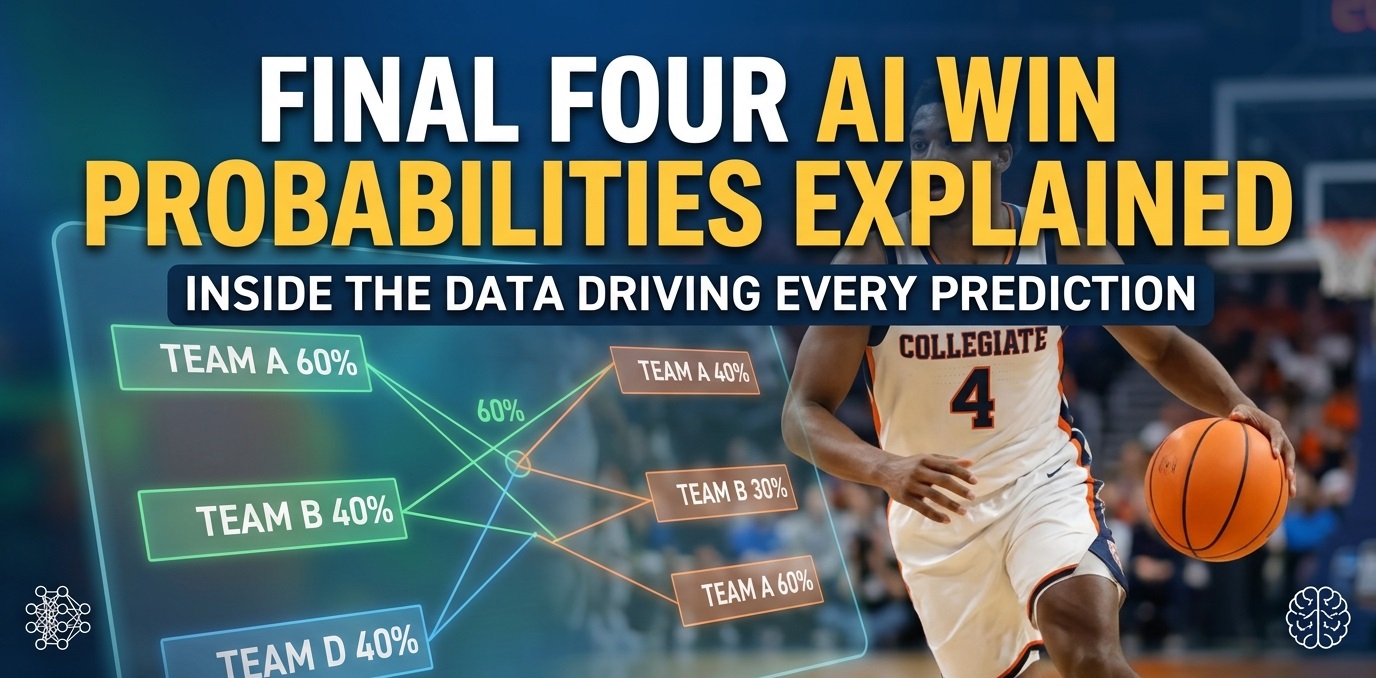
The excitement around the Final Four is honestly on a different level. Even if you’re just a casual college basketball fan, there’s something about those last few games that feels bigger, louder, and way more intense than anything earlier in the tournament. But what’s really changed the experience over the past few years is how much data and tech has gotten involved. It’s not just about gut feelings or picking teams based on vibes anymore. Now people are digging into numbers, trends, and AI-driven insights to try and figure out who actually has the edge. Coverage from major outlets like Fox Sports has also leaned heavily into analytics, showing just how mainstream this approach has become.
That’s where the Final Four AI model comes in. Instead of guessing or relying on surface-level stats, this kind of model breaks things down in a way that actually makes sense. It looks at everything from team performance to player efficiency and even historical tournament behavior. The result is a clearer picture of win probabilities, which is something fans, analysts, and bettors all care about. And if you’re someone who likes having an extra layer of insight before making decisions, this stuff gets really interesting fast. For a deeper dive into strategies built around these insights, check out the Final Four AI Betting Picks for 2026
Table Of Contents
- The Final Four AI Model Win Probability
- Conclusion
- Frequently Asked Questions (FAQs)
Key Takeaways
The Final Four AI model is built to take a ton of complex data and turn it into something useful. It analyzes team performance, player stats, and past tournament trends to estimate how likely each team is to win. While it’s a powerful tool, it’s not a crystal ball. Upsets still happen and randomness is always part of sports. Platforms like ATSwins use similar AI-driven systems to give users access to predictions, betting insights, and tracking tools across multiple leagues. Understanding how these models work can make watching games way more engaging and can help you make smarter decisions if you’re betting.
The Final Four AI Model Win Probability
Understanding the Final Four AI Model
So let’s break this down in a way that actually feels real and not overly technical. The Final Four AI model is basically a system that takes in a massive amount of basketball-related data and processes it through algorithms designed to find patterns. Those patterns then get turned into probabilities. Instead of saying “Team A will win,” it might say “Team A has a 64 percent chance of winning.” That difference matters because it gives you a sense of risk instead of a yes or no answer.
What makes this kind of model stand out is how much information it considers at once. A human can only track so many stats in their head, but an AI model can process thousands of data points in seconds. That includes things like shooting efficiency, defensive ratings, turnover rates, pace of play, and even how teams perform under pressure. When all of that gets combined, you end up with something that feels way more grounded than just picking based on rankings or hype.
It’s also worth mentioning that these models are constantly evolving. They’re not static systems. As new games are played and new data becomes available, the model updates itself. That means the probabilities you see are always based on the most current information possible, which is a huge deal during a fast-moving tournament like March Madness.
Elements of the Model
To really understand how this works, you have to look at the different pieces that go into it. The model isn’t just pulling numbers out of nowhere. It’s built on layers of data that all contribute to the final prediction.
First, there’s team performance. This is the foundation. It includes win-loss records, offensive and defensive efficiency, and how well a team performs in different situations. For example, some teams are great when they’re ahead but struggle when they’re behind. Others might have strong second-half performances. All of that gets factored in.
Then you have player statistics. This is where things get more detailed. Individual players can have a huge impact on a game, especially in high-pressure situations. The model looks at points per game, assists, rebounds, shooting percentages, and even things like usage rate. Injuries are also a big factor. If a key player is out or not at full strength, that can shift the entire probability.
Historical data is another major piece. The tournament has been around for a long time, and there are patterns that show up over the years. Some teams consistently perform better than expected, while others tend to underperform. Matchup history also matters. If two teams have played each other before, that data can give insight into how they might match up again.
All of this data gets combined into a single system, which is what allows the AI model to generate its predictions.
Methodology Behind Win Probabilities
Now let’s talk about how the model actually turns all that data into something useful. It’s not just about collecting information. There’s a process behind it that makes everything work.
It starts with gathering data. This is where the model pulls in everything it needs to know about teams and players. That includes official stats, game results, and betting trends from platforms like ATSwins . The goal here is to build a complete picture of what’s going on.
After that comes data cleaning and preprocessing. This part isn’t glamorous, but it’s super important. Not all data is useful, and some of it can even be misleading if it’s not handled correctly. So the model filters out irrelevant information, fills in missing values, and standardizes everything so it can be compared properly.
Next is feature selection. This is basically deciding which pieces of data matter the most. Not every stat has the same impact on a game. The model focuses on the ones that actually influence outcomes, like shooting efficiency or turnover rate. Choosing the right features is a big part of what makes the model accurate.
Then comes model selection. This is where different types of algorithms come into play. Some models are better for simple predictions, while others can handle more complex patterns. Logistic regression is often used for basic win-loss predictions. Decision trees help break down how different factors influence outcomes. Neural networks can pick up on deeper patterns but require more data to work effectively.
Once the model is chosen, it needs to be trained. This means feeding it historical data so it can learn from past results. The model tests itself against known outcomes and adjusts until it reaches a level of accuracy that’s considered reliable. This step is what turns raw data into actual predictive power.
Real-World Applications of the Model
This isn’t just theory. The Final Four AI model has real-world applications that people actually use, especially when analyzing actual matchups like the 2026 Final Four.
According to the official NCAA Tournament schedule, the Final Four games are set for April 4, 2026, featuring Illinois vs. UConn and Michigan vs. Arizona . These are exactly the kinds of high-stakes matchups where AI models become especially valuable, helping break down win probabilities and uncover edges that aren’t immediately obvious.
Take a past tournament as an example. There have been years where underdog teams made deep runs, and a lot of those cases were picked up by AI models before they happened. The model might notice that a lower-seeded team has strong efficiency metrics or favorable matchups, even if public opinion is leaning the other way. That kind of insight can be huge.
Betting is another major application. A lot of bettors use AI-generated probabilities to find value. If the model says a team has a 60 percent chance of winning, but the betting odds imply only a 50 percent chance, that’s a potential opportunity. Over time, making decisions like that can lead to better results.
Platforms like ATSwins take this a step further by packaging these insights into something easy to use. Instead of building your own model from scratch, you can access predictions, player props, and betting splits all in one place. There are also tracking tools that help you see how your bets are performing over time, which is something a lot of people overlook. You can also explore more in-depth matchup analysis and storytelling angles in pieces like this: Dayton’s House of Horrors: Illinois State Seeks Quarterfinal Upset .
The Future of Predictive Models in Sports
Looking ahead, this kind of technology is only going to get better. The amount of data available in sports is growing every year, and models are getting more advanced in how they use it.
One big area of growth is real-time data. Instead of just analyzing past games, future models will be able to adjust probabilities during a game. Things like momentum, player fatigue, and in-game injuries could all be factored in instantly. That would take predictions to a whole new level.
Another trend is more detailed player tracking. With advanced metrics becoming more common, models can get a better understanding of how individual players impact the game beyond basic stats. That means more accurate predictions and deeper insights.
For fans, this all adds another layer to the experience. Watching a game becomes more interactive when you understand the probabilities and how they’re changing. It’s not just about who’s winning, but how likely each team is to hold on or come back.
Betting Strategies and Insights
If you’re into betting, the Final Four AI model can be a really useful tool, but only if you use it the right way. It’s not about blindly following predictions. It’s about understanding what those predictions mean and how to apply them.
One approach is value betting. This is where you look for situations where the model’s probability is higher than what the odds suggest. Over time, consistently finding value like that can improve your results.
Another angle is looking at performance against the spread. Some teams consistently outperform expectations, while others fall short. The model can help identify those trends, which can be useful when deciding where to place bets.
Tracking your bets is also a big deal. It might sound basic, but a lot of people skip this step. Keeping a record of what you bet on, why you made that decision, and what the outcome was can help you improve over time. ATSwins offers tools for this, which makes it easier to stay organized and actually learn from your results.
Tools and Templates for Success
To really get the most out of this, having some kind of system helps. Whether it’s a simple spreadsheet or a more advanced tracking tool, the goal is to keep everything in one place.
A bet tracking setup lets you see patterns in your decisions. Maybe you’re better at picking underdogs, or maybe you do better with certain types of bets. Without tracking, it’s hard to notice those trends.
Visualization tools can also be helpful. Seeing data in a visual format makes it easier to understand. Trends that might not be obvious in raw numbers can stand out when they’re presented visually.
The key is consistency. The more you use these tools and the more you pay attention to the data, the better your decision-making becomes.
Concluding Notes on AI in Sports
At the end of the day, the rise of AI in sports isn’t just a trend. It’s becoming a core part of how people analyze games. From casual fans to serious bettors, more and more people are relying on data-driven insights to guide their decisions.
That doesn’t mean intuition is useless. There’s still a place for experience and personal judgment. But combining that with AI-based analysis gives you a stronger overall approach.
Conclusion
The Final Four AI model is changing how people look at college basketball’s biggest games. By analyzing team performance, player stats, and historical data, it provides a clearer picture of win probabilities. It doesn’t guarantee outcomes, but it does offer a more informed way to think about them.
For anyone looking to go deeper, platforms like ATSwins bring these insights together in a way that’s easy to use. Whether you’re tracking bets, exploring player props, or just trying to understand the numbers behind the game, having access to that kind of data can make a big difference.
As technology continues to evolve, the role of AI in sports will only grow. Learning how to use these tools now puts you in a better position moving forward, whether you’re watching for fun or trying to make smarter betting decisions.
It’s a system that uses data and algorithms to estimate how likely a team is to win during the Final Four. Instead of guessing, it provides a percentage based on multiple factors like performance and matchups.
Frequently Asked Questions (FAQs)
How does the AI model calculate win probabilities?
It analyzes historical data, current season stats, and player performance. Then it applies machine learning techniques to identify patterns and generate predictions.
Can I rely on these predictions for betting purposes?
They’re helpful, but not guaranteed. The model gives you a strong foundation, but unexpected things can still happen during games. It’s always smart to combine model insights with your own research.
What makes ATSwins a reliable platform for sports predictions?
ATSwins combines data-driven picks, player props, betting splits, and tracking tools across multiple sports. It offers both free and paid options, making it accessible while still providing depth.
How can I use the Final Four AI model to my advantage?
Start by looking at the win probabilities and comparing them to betting odds. Use that information to identify value, manage risk, and build a more informed strategy over time.
Related Posts
College basketball conference tournament betting strategies - How to bet smart in March
Why a College Basketball Tournament Simulation Model Beats Bracket Gut Feelings
March Madness bracket seeding trend analysis - 7 Ways to win
Sources
The Game Changer: How AI Is Transforming The World Of Sports Gambling
AI and the Bookie: How Artificial Intelligence is Helping Transform Sports Betting
How to Use AI for Sports Betting
Keywords
final four ai odds prediction model
final four ai expected value betting angles
final four ai simulation model ncaa basketball
final four betting angles with machine learning
final four ai prediction algorithm march madness
final four ai betting system ncaa basketball
final four betting trends data driven ai
final four ai model win probability
final four ai betting picks college basketball
final four betting angles ai model
final four prediction model college basketball ai
final four betting trends ai analysis