
Essential MAC Basketball Conference Tournament Betting Angles for 2026
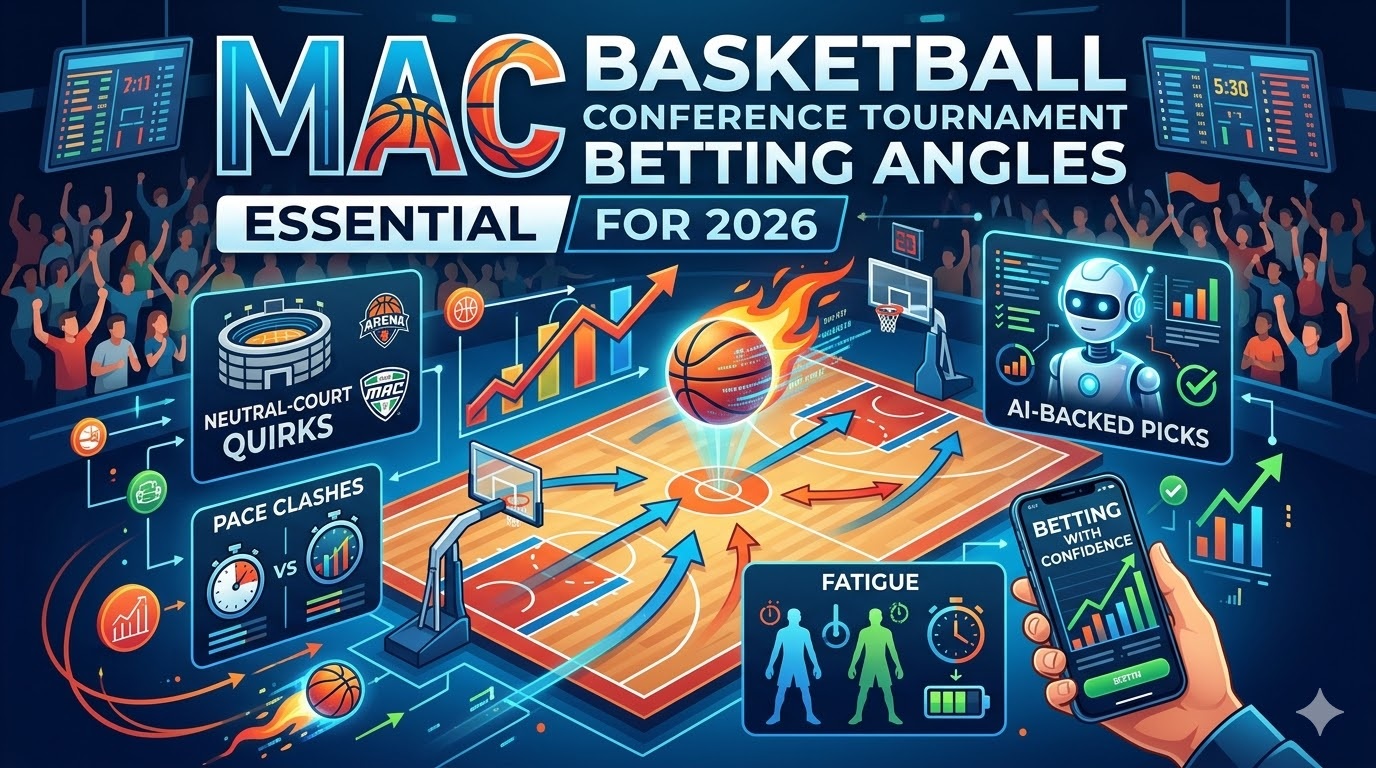
Table Of Contents
- MAC Tournament rhythms that shape betting value
- Sides angles that actually move ROI
- Totals and tempo in a compressed tournament
- Market timing and execution
- AI modeling workflow built for the MAC tournament
- Practical betting templates and checklists
- Examples and what-if matchups
- Where to pull the data fast
- Putting it all together on MAC tournament week
- Conclusion
- Related Posts
- Frequently Asked Questions (FAQs)
MAC Tournament rhythms that shape betting value
March in the MAC is honestly one of my favorite little pockets of chaos in college basketball. If you follow the big conferences you might miss it, but this tournament is always wild. The mix of mid major talent, short rest, and neutral court games creates a betting environment that feels way different from the regular season. One night a team looks like a juggernaut and the next night they can barely score 60 points. If you are betting it without adjusting for those differences you are basically guessing.
For a deeper breakdown of historical patterns and how these dynamics play out over time, see Decoding MAC Basketball Conference Tournament Betting Trends: Data-Driven Insights .
The biggest factor that changes everything is the neutral court setup. These teams are used to playing in their own gyms where they know the shooting background, the crowd is loud, and refs tend to lean slightly toward the home team (KenPom home-court advantage studies). Once the tournament starts that all disappears. Everyone is in the same building and the environment is way more balanced. That can level the playing field a lot more than people expect. A team that dominated at home during the regular season might not look nearly as comfortable when they lose that familiarity.
Another thing that jumps out every year is how tight the quality gap really is between teams in this conference. The seed numbers make it look like there are huge differences between teams but that usually is not true. A one seed might only be a couple possessions better than a six seed on a neutral floor (BartTorvik efficiency margin data). When you combine that with shooting variance and fatigue, upsets become way more common than casual bettors think.
The schedule is also brutal. Teams often play multiple games in just a few days, which means depth and conditioning start to matter a lot more than they did during the regular season (NCAA tournament workload trends). If a team relies heavily on five or six players, you can almost guarantee they will look slower and less efficient by the time the semifinals roll around. Legs get heavy, jump shots start falling short, and defensive rotations get sloppy.
Coaching adjustments matter more too. There is not a full week to prepare for each opponent. Instead teams get maybe a day to scout and install adjustments. Programs with simple and repeatable systems tend to handle this better. Teams that rely on complicated game specific schemes can struggle when they do not have time to drill every detail (tournament coaching efficiency studies).
All of these little tournament quirks create opportunities if you pay attention to them. The market often reacts heavily to seeds or recent scores without fully accounting for how neutral courts and fatigue reshape the matchup.
Sides angles that actually move ROI
When I look at a MAC tournament game the first thing I care about is not the seed or the record. I care about the actual strength of the teams and how their styles interact. That sounds obvious but a lot of bettors still anchor too much on standings.
I start by building a neutral court expectation for the matchup. That means stripping away any regular season home advantage and focusing only on how efficient each team actually is on offense and defense (adjusted efficiency metrics from KenPom and BartTorvik). Once you do that you start seeing games where the market favorite might not actually be that much stronger.
Matchups around the rim are one of the biggest edges. Teams that consistently attack the basket tend to translate better in tournament settings. Jump shooting teams can win big when shots are falling but they are way more volatile. On a neutral floor with tired legs, relying purely on outside shooting is risky (ShotQuality variance research).
Rebounding also becomes a massive factor. Defensive rebounding controls pace and prevents second chances. If one team is clearly better on the defensive glass, they can slow the game down and limit easy points for their opponent. That type of advantage is not always fully priced into the spread (NCAA rebounding impact data).
Ball handling is another detail I always watch closely. Guard play often decides tournament games. Teams that can run pick and roll efficiently and protect the ball under pressure usually hold up better when the stakes rise. If a defense struggles to contain dribble penetration it can get exposed quickly (turnover rate and guard efficiency metrics).
Free throw rate is a sneaky stat that becomes more important late in games. Teams that attack the rim draw more fouls, which leads to easier points and better chances of covering tight spreads. When the clock gets late and the trailing team starts fouling intentionally, good free throw shooters can stretch a margin quickly (free throw rate correlations with ATS outcomes).
Another angle I like is looking at how the market reacts to a team that shot poorly the previous game. If the underlying shot quality was actually good, there is often value on a bounce back performance. Shooting percentages can swing wildly from one night to the next, especially in a small sample like a tournament (regression to the mean principles in sports analytics).
On the flip side, sometimes a team wins a game purely because they hit an unsustainable number of three pointers. When that happens the betting market can overreact and push the line too far in their direction. If the underlying numbers suggest that shooting performance was a fluke, fading that team in the next round can be profitable.
Fatigue becomes the final piece of the puzzle. By the second or third game of the tournament, teams with shallow rotations start showing signs of wear. That is when I start leaning toward deeper rosters that can keep fresh legs on the floor.
For a current example of how matchup context and narrative collide in tournament settings, read Miami (OH)’s Perfect Season vs. SMU’s Bubble Escape: Who Advances?
Totals and tempo in a compressed tournament
Betting totals in the MAC tournament is honestly just as interesting as betting sides. The pace of these games can shift dramatically depending on matchups and tournament context.
Early session games often start slower than expected. Players are adjusting to the arena, nerves are high, and both teams tend to open with more structured half court sets. That combination usually leads to lower scoring first halves.
As the game progresses things can change quickly. Once teams settle in and coaches make adjustments, the pace sometimes picks up. Late game situations can also inflate scoring because of fouling and clock management strategies.
One of the most important factors in projecting totals is identifying which team actually controls the tempo. A fast team does not automatically guarantee a fast game. If their opponent dominates the defensive glass and limits transition opportunities, the pace can slow down significantly.
Fatigue also affects scoring efficiency. Jump shots become less consistent as players get tired, which can drag down overall shooting percentages. At the same time, tired defenders commit more fouls, which adds free throws to the scoreboard.
Because of that balance, I often prefer targeting first half totals in tournament games. Early stretches tend to be more predictable before late game fouling and desperation strategies start altering the scoring pattern.
Live betting also becomes really useful for totals. If both teams come out hitting a crazy percentage of contested three pointers, there is a good chance regression will hit in the second half. Those moments can create strong live under opportunities if the market inflates the number too aggressively.
2026 MAC Tournament Schedule
Quarterfinals — Thursday, March 12
(1) Miami (OH) vs (8) UMass — 11:00 AM
Market timing and execution
Timing matters a lot when betting tournament games. Lines move quickly once bettors start reacting to matchups, injuries, or steam from sharp money.
I try to evaluate games as early as possible so I have a clear number in mind before the market opens. If the opening line is clearly off from my projection, I am comfortable betting it right away. Early mistakes by the market do happen, especially in smaller conferences.
At the same time, I always pay attention to line movement. If the market moves heavily against my position, I double check my assumptions. Sometimes new information hits the market before it becomes widely reported. Other times the move is just momentum and does not actually reflect a real edge.
Live betting during games can also be powerful when you understand how pace and matchups are evolving. A team might start the game pushing the ball more than expected, or the referees might call the game much tighter than average. Those adjustments can create new opportunities that were not visible before tipoff.
Throughout the tournament I track my bets and results carefully using ATSwins . The platform helps monitor projections, betting splits, and overall performance across different angles. Having that feedback loop makes it easier to identify which strategies are actually working.
AI modeling workflow built for the MAC tournament
One of the biggest advantages modern bettors have is the ability to incorporate AI modeling into their process. That does not mean blindly trusting a computer prediction. Instead it means combining data driven insights with actual basketball knowledge.
My modeling approach starts with baseline team efficiency. Offense and defense are evaluated on a per possession basis so that pace differences do not distort the numbers. From there I apply adjustments based on recent performance and rotation changes.
The next step is incorporating matchup features. This includes things like rim attack frequency, turnover pressure, and rebounding rates. These variables help identify situations where one team’s strengths align directly with another team’s weaknesses.
Fatigue modeling is especially important during tournaments. Players who logged heavy minutes in the previous round receive a slight downgrade in projected efficiency. Teams with deeper benches receive smaller penalties because they can spread out playing time more evenly.
Neutral court adjustments are also applied. Even though the change is small, removing home court advantage creates more accurate projections. Shooting percentages often dip slightly in unfamiliar arenas, especially during early games.
After the adjustments are calculated, the model produces projected spreads and totals. These numbers are then compared against the market to identify potential value. If the difference is large enough, the game becomes a betting candidate.
I still review every potential bet manually. Numbers alone cannot capture every nuance of a basketball game. Watching how teams play and understanding coaching tendencies adds context that raw data cannot always see.
Using ATSwins alongside this modeling process helps validate projections and monitor betting performance. The platform provides AI powered insights that can confirm or challenge a model’s conclusions, which helps sharpen decision making over time.
Practical betting templates and checklists
Having a consistent process is huge during a fast moving tournament. Games happen quickly and it is easy to rush decisions if you do not follow a structured routine.
My pregame evaluation starts with creating a neutral court spread based on team efficiency and recent form. Once that baseline number exists, I begin layering in matchup factors like rebounding, rim pressure, and turnover rates.
After that I apply fatigue adjustments based on the previous game’s minutes and rotation usage. Teams that relied heavily on their starters often receive a small downgrade in the following round.
Totals projections follow a similar pattern. I estimate the number of possessions based on each team’s typical tempo and rebounding strength. Efficiency projections are then applied to estimate the likely scoring output.
During games I monitor pace, shooting quality, and foul patterns. If the game environment differs significantly from expectations, I look for live betting opportunities that take advantage of that shift.
Tracking results is also part of the process. Every wager is logged and compared against the closing line. Over time that data shows whether the strategy is consistently beating the market.
Examples and what-if matchups
To understand how these concepts play out, it helps to imagine a few different matchup scenarios.
Picture a guard driven offense facing a defense that plays conservative pick and roll coverage. In this case the offensive guards might find plenty of room to operate in the mid range. If those players are comfortable pulling up for jumpers or floaters, the defense could struggle to contain them.
Another scenario involves a team that relies heavily on three point shooting reaching the championship game after two intense contests. Their opponent happens to be one of the best defensive rebounding teams in the conference. That combination can be tough for the shooting team because missed threes rarely lead to second chances.
A different example might involve a pace clash. One team prefers to push the ball in transition while the other deliberately slows the game down and works deep into the shot clock. In situations like that the team controlling the defensive glass usually dictates the tempo.
Thinking through these hypothetical matchups before games start helps prepare for real situations that arise during the tournament.
Where to pull the data fast
When the tournament schedule is packed, having quick access to reliable data becomes extremely valuable. Box scores, minute distributions, and recent game logs all provide clues about fatigue and rotation patterns.
Player level statistics can reveal which teams rely heavily on specific individuals. If a star player logged nearly the entire previous game, that could affect their performance in the next round.
Team level statistics provide insight into broader trends like rebounding strength, turnover creation, and free throw rates. Combining those numbers with video observations helps build a complete picture of each matchup.
For AI projections and betting insights, I use ATSwins as a central tool. The platform provides model predictions, betting split data, and performance tracking that help keep everything organized during the tournament.
Putting it all together on MAC tournament week
When tournament week actually arrives, preparation becomes key. I usually build projections the night before the first round so that I already have a baseline for each matchup.
On the morning of the games I double check injury updates and confirm rotation patterns from the previous round. Even small changes in playing time can influence fatigue adjustments.
Throughout the day I update projections after each game finishes. If a team had to play overtime or relied heavily on its starters, that information gets incorporated into the next round’s analysis.
Semifinals often present the most interesting betting opportunities because fatigue starts playing a larger role. Teams that barely survived the previous round sometimes struggle to maintain the same level of intensity.
By the time the championship game arrives, the focus shifts toward experience and depth. The teams that can control rebounds and limit turnovers usually have the edge when legs are tired and pressure is high.
Conclusion
The MAC tournament might not get the same attention as bigger conferences, but from a betting perspective it can be incredibly interesting. Neutral courts, quick turnarounds, and tight competition create a unique environment where careful analysis can uncover real value.
Success in this tournament usually comes down to a few core ideas. First, evaluate teams based on actual strength instead of seed numbers. Second, pay attention to fatigue and minute loads as the week progresses. Third, understand how matchups influence pace, rebounding, and shot quality.
Using AI tools like ATSwins can strengthen this process by providing data driven projections and performance tracking. When those insights are combined with careful game analysis, bettors can approach the MAC tournament with a clear and disciplined strategy.
You can explore more analysis, tournament previews, and betting strategy content directly through ATSwins. The platform regularly publishes insights covering college basketball matchups, AI projections, and betting education designed to help bettors refine their process.
Frequently Asked Questions (FAQs)
What are the core MAC basketball conference tournament betting angles to focus on?
The most important angles usually revolve around matchup strengths rather than seed numbers. Teams that attack the rim, rebound well on defense, and limit turnovers often translate better to neutral court environments. Guard play is also extremely important because late game possessions often come down to pick and roll execution. Evaluating those factors before the market fully adjusts can create betting value.
How should neutral court shooting affect betting decisions?
Neutral court games sometimes produce slightly lower shooting percentages, especially early in the day. Players are adjusting to a different arena and the energy level can be different from a normal home game. Because of that, early game scoring occasionally starts slower. Bettors often look toward first half unders or wait for live opportunities if the market reacts too strongly to early shooting runs.
Do back to back games change betting strategy in this tournament?
Yes, fatigue becomes a major factor as the tournament progresses. Teams that rely heavily on a small group of players may struggle to maintain the same level of performance on consecutive days. Jump shooting tends to decline when legs get tired, while defensive mistakes and fouls increase. Recognizing those trends can help bettors adjust both side and total projections.
Which statistics matter most when evaluating these games?
Several key statistics consistently influence tournament outcomes. Defensive rebounding percentage helps determine which team controls pace. Free throw rate reveals which offenses can generate easy points when shots are not falling. Turnover rates show which teams protect the ball under pressure. When those factors align with favorable matchups, they often signal strong betting opportunities.
How can ATSwins help with MAC tournament betting?
ATSwins is an AI powered sports prediction platform that provides projections, betting splits, and performance tracking tools. During tournament week it helps bettors compare their own analysis against data driven models and monitor how the market is reacting to different matchups. Using those insights alongside traditional analysis can improve decision making and help bettors stay organized throughout a busy slate of games.
Related Posts
College basketball conference tournament betting strategies - How to bet smart in March
Why a College Basketball Tournament Simulation Model Beats Bracket Gut Feelings
March Madness bracket seeding trend analysis - 7 Ways to win
Sources
The Game Changer: How AI Is Transforming The World Of Sports Gambling
AI and the Bookie: How Artificial Intelligence is Helping Transform Sports Betting
How to Use AI for Sports Betting
Keywords
mac basketball conference tournament betting trends
mac basketball conference tournament betting angles
sun belt basketball conference tournament betting trends
sun belt basketball conference tournament betting angles
conference usa basketball tournament betting trends
conference usa basketball tournament betting angles
missouri valley basketball conference tournament betting trends
missouri valley basketball conference tournament betting angles
atlantic 10 basketball conference tournament betting trends
atlantic 10 basketball conference tournament betting angles
aac basketball conference tournament betting trends
aac basketball conference tournament betting angles