College Basketball Betting Scandal: Indictment Details Player Bribes and Manipulated Results
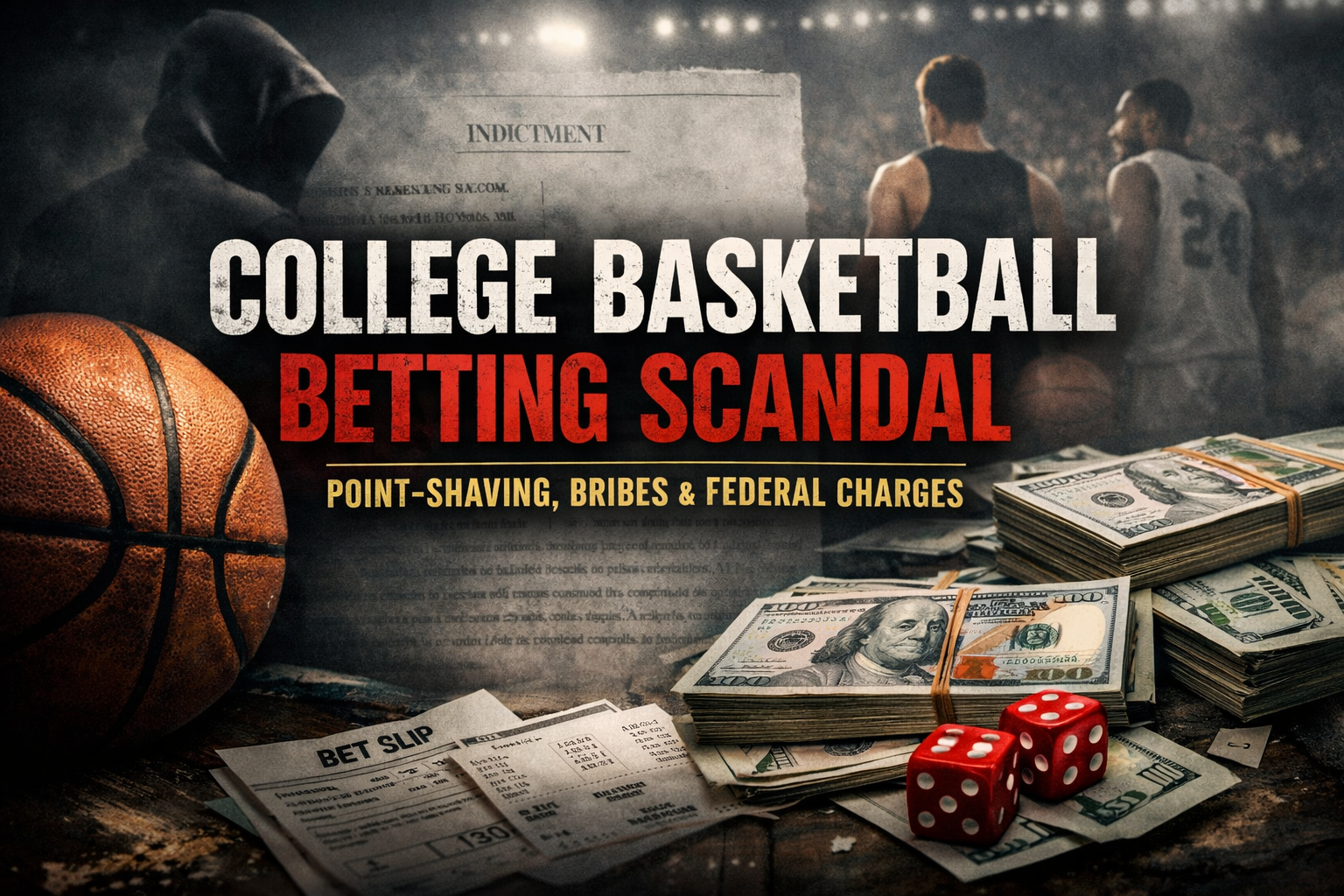
A federal indictment unsealed Thursday in the Eastern District of Pennsylvania alleges a sweeping point-shaving operation tied to sports gambling that prosecutors say involved more than 39 players across 17 NCAA Division I programs, with dozens of games over the last two seasons allegedly manipulated to benefit a betting ring that included a former NBA player.
According to the indictment, 26 people are charged in total, and 20 of them played Division I college basketball during the 2023–24 and/or 2024–25 seasons. Four players specifically named in the filing — Simeon Cottle, Carlos Hart, Camian Shell, and Oumar Koureissi — have appeared for their current teams within the past week. Prosecutors say the conduct attributed to Hart, Shell, and Koureissi relates to their prior schools, and that Cottle’s alleged involvement dates back to the 2023–24 season. The filing does not allege that any of those incidents occurred this season.
Schools identified in the indictment are:
- Abilene Christian
- Alabama State
- Buffalo
- Coppin State
- DePaul
- Eastern Michigan
- Fordham
- Kennesaw State
- La Salle
- New Orleans
- Nicholls State
- North Carolina A&T
- Northwestern State
- Robert Morris
- Saint Louis
- Southern Miss
-
Tulane
In response, Eastern Michigan said Hart has been removed from all basketball activities while the matter plays out. Kennesaw State announced Cottle has been suspended indefinitely from team activities.
Cottle, who was Conference USA’s preseason player of the year entering this season, is listed as Kennesaw State’s leading scorer at 20.2 points per game. He scored 21 points in Wednesday’s win over Florida International, including five of the team’s last eight points.
Prosecutors describe five defendants as “fixers,” alleging they sought out players and offered payments, generally between $10,000 and $30,000, in exchange for intentionally falling short of expected performance marks, allowing bettors to cash wagers tied to spreads and segments of games. Authorities say the gambling side of the group placed bets totaling millions and profited substantially when the manipulated outcomes hit.
Two alleged fixers — Shane Hennen and Marves Fairley, are also charged in a separate federal case in the Eastern District of New York connected to NBA gambling schemes, according to the filing. Prosecutors say three other alleged fixers had existing ties to college basketball as well.
The Pennsylvania indictment charges defendants with bribery in sporting contests and conspiracy to commit wire fraud; the alleged fixers face additional wire fraud counts. The bribery count carries up to five years in prison, while the fraud charges can carry penalties of up to 20 years. Fairley’s attorney told ESPN he was reviewing the indictment and declined further comment; an attorney for Hennen did not immediately respond to a request for comment.
Former NBA player Antonio Blakeney is named in the indictment but is not charged in that filing; prosecutors allege he helped recruit players and facilitate bribe offers, and that he faces a separate case. Blakeney starred at LSU, played for the Chicago Bulls from 2017–19, and later played professionally overseas, including stints in China and Israel.
The indictment (about 70 pages) claims the operation began around September 2022 with a focus on games in China’s professional league, where Blakeney was playing. Prosecutors allege he manipulated his own play and brought in teammates. At one point, Hennen allegedly texted a co-conspirator after one such game, joking that the only sure things are “death, taxes and Chinese basketball.”
Authorities say the group shifted toward college basketball before the 2023–24 season, targeting players whose financial situations made bribes especially tempting — specifically those for whom cash payments could rival or exceed legitimate NIL opportunities. U.S. Attorney David Metcalf said Thursday that, as the scheme expanded into college hoops, the group deliberately added fixers with deeper basketball connections, people he described as trainers, recruiters, networkers, and influential figures, to give the operation access and credibility.
After the indictment became public, NCAA president Charlie Baker said the NCAA has launched betting-integrity investigations involving roughly 40 players across 20 schools over the last year, including nearly all of the programs referenced in the indictment. He said the NCAA uses an integrity monitoring system covering more than 22,000 contests and urged athletes to avoid decisions that could compromise their eligibility and the sport’s integrity.
The indictment also details individual episodes. Former Kennesaw State guard Demond Robinson is charged alongside Cottle. Prosecutors allege that before Kennesaw State’s March 1, 2024 game against Queens University, a fixer sent Cottle and Robinson an image showing roughly $100,000 in cash. The filing claims Cottle, Robinson, and a third unnamed person were paid $40,000 for their participation.
Investigators allege some players attempted to pull additional athletes into the arrangement. In one example, the indictment says Saint Louis center Bradley Ezewiro (accused of throwing a game against Duquesne) messaged alleged fixer Jalen Smith with a screenshot of DePaul forward Da’Sean Nelson’s stats, calling DePaul the “worst team in the Big East” and saying Nelson was ready to get involved. Smith allegedly replied that Nelson was already secured.
Prosecutors claim Nelson and three teammates, Jalen Terry, Micawber Etienne, and an unnamed player, agreed to underperform in three 2024 games (Georgetown, Butler, and St. John’s). The filing alleges bettors put at least $27,000 on Georgetown to cover a first-half spread on Feb. 24, and Georgetown led 41–28 at halftime. The indictment highlights that Terry had zero points in the first half and then scored 16 after the break. Around halftime, Smith allegedly texted Etienne about payouts and praised Terry and Nelson for executing. Prosecutors say Smith traveled the following day to deliver $40,000 in cash to the four players.
The indictment further alleges the group wagered over $52,000 that DePaul would fail to cover a first-half spread against St. John’s. Terry again went scoreless in the first half and Nelson scored four points. Prosecutors say Smith complained by text during the game that an uninvolved teammate was playing too well; Etienne allegedly responded that they would keep that player from getting the ball. Nelson and Terry are charged in the indictment, while Etienne is charged separately.
Metcalf described the operation as highly profitable, while acknowledging that not every attempt worked as planned. The indictment cites a game where the group allegedly wagered at least $195,000 that Fordham would not cover against Duquesne on Feb. 23, 2024. Prosecutors say Fordham forward Elijah Gray and an unnamed teammate tried to underperform, yet Fordham still won. The filing alleges Gray later texted Smith, “I tried,” and Smith replied that Gray had done what was asked. Gray, who transferred to Wisconsin before this season and was dismissed from the team in October, was charged separately.
Metcalf emphasized that basketball is particularly vulnerable because a single player can strongly affect outcomes, but even then, it isn’t foolproof.
The case is the latest in a recent run of sports-betting controversies, with allegations of manipulation surfacing across multiple leagues in the last couple of years, including the NBA, MLB, and UFC. Metcalf argued that the growth of legalized betting and the broader monetization of sports (including normalized athlete compensation) created conditions that made schemes like this easier to attempt.
Baker also sent a letter Thursday to state gambling regulators urging rule changes aimed at protecting athletes and competition integrity, including a call to eliminate prop betting. Metcalf added that the harm goes beyond gamblers who lost money, saying the fallout hits fans, honest players, and teammates who competed in good faith.