
ATS AI Betting Predictions - How To Make Smarter ATS Picks
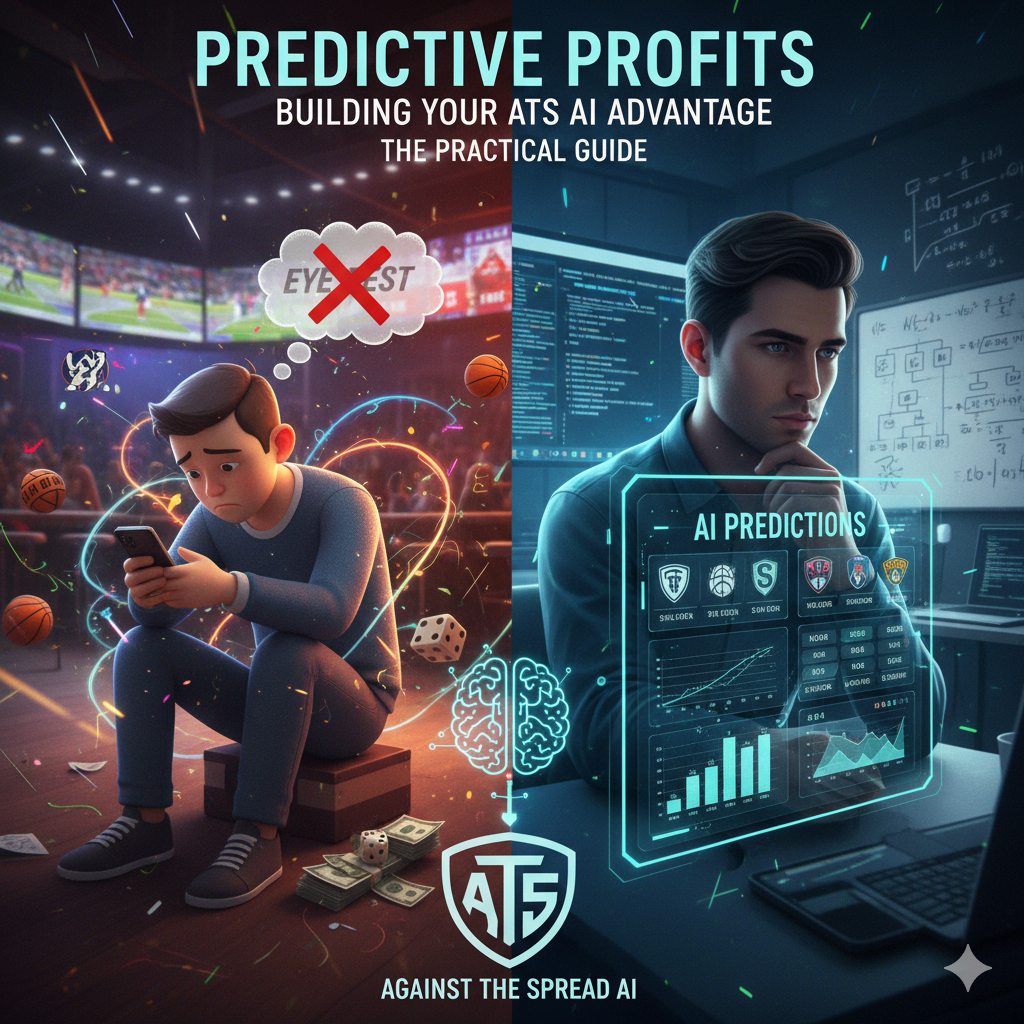
When I first started betting sports, I honestly thought I was the smartest guy in the room. I’d look at ESPN stats, maybe scroll Twitter for injury news, and then fire off a bet because “the vibes felt right.” Yeah, that didn’t last long. After getting humbled by the randomness of NBA back-to-backs and NFL road trips, I realized that gut feelings don’t cut it when you’re dealing with spreads and odds set by the sharpest minds in Vegas.
That’s where AI comes in. I’m not talking about hypey buzzwords or fake “guaranteed locks” you see on random betting accounts. I mean real models that take clean data, transform it into probabilities, and then map those probabilities into bets sized correctly for your bankroll. That’s what this article is about: how to actually build, test, and run an AI system that predicts against-the-spread (ATS) results in a way that holds up on game day.
This isn’t about throwing jargon at you. I’ll walk you through how to think about ATS AI predictions step by step, from setting up your first dataset to calibrating your model, tracking your results, and working ATSwins into your process. Think of this as the practical guide I wish I had when I first decided to move past “eye test” betting.
Table Of Contents
- Definition and scope of ATS AI betting predictions
- Data pipeline and labeling
- Modeling approach
- Evaluation and bankroll
- Workflow with ATSwins
- Practical how-to: from zero to first ATS model in 10 days
- Tools and resources that speed things up
- Example schema and features by sport
- Simple automation blueprint
- Evaluation templates you can copy
- Ethics, compliance, and privacy
- Bringing ATSwins into your ongoing process
- Extra notes on CLV, pushes, and key numbers
- Common pitfalls and quick fixes
- Checklist before placing any ATS wager
- Where to go next
- Conclusion
- Related Posts
- Frequently Asked Questions (FAQs)
Definition and scope of ATS AI betting predictions
So first things first: what exactly are ATS predictions?
If you’re new, ATS means “against the spread.” The sportsbook sets a spread, and your job is to decide if the favorite covers or the underdog keeps it close. Let’s say the Lakers are -7 against the Kings. If you bet Lakers ATS, they need to win by more than seven. If you take the Kings, they can either win outright or just lose by fewer than seven. If the Lakers win by exactly seven, that’s a push and you get your money back.
Now, AI comes in by trying to calculate the actual probability of each of those outcomes based on data. A sportsbook line already implies a probability, but it’s shaded with the vig (the house edge). If your model thinks the true chance of covering is higher than the book’s implied chance, you’ve got an edge. That edge is the whole game—without it, you’re just guessing.
Why does this matter? Because sports betting isn’t about picking winners; it’s about picking value. And you can’t measure value unless you know the probabilities. AI lets you turn team stats, injuries, travel, weather, and even betting market signals into those probabilities.
Data pipeline and labeling
Data is where most beginners trip up. You can’t just scrape final scores from Google and think you’re good. You need clean, timestamped, decision-time data. That means recording what the spread and injuries looked like at the exact time you would have bet—not after the game, not at closing.
For example, if you’re building an NBA model, maybe you decide that you’ll always place bets at 10 a.m. Eastern. That’s your “decision time.” You need to log the spreads, injury statuses, and stats as of that time. If LeBron is later ruled out at 2 p.m., your dataset shouldn’t magically know that. Otherwise, your model is cheating with information you wouldn’t have had in real life.
Features you’ll want include:
Team stats like offensive/defensive rating, pace, yards per play, EPA per play, whatever fits the sport.
Injuries with last confirmed status.
Travel miles and rest days.
Weather for outdoor games.
ELO or power ratings that update weekly.
Market signals like line movement and juice asymmetry.
For labels, it’s simple: did the team cover or not? Pushes you can either exclude or model as their own category, but don’t just throw them in the “loss” bucket or you’ll distort the results.
When I built my first dataset, I underestimated how annoying this would be. Logging sources, versioning data, making sure I wasn’t leaking future information—it felt like extra homework. But trust me, this is where edges are born. One leak and your backtests look like gold when your real-life bets bleed money.
Modeling approach
Once you’ve got your data, now comes the fun part: building the model. Don’t overcomplicate it at first. Start with logistic regression. It’s fast, interpretable, and it forces you to actually check if your data is calibrated. Then, once you’ve got a baseline, move into gradient boosting methods like XGBoost or LightGBM. These handle messy tabular sports data really well.
Neural nets can be cool if you’re modeling play-by-play or drive-by-drive data, but honestly, most of the time they’re overkill. Stick to what works until you’re sure complexity is giving you real lift.
And whatever you do, don’t randomly shuffle your cross-validation. Use rolling or walk-forward splits so your model isn’t secretly learning from the future.
Calibration is huge. If your model says a team covers 60% of the time, it better actually happen around 60% of the time in practice. Plot reliability curves. Use Brier scores. It sounds nerdy, but this is what separates hype from reality.
Evaluation and bankroll
Even the best model is useless if you size your bets wrong. This is where bankroll management kicks in.
The most popular method is fractional Kelly. Basically, if your edge says you should bet $100, you only bet like $25 or $50 instead to reduce variance. You cap your daily exposure, avoid doubling down after losses, and treat bankroll like your lifeline.
Another key metric is closing line value (CLV). If you consistently beat the closing spread, that means your process has signal even if short-term results look shaky. For example, if you take +3 early and the game closes at +2, you beat the market by a point. That’s gold long term.
And please, don’t chase steam. If the number’s gone, it’s gone. Log it, learn, and move on.
Workflow with ATSwins
This is where ATSwins makes life easier. You don’t have to build everything from scratch to take advantage of AI insights. ATSwins delivers data-driven picks, player props, betting splits, and profit tracking across major sports. I personally use it as a cross-check: when my model lines up with ATSwins, I feel more confident. When it disagrees, I pause and double-check my inputs.
It’s like having a second set of eyes. And honestly, in sports betting, that extra layer of accountability helps you avoid dumb mistakes.
Practical how-to: from zero to first ATS model in 10 days
This part is basically a roadmap if you want to actually try building your own model. Think of it as a 10-day crash course:
Day 1: Set up your league and decision time.
Day 2: Collect odds data.
Day 3: Add team stats.
Day 4: Label your data with ATS results.
Day 5: Train a logistic regression model.
Day 6: Try a gradient boosting model.
Day 7: Calibrate and set edge thresholds.
Day 8: Add CLV tracking.
Day 9: Overlay ATSwins signals for cross-check.
Day 10: Run a no-money trial week.
By the end, you’ll know if your pipeline actually works.
Tools and resources that speed things up
There are tons of libraries that make life easier—scikit-learn for models, PyTorch if you get fancy, SHAP for feature explainability. Odds feeds and historical stats are the backbone, and having a clean storage setup for snapshots is underrated.
I wish I’d known this earlier: don’t try to memorize everything. Write runbooks, config files, and templates. Betting is already stressful—don’t make it harder by winging the boring parts.
Example schema and features by sport
Every sport has its own quirks. NFL models lean on EPA, pressure rates, weather, and QB injuries. NBA models care about pace, offensive/defensive ratings, rest days, and late scratches. College football is chaos, so tempo and havoc rates become way more predictive.
The point is, you can’t just copy-paste features across sports. Document your schemas, keep things reproducible, and avoid hidden leakage.
Simple automation blueprint
Once you’re confident, start automating. Poll odds every 15 minutes, trigger recalculations on line moves, and set up alerts for when your edge crosses a threshold.
This is also where ATSwins helps, because you can use their profit tracking and signals alongside your own logs. That way, you’re not flying blind.
Evaluation templates you can copy
Create dashboards for calibration, ROI, and CLV. Do weekly postmortems. Pick a few bets—winners and losers—and trace back why you made them. Was the edge real, or was it noise? The more honest you are here, the faster you improve.
Ethics, compliance, and privacy
Quick but important: make sure sports betting is legal where you live. Only risk what you can afford to lose. If you’re tilting, step back. This stuff should be fun, not destructive.
Bringing ATSwins into your ongoing process
This is where everything comes full circle. You build your model, set your rules, and then use ATSwins as a companion layer. Compare edges, track units, and let their signals push you to keep your own process sharp.
The best bettors I know don’t go solo. They combine their own edges with trusted platforms like ATSwins to stay accountable.
Extra notes on CLV, pushes, and key numbers
A quick note on pushes and key numbers: NFL spreads around 3 and 7 are landmines. Model push probabilities explicitly. Don’t ignore them. And always, always track CLV. Even if you’re break-even on results, positive CLV means you’re on the right path.
Common pitfalls and quick fixes
Pitfalls: using closing lines for backtests, overfitting to one season, ignoring pushes, chasing steam.
Fixes: snapshot at decision time, use multiple seasons, model pushes, set no-bet rules.
Simple, but easy to mess up.
Checklist before placing any ATS wager
Before you click “place bet,” run through this:
- Are your odds and injuries up to date?
- Does your edge clear your threshold?
- Are you within bankroll limits?
- Have you compared against ATSwins signals?
- Is your log ready to capture details?
Yes, it feels robotic, but trust me, discipline is the difference between sharp and broke.
Where to go next
Once you’ve nailed ATS, expand into moneylines, totals, and props. Props especially are where AI can shine, because player-level data is rich and markets can be softer.
And don’t do it alone. Build a team, even if it’s just a buddy who double-checks your logs. Betting is high variance; process discipline is your best edge.
Conclusion
Sports betting is supposed to be fun, but it’s also brutally competitive. If you want to win long term, you need clean data, calibrated models, disciplined bankroll management, and steady review. That’s the playbook.
And if you don’t want to build all that from scratch, ATSwins has your back. It’s an AI-powered platform that gives you ATS picks, player props, betting splits, and profit tracking across the NFL, NBA, MLB, NHL, and NCAA. You can start free, and if you’re serious, you can upgrade for deeper insights. Either way, it’s about betting smarter, not just more often.
Frequently Asked Questions (FAQs)
What are ATS AI betting predictions?
They’re machine learning models that estimate the probability of a team covering the spread. Instead of just picking a winner, you’re comparing your model’s probabilities to the sportsbook’s implied probabilities to find edges.
How can I start with a small bankroll?
Pick one league, set a flat unit size, only bet when your model shows positive expected value, and log everything. After 50–100 bets, review your CLV and ROI.
What data should I track?
Odds history, team and player stats, injuries, travel, rest, and context like weather. Always snapshot at decision time to avoid leaks.
How do I know if my model is good?
Check if you’re consistently beating the closing line (CLV), if your probabilities are calibrated, and if your ROI holds up over hundreds of bets.
How does ATSwins use ATS AI predictions?
ATSwins is built to make this process easier. It gives you AI-powered ATS picks, props, betting splits, and profit tracking. You can compare your own numbers with ATSwins, track units, and make decisions with way more confidence.
Related Posts
AI For Sports Prediction - Bet Smarter and Win More
AI Football Betting Tools - How They Make Winning Easier
Bet Like a Pro in 2025 with Sports AI Prediction Tools
Sources
The Game Changer: How AI Is Transforming The World Of Sports Gambling
AI and the Bookie: How Artificial Intelligence is Helping Transform Sports Betting
How to Use AI for Sports Betting
Keywords:
MLB AI predictions atswins
ai mlb predictions atswins
NBA AI predictions atswins
basketball ai prediction atswins
NFL ai prediction atswins