
AI Sports Picks With Line Movement Tracking - How To Hit CLV
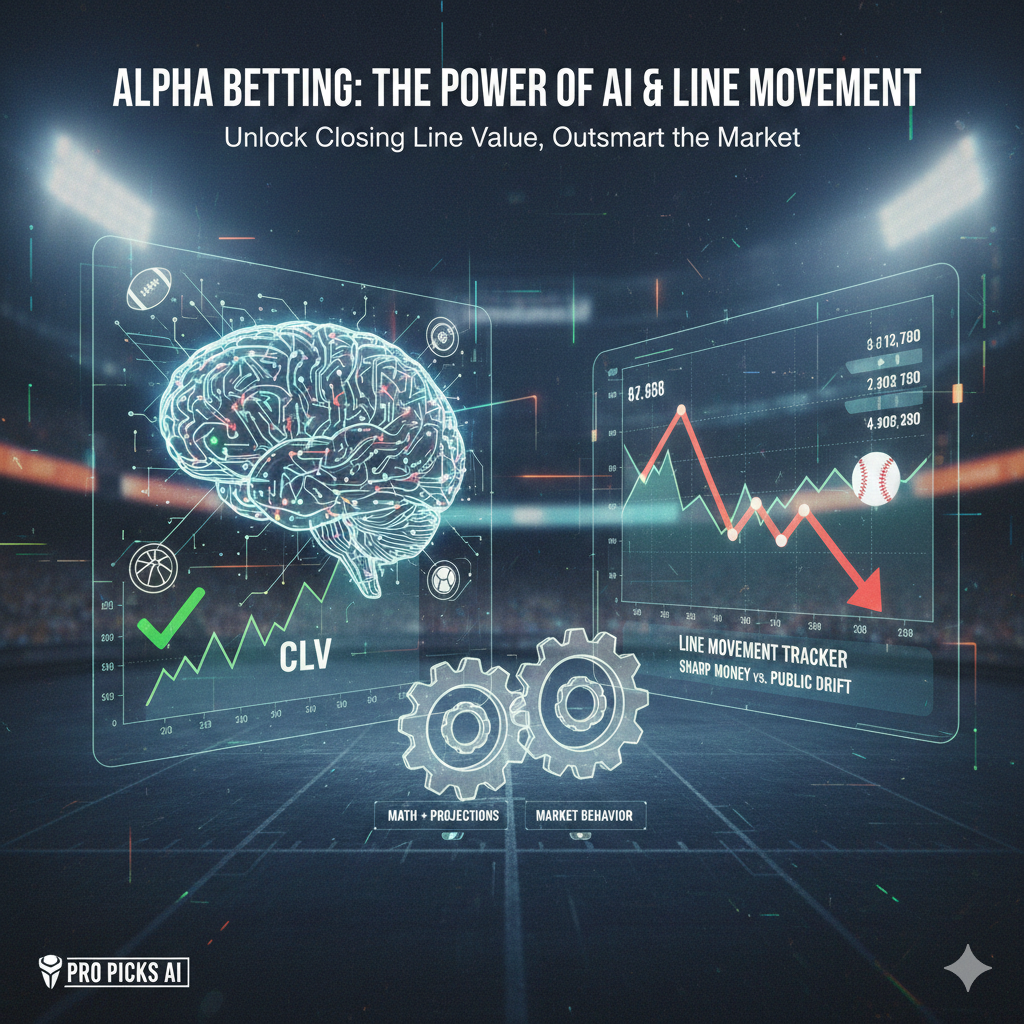
Table Of Contents
- What “AI sports picks with line movement tracking” really means
- Data intake and tracking that will not fail you on game day
- Feature engineering and modeling the market, not just the game
- Backtesting and evaluation that survives scrutiny
- Operations, monitoring, and trust
- How to put this into play with ATSwins
- Useful tools to implement the stack
- Conclusion
- Frequently Asked Questions (FAQs)
What “AI sports picks with line movement tracking” really means
When people hear the phrase AI sports picks, they usually picture some sci-fi model spitting out predictions and magically telling them what to bet. But when you add line movement tracking into the mix, the whole thing becomes way more realistic and, honestly, way more profitable when done right. The real meaning behind AI sports picks with line movement tracking is combining math, projections, and the actual behavior of the betting market to grab valuable numbers before the market corrects itself. If you think of sports betting like a financial market, then line movement is basically price action. The earlier you see real signals and not noise, the more likely you are to grab a number that will eventually close worse than the one you got. That difference is called closing line value, usually referred to as CLV, and it is basically the oxygen that sharp bettors breathe.
A lot of people still think winning bets make you sharp. In reality, beating the closing line consistently is a much stronger indicator. If you’re pulling +3.5 and the market closes +3, you basically bought the stock before it surged. You keep doing that long enough and the long term profit usually follows. It does not guarantee profits every single day, but it shows your process is better than the average bettor who is just reacting late.
Line movement tracking also means understanding why lines move in the first place. There is sharp steam, which is when influential books move in sync within a short window, and then there is public drift, which is when a ton of recreational bettors push a line in one direction simply because of hype or narratives. Knowing the difference matters a ton. For example, if you see a slow move toward a big market team because the public is piling on, but your AI projections disagree, you often get a great opportunity to fade that inflated line. On the other hand, if top books move within minutes of each other, especially on a weekday morning when limits are climbing, your model better react because that movement is usually real.
The whole point here is that AI without market context is like driving a fast car without a steering wheel. You get the horsepower but none of the direction. Once you merge the two, that is where the sharp edges appear. And that is why CLV becomes your north star. It is objective, measurable, and repeatable. Anyone with the data can track it, and it cuts through the randomness that happens in actual games.
At ATSwins , everything revolves around beating the number. They track CLV across NFL, NBA, MLB, NHL, and NCAA games so members can see not just the pick itself but whether the pick actually beat the close. That type of transparency matters more than a hot week or a cold week. The goal is long term process, not streaks.
What most people do not realize is that line movement is rich with information. You can treat it like a live ecosystem that reacts to injuries, weather, travel situations, handle splits, and even internal risk management at books. When you track these movements over time, you start to spot patterns like how certain books move earlier than others, how some markets overreact to news, and how some hold their number stubbornly until better information arrives. When you mix that with model projections, you basically turn the oddsboard into a constantly updating dataset that can improve your betting accuracy.
The idea is simple but powerful: track the market like you track the games themselves. Your AI model might say a team should be favored by 3.5 points, but if the market is still sitting at -2.5 with the juice shading toward -3, that is usually a sign that you need to strike now before the rest of the market adjusts. Over hundreds of bets, these little edges compound. And that is why the fusion of AI and line movement tracking has become one of the strongest ways to find value in sports betting today.
Data intake and tracking that will not fail you on game day
A lot of bettors underestimate just how important clean, consistent data really is. If your odds feed is sloppy, out of sync, or missing books, the entire model becomes unreliable. It is like trying to cook a high end recipe with expired ingredients. No matter how good the chef is, the output will not be right. When you are building AI sports picks that rely on line movement, you need to capture prices from multiple books, across multiple time stamps, and convert everything into clean implied probabilities that your model can actually use.
Odds should be pulled from as many books as possible because you want a mix of sharp market makers and slower recreational books. The sharp books usually move first, which gives you signals. The slower books sometimes lag behind, which gives you opportunities. When you log line ticks with timestamps, you get a full picture of how a market evolved. This helps you understand whether a move is sharp-driven, news-driven, or just random.
Travel, rest, pace, weather, injuries, and betting splits might seem like small details, but in practice, they are huge for modeling. For example, if an NBA team is playing their fourth game in six nights and flying across multiple time zones, their pace and efficiency almost always drop. If an MLB game has heavy winds blowing out, your model for totals must adjust. If an NFL running back is ruled out 45 minutes before kickoff, the spread will usually jump within seconds. AI models thrive on these details because they provide context that raw scores and averages never capture.
A well-structured database makes all of this easier to work with. Each event should have clean identifiers, timestamps, book IDs, and consistent fields for numbers, prices, implied probabilities, and enrichment factors. When done right, you can query line histories, calculate steam events, evaluate price dispersion, and merge everything with model features. When done wrong, you end up with messy logs and unreliable evaluation.
ATSwins has a standardized approach across all major sports. Their system adjusts team and player priors automatically as injuries and travel conditions change, and that gives bettors a realistic baseline before the market even starts reacting. By the time line movement kicks in, the model already knows which teams are fatigued, which conditions might affect totals, and which players might swing a matchup.
The more clean data you feed the model, the more accurate it becomes. And on game day, you want zero surprises. Data needs to be fresh, properly timestamped, and completely aligned with your decision windows. When your model sees a juice flip or an early morning steam event, you need confidence that the data behind that signal is accurate. That is how you turn market moves into real actionable bets instead of just noise.
Feature engineering and modeling the market, not just the game
This is where the fun starts. You can have tons of data, but the value comes from transforming it into features your model can actually learn from. Predicting who wins a game is one thing. Predicting whether the line you are seeing is mispriced is another. The best AI systems do both at the same time. They estimate the game outcome, but they also estimate the probability that the price you are seeing right now will end up being better than the closing price. That second part is what separates recreational modeling from true sharp modeling.
One of the strongest features you can create is a CLV proxy. This is basically a prediction that estimates whether your current line has a high chance of beating the closing line. If your model thinks a spread of -2.5 has a 70 percent chance of closing at -3 or worse, then you know that grabbing -2.5 now is likely profitable. Even if the team loses the game, that does not invalidate your process. Modeling needs to focus on beating the close, not just predicting wins.
Injury adjustments matter a lot too. Instead of treating injuries as simple yes or no variables, advanced models weigh them based on minutes, roles, and replacements. Losing an NBA point guard changes pace and shot distribution. Losing an MLB pitcher affects bullpen usage. Losing an NFL cornerback might dramatically shift expected yards allowed. These details help you build realistic priors before the odds even move.
Market microstructure features are another huge layer. You want variables that represent dispersion across books, move velocity, the likelihood of a key number break, and the impact of juice changes. For example, a move from -110 to -125 with no spread change often implies pressure that will soon trigger a number shift. If your model can detect these patterns early, you can grab edges while they still exist.
A well built modeling stack usually includes logistic regression for calibration, boosted trees for complex interactions, and isotonic regression for probability correction. Time based constraints keep things realistic, and forward chaining avoids leakage. This whole structure ensures that your AI model is predicting what it should be predicting, using only the data that would have existed at bet time.
The end result is a system that does not just understand the sport, but also understands the behavior of the market. Because at the end of the day, you are not betting on the game itself. You are betting on the market's misjudgment of the game.
Backtesting and evaluation that survives scrutiny
A model is only as strong as the way you test it. Backtesting sports betting strategies is notoriously tricky because it is so easy to introduce look ahead bias without realizing it. If your system uses information that would not have existed at the time of the bet, your results become fantasy. That is why forward chaining matters so much. Train on old data, validate on new data, and keep moving through the timeline.
The most important metrics are ROI, CLV hit rate, and edge decay. ROI is obvious, but CLV hit rate shows how often your bets beat the closing number. If that number stays above 55 to 60 percent over large samples, you usually have a winning process. Edge decay shows whether the market quickly corrects toward your model or whether your signals are weak. Strong signals usually decay fast because the market eventually moves to your fair price.
Realistic backtesting also needs slippage, limits, and rejections. You cannot assume perfect fills at perfect prices. Books throttle bettors, delay bets, or shift lines faster than your execution. So your simulator has to apply realistic penalties. That way your backtest resembles actual conditions.
Sizing strategies matter too. Kelly sizing is mathematically optimal in theory but very volatile in practice. Fractional Kelly is way more realistic for humans. Most experienced bettors cap bets between 0.5 percent and 2 percent of bankroll. Correlated exposures should shrink bet sizes because you do not want half your bankroll riding on one game indirectly.
A good model with bad risk management will still blow up. A decent model with disciplined sizing can survive streaks easily. Backtesting needs to reflect the world you will actually bet in, not an idealized casino simulator.
Operations, monitoring, and trust
Once your model and backtesting are solid, you need operational guardrails. Real time monitoring prevents bad data or glitches from triggering bad bets. If a book feed goes stale, if implied probabilities sum incorrectly, or if only one book moves violently while others are frozen, you need circuit breakers. The safer the system, the more consistently the model performs.
Versioning also matters a lot more than people think. Every change to your model, your features, your data sources, or your sizing rules needs to be recorded. That way you always know what version created which results. It helps you spot regressions, improvements, and unintended side effects.
ATSwins uses all these principles in their own infrastructure. They track fresh data, profit, CLV, and model performance across all sports. They also let members see performance in context, not just raw picks. That builds trust because bettors can see the reasoning and the numbers, not just outcomes.
Legal considerations matter too. Sports betting is regulated, and bettors should always follow local rules. Responsible bankroll management keeps betting fun instead of stressful. The whole purpose of modeling is to make betting smarter, not riskier.
How to put this into play with ATSwins?
Putting all of this into actual practice takes a blend of planning, discipline, and real time reaction. Most bettors start by choosing a bankroll that they can lose without affecting their life. Then they choose a unit size, usually around one percent. That becomes the building block.
From there, you choose your markets. Sides and totals are the easiest starting point. Props can be softer but also have lower limits. Once your markets are chosen, you configure alerts based on your thresholds. For example, you might want an alert only when projected EV is above two percent and the probability of beating the closing line is above sixty percent.
Once alerts come in, you scan line screens to see whether the move is real. Juice flips matter a ton. You want to act before numbers move, not after. If dispersion across books is wide, that usually means there is opportunity. If the market is tight, you might size down.
You also cross check injuries, splits, and travel conditions. If everything lines up with your model and the move direction, you place the bet. Fractional Kelly helps convert your edge into bet size, while caps keep it safe.
Every bet should be logged with the line you took and the closing line. That log becomes gold after a few weeks. You can see where you consistently beat the number, where you are late, and where your signals are strongest. Over time, your process becomes cleaner and sharper.
Daily routines help too. Mornings are great for reviewing overnight moves. Midday is great for lineup checks. Evenings are great for reacting to final news and then auditing CLV. Each part of the day gives different opportunities depending on the sport.
ATSwins integrates many of these steps automatically. Their AI picks come with movement context, splits, confidence levels, and profit tracking. Members can use their insights to find edges faster and more confidently. Free members get meaningful picks. Paid members get more real time firepower across more markets and props.
Useful tools to implement the stack
You do not need a massive tech stack to run a solid system, but you do need reliable odds, historical stats, modeling frameworks, and clean storage. Tools for modeling like scikit-learn, LightGBM, and Poisson frameworks help you build probability estimates. Data storage tools keep things organized. Monitoring tools track freshness and anomalies. The whole point is to make sure your AI model sees clean data, knows how to react to the market, and can be calibrated and backtested in a way that holds up under real conditions.
ATSwins already handles a lot of this burden for bettors. Instead of building a whole infrastructure from scratch, members can plug into a system that already tracks CLV, splits, projections, props, and model edges. But if you are building your own system, these tools help create a reliable workflow.
Conclusion
The combination of AI sports picks and line movement tracking is one of the most powerful edges available to sports bettors today. When you understand how prices move, how to detect sharp signals, how to react before key numbers break, and how to measure your performance with CLV, you give yourself a real shot at beating the market. None of this is about guessing winners or chasing streaks. It is about turning noisy odds into actionable signals. Whether you are building your own stack or using a platform like ATSwins, the core foundations remain the same. Track the market. Respect the numbers. Stay disciplined. And let the long term math do its job. ATSwins gives bettors AI powered picks, player props, betting splits, and profit tracking so you can see exactly where the value is. Free and paid plans offer tools that help you bet smarter and more confidently across all major sports.
Frequently Asked Questions (FAQs)
What does “AI sports picks with line movement tracking” actually mean?
AI sports picks with line movement tracking means combining model projections with real time odds changes to identify mispriced numbers before the market corrects itself. It is not about guessing winners. It is about consistently getting better prices than the closing line.
Why is closing line value so important?
Because it is the strongest long term indicator of skill in sports betting. If you repeatedly beat the closing number, it usually means your read on the market and the matchup is better than average. It smooths out short term luck and focuses on process.
How does ATSwins use this approach?
ATSwins presents AI picks with context around line movement, betting splits, model confidence, and profit tracking. Members can see whether a pick beat the close and how strong the signal was. This transparency helps users trust the process instead of relying on streaks.
Related Posts
AI For Sports Prediction - Bet Smarter and Win More
AI Football Betting Tools - How They Make Winning Easier
Bet Like a Pro in 2025 with Sports AI Prediction Tools
Sources
The Game Changer: How AI Is Transforming The World Of Sports Gambling
AI and the Bookie: How Artificial Intelligence is Helping Transform Sports Betting
How to Use AI for Sports Betting
Keywords:
MLB AI predictions atswins
ai mlb predictions atswins
NBA AI predictions atswins
basketball ai prediction atswins
NFL ai prediction atswins
ai betting analysis