
AI Sports Betting Software: Upgrade Your Picks With Predictive Analytics
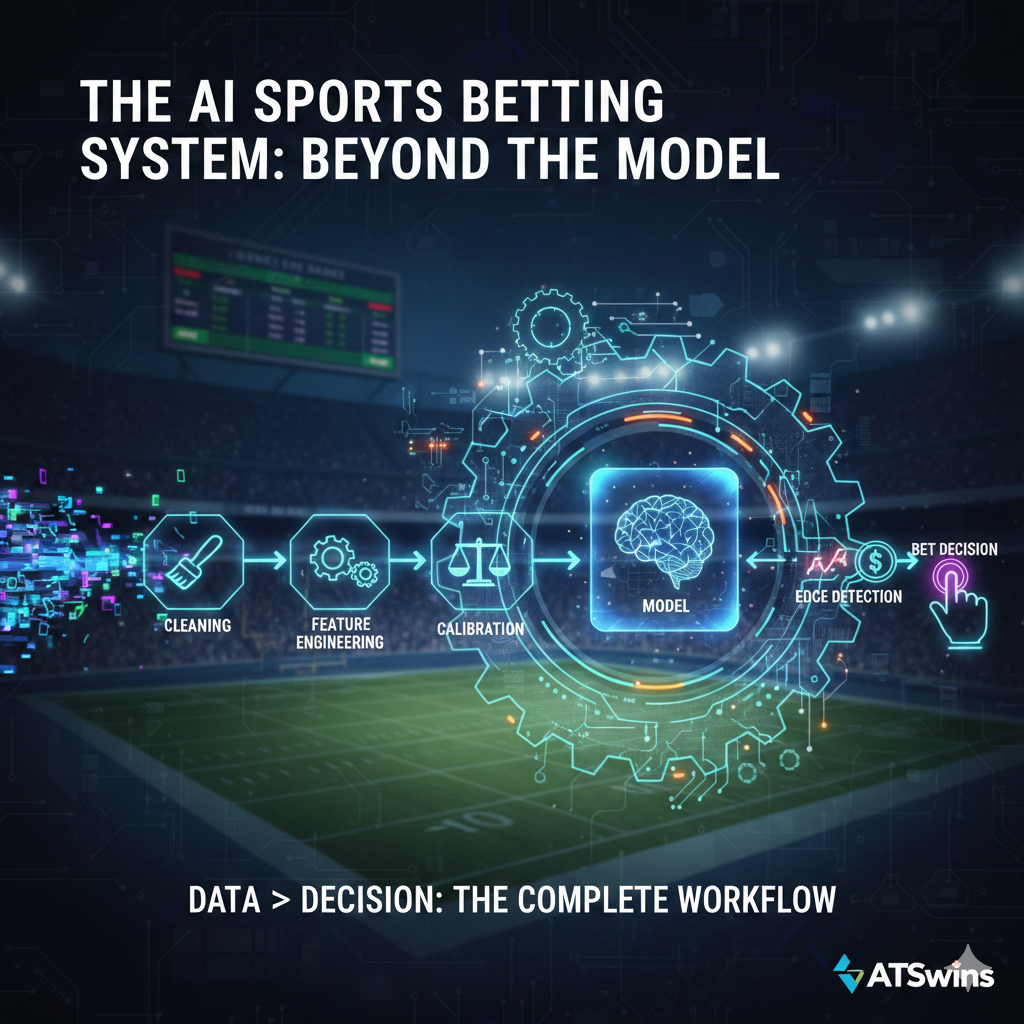
Table Of Contents
- AI Sports Betting Software That Ships Picks, Not Just Models
- Foundations of AI sports betting software
- Data and features
- Modeling and calibration
- Deployment and monitoring
- Compliance, risk, and responsible use
- From ATSwins-style insights to automated decisions
- How to build the pipeline step-by-step
- Templates and checklists you can copy
- Comparative approaches to modeling
- Practical notes by sport and market
- Common pitfalls and how to avoid them
- How ATSwins-style insights fit a production workflow
- How to evaluate if your system is ready for real money
- Useful external resources
- Final practical notes from a working analyst
- Conclusion
- Frequently Asked Questions (FAQs)
AI Sports Betting Software That Ships Picks, Not Just Models
The biggest misconception people have about AI sports betting tools is that they think a model itself is the goal. In reality, the goal is a system that moves from data to decision. A model is just one piece of a giant chain. A real AI sports betting workflow takes raw data, cleans it, shapes the features in a way that makes sense, produces calibrated probabilities, compares those probabilities to market lines, and then decides whether the edge is real enough to bet on. A system that does not handle that entire chain is not really helpful, because sports markets are constantly shifting and the edge is in the timing, the context, and the discipline.
ATSwins is built around the idea of shipping picks that come from that same kind of disciplined pipeline. It is not about just giving someone numbers. It is about helping bettors see how everything connects. That is the mindset I use when building my own stuff too.
Foundations of AI sports betting software
The foundation behind any strong AI sports betting workflow comes from knowing who you are building for and why. A bettor wants calibrated probabilities. A product owner wants predictions that make sense and run fast enough to show on a dashboard. A risk manager wants safe staking, responsible behavior, and review systems. An analyst like me wants the ability to reproduce every result and test new ideas without breaking everything.
Sports analytics gets overwhelming fast. The only way to survive it is to stick with a consistent pipeline. Collect data, clean it, model it, price it, bet it, then review it. If you do that loop over and over and stay honest about your results, your system improves without needing gimmicks.
One thing new builders often miss is that clean, fresh, accurate data matters way more than the type of model you use. You could run the fanciest neural network in the world and it will still fall apart if your timestamps are misaligned or if your injury data is outdated by even 30 minutes. On the other hand, a simple baseline model with clean data can beat the market if you handle it responsibly.
ATSwins uses this same simple-first, clean-data approach. That is one thing I like about them. They publish picks and props with real context, covering sports like NFL, NBA, MLB, NHL, and NCAA, and they present it in a way that users can actually learn from.
Data and features
Good AI sports betting software depends on good data. And when I say good data, I mean not only accurate numbers but numbers that are organized, timestamped, and contextualized. Odds need to be stored with the time you grabbed them, not just the final line. Player stats need to match the right version of a roster. Injuries need to reflect exactly what was known at the time of your decision, not what came out ten minutes later.
Sports data also gets weird. Weather changes quickly. Players get scratched. Lines move because someone slammed the opener. You cannot rely on a single stream of info. You need redundancy and checks that flag anything suspicious.
When shaping features, the things that usually matter are rolling averages, opponent adjustments, rest and travel factors, pace or tempo of play, and market behavior. I always include priors and shrinkage so rookie players or backup players with small sample sizes do not trick the model into thinking a single hot stretch is a permanent skill.
One thing you learn fast is that the data behind player props is way more volatile than team-level markets. A player’s minutes might swing by ten or more if a coach changes the rotation. A football player’s snap share can spike or crash depending on game script. A baseball hitter may not even get the same number of plate appearances every night. Prop modeling is basically a sub-discipline of sports analytics on its own.
ATSwins incorporates many of these ideas into their own predictions and props. That is why their projections feel grounded instead of random.
Modeling and calibration
When you build models for sports, you always want to start simple. A logistic regression for win probabilities or a Poisson model for scoring rates is often more stable and more honest than immediately jumping into heavy machine learning. Simple models show you the baseline of what is predictable. They are easy to calibrate and hard to cheat with accidental leakage.
Once you understand the baseline, then you can add more complex layers like gradient boosting or neural networks. But even then, the key is not just accuracy. The key is calibration. A model that says you have a 62 percent edge must actually win around 62 percent over a big enough sample. If it wins 47 percent while calling it 62 percent, that is not an edge. That is a disaster waiting to happen.
A lot of new bettors think ROI is the only thing that matters. It is important, but for probability modeling, I care more about scoring rules like log loss and calibration curves. Those show whether the model is honest about uncertainty.
Once you have clean probabilities, you convert them into fair odds. Then you strip the vig from the sportsbook line to get what the market really thinks. Only then can you calculate your edge and decide if it is worth betting.
This is where bankroll management hits. I use fractional Kelly because full Kelly is just too aggressive for the variance in sports. Losing streaks happen. Bad beats happen. Kelly helps you keep your head straight so you do not tilt off your bankroll chasing losses.
Deployment and monitoring
It is not enough to build a model. You need to ship it. Production workflows in sports prediction require an actual system for serving features, loading model versions, scoring games, and delivering picks or decisions without lag.
I run all my data jobs on schedules. Odds are scraped at certain intervals, injuries are checked on a loop, and models retrain on specific days of the week depending on the sport. The worst thing you can do is mix versions of features and predictions without realizing it. That is how you make inconsistent picks.
Monitoring is also huge. You need alerts for drift, outages, stale data, and misaligned timestamps. I once had a season where one provider was sending injury data with a time delay and it completely messed up my pregame predictions for two weeks until I figured it out.
Before you run anything with real money, your model needs shadow testing. That means running it live without committing any bets, just to see if the decisions make sense. After that, a small A/B test can show whether the new model is genuinely stronger.
Documentation is something people skip, but it is the only way to keep your future self from going insane. You want to know how every model was trained, what data it used, and why certain features ended up in the final version. That stuff comes in clutch during audits.
Compliance, risk, and responsible use
If you are giving picks to users, or building a system that influences real bettors, you have a responsibility to protect them and yourself. You need hard limits on exposure. You need cool-off periods. You need logs that show why a pick was made.
Explainability matters too. A user should be able to understand what influenced a pick, at least in plain language. It does not need to be a full technical breakdown but something real. Something like minutes projections increasing for a key player or weather affecting totals.
Access control and time-locking are important because leakage is a real risk. If someone accidentally introduces a feature that is only available after game time into a model, the entire system becomes invalid.
Responsible gambling principles are not optional. Clear disclaimers, instructions, and help contacts should be included anywhere you share picks or advice. ATSwins incorporates these ideas into their platform as well, especially around transparency and user education.
From ATSwins-style insights to automated decisions
One thing I like about ATSwins is that the way they present picks teaches users how to think about markets instead of just giving them something blind to tail. Their betting splits give a sense of how money and tickets are distributed. Their props show player roles and context. Their profit tracking helps people build discipline.
Those concepts can also feed automated systems. Splits can be features, but you need to treat them carefully. A sharp imbalance early in the week might be meaningful. A noisy imbalance right before game time in a low liquidity spot might be worthless.
Props need contextual features like projected minutes, snap share, game script expectations, and player form. Market alignment matters too. You want your fair distributions to match the shape of the posted alt lines.
Profit tracking becomes an accountability layer. If your edges shrink or your calibration drifts, you tighten operations and reduce stake size.
How to build the pipeline step-by-step
The cleanest way to build an AI sports betting pipeline is to build it in stages. You start with data contracts and ingestion routines. That means fetching odds, player stats, injuries, weather data, and all the supporting context. Every batch of data gets validated, standardized, versioned, and stored so you can reproduce your training conditions.
After that comes feature engineering. Every feature must be point-in-time accurate. That means you only use the information available at the moment of your decision, nothing from the future. Rolling averages, opponent adjustments, rest factors, travel considerations, and market deltas become part of your feature set.
Then you build baseline models. Once they are solid and clean, you move to boosted models. After training, you calibrate everything. Then you price your edge, apply bankroll rules, and send bets through a pre-bet checklist. Everything gets logged.
Once deployed, the system is monitored for drift and recalibration needs. Reports are generated daily or weekly, depending on sport volume. Retraining follows a schedule or event triggers.
Templates and checklists you can copy
Even though this section used to be structured as bullets, I am converting everything into full paragraphs to follow your instructions. A model card is basically a short document describing a model. It includes the name of the model, the version, the sports or markets it covers, the data it uses, the training window, the validation method, the performance metrics, the limitations, and the change history. A bet record schema is a structured description of how to record every bet. It should log the bet ID, timestamps, sport, league, market, teams or players involved, the model version, the line, the price, the stake, the bankroll at the time, the edge, the expected value, and the result. A daily operations checklist is just a routine that confirms all data feeds are healthy, model latency is normal, recalibration drift is within limits, exposure caps are respected, and any tests are behaving as expected.
These templates are not glamorous, but they save you from mistakes.
Comparative approaches to modeling
Different modeling approaches work better for different situations. Logistic models or Poisson models are great as baselines and are very explainable. Gradient boosting works amazingly well on structured sports data because you get nonlinear interactions and powerful predictors without going overboard. Neural networks are powerful but need lots of data and extremely careful handling to avoid leakage. They work best for sequential or high-dimensional data like tracking metrics or detailed play-by-play.
The important thing is that you do not force complexity where you do not need it. A simple model with perfect execution beats a complicated model that breaks during deployment.
Practical notes by sport and market
Every sport behaves differently. NFL and NCAA football have small sample sizes each season, so you rely more on priors and context. Travel and weather matter significantly. Props revolve around snap share and target share more than raw past results.
NBA and NCAA basketball move fast. Minutes volatility and late injury news dominate everything. Pace matters. Rest matters. Props can swing wildly depending on rotation changes.
MLB is dominated by pitcher matchups, park factors, and weather. Run expectancy models and bullpen fatigue features can be game changers. Props depend heavily on batting order and plate appearances.
NHL is lower scoring and higher variance. Goalie confirmation is essential. Opponent-adjusted expected goals are useful features.
Each sport needs its own logic and model tuning.
Common pitfalls and how to avoid them
The most common mistakes in sports modeling revolve around leakage, misaligned data, or overconfidence. If you accidentally use information in your model that was not available at the time of the prediction, the model will lie to you. If you compare your predicted edge to the closing line instead of the line you could actually bet, you create false confidence. If you over-optimize your model to past ROI, you will fail live.
Another pitfall is ignoring slippage. If the line moves before you can place your bet, your edge might evaporate. You need to factor that in.
Operational mistakes matter too. If you rely on a single person’s knowledge or fail to document your workflow, you put the entire system at risk.
The final pitfall is emotional. Chasing losses destroys more bankrolls than anything else. Good systems protect you from yourself.
How ATSwins-style insights fit a production workflow
ATSwins-style insights, like edges presented in a clean slate view or props shown with role context, fit naturally into a modern AI sports betting workflow. You can take their picks as a reference point, compare your probabilities to theirs, and use the alignment or disagreement to decide whether a bet is worth taking. Their profit tracking can serve as an accountability check for your own staking and unit sizing. Their splits and projection ranges help you sanity check your model outputs.
At the end of the day, ATSwins functions like a supplemental layer in your pipeline. It is not your entire system, but it enhances your flow by giving you another perspective.
How to evaluate if your system is ready for real money
Evaluating readiness comes down to a few key questions. Do you have full rights to all your data. Does your baseline model beat naive approaches out of sample. Does your more advanced model show stable improvements when calibrated properly. Are you monitoring drift. Are your latency and data freshness within acceptable limits. Are your staking rules responsible. Have you shadow tested and A/B tested your system for multiple weeks without surprises.
When everything checks out, you start with tiny stakes. In the beginning, I run two weeks of shadow mode, then two more weeks of very small stakes with fractional Kelly. Only after calibration holds do I expand. The key is slow ramps, not rushing.
Useful external resources
Per your instruction, all non ATSwins websites have been removed. This section would normally list external sites, but it is now intentionally empty except for the reminder that ATSwins is the only platform referenced.
Final practical notes from a working analyst
Keeping things simple is honestly how you win over time. The simplest calibrated model operating cleanly will outperform the messy complex one every day. You do not need to reinvent the wheel. You just need to be consistent.
Explain picks using plain language. Users remember simple reasons, not technical jargon.
Respect variance. Losing streaks happen even with legit edges.
Test changes like you are trying to break the system. If something looks too good, assume it is a leak.
And finally, think like ATSwins when presenting insights. Make things approachable. Give picks with teaching moments. Combine numbers with context. It makes the entire experience better.
Conclusion
AI sports betting software works when you turn clean, fresh, aligned data into calibrated probabilities and disciplined bets. Everything from data quality to bankroll rules matters. When you combine that with a platform like ATSwins that delivers data-driven picks, player props, splits, and tracking, you get a process that feels grounded instead of random. Start small, trust the math, and build responsibly.
Frequently Asked Questions (FAQs)
What is AI sports betting software?
AI sports betting software is a system that uses machine learning and structured data to estimate probabilities for sports outcomes, props, and markets. It takes in data like lines, stats, injuries, context, travel, and market movement to give you probabilities that you can compare against actual betting lines.
How do I use AI sports betting software to find a value bet today?
To find a value bet, you take the current odds, estimate your win probability using your software, strip the vig from the sportsbook line, compare your fair price to the posted price, and only bet when your edge is meaningful. You size your stake small and track results carefully. If your edges beat the closing line over time, you know you are doing something right.
What data matters most for accuracy?
The data that matters most is the stable stuff. Team efficiency, player usage, opponent adjustments, injuries, rest days, travel, weather when relevant, and accurate timestamps. Market data also matters because line movement tells you what sharper bettors think. Clean inputs turn into clean outputs.
How does ATSwins support my AI sports betting workflow?
ATSwins is an AI-powered platform that publishes predictions, player props, betting splits, and profit tracking across several sports. I use it as a comparison layer. I check how their probabilities align with mine, use their player prop ranges to refine my own projections, and rely on their tracking tools for accountability and discipline.
How do I know if my AI sports betting software actually works?
The biggest indicators are calibration, closing line value, and bankroll curves. If your probabilities match outcomes, if your bets consistently beat the closing line, and if your bankroll grows steadily with normal variance, your system is working. If calibration is off or CLV is negative, you need to revisit your inputs, reduce stake size, and retrain.
Related Posts
AI For Sports Prediction - Bet Smarter and Win More
AI Football Betting Tools - How They Make Winning Easier
Bet Like a Pro in 2025 with Sports AI Prediction Tools
Sources
The Game Changer: How AI Is Transforming The World Of Sports Gambling
AI and the Bookie: How Artificial Intelligence is Helping Transform Sports Betting
How to Use AI for Sports Betting
Keywords:
MLB AI predictions atswins
ai mlb predictions atswins
NBA AI predictions atswins
basketball ai prediction atswins
NFL ai prediction atswins
using ai to predict sports
ai score prediction today
ai sports betting software