
ai soccer prediction tool for epl - How to pick winners
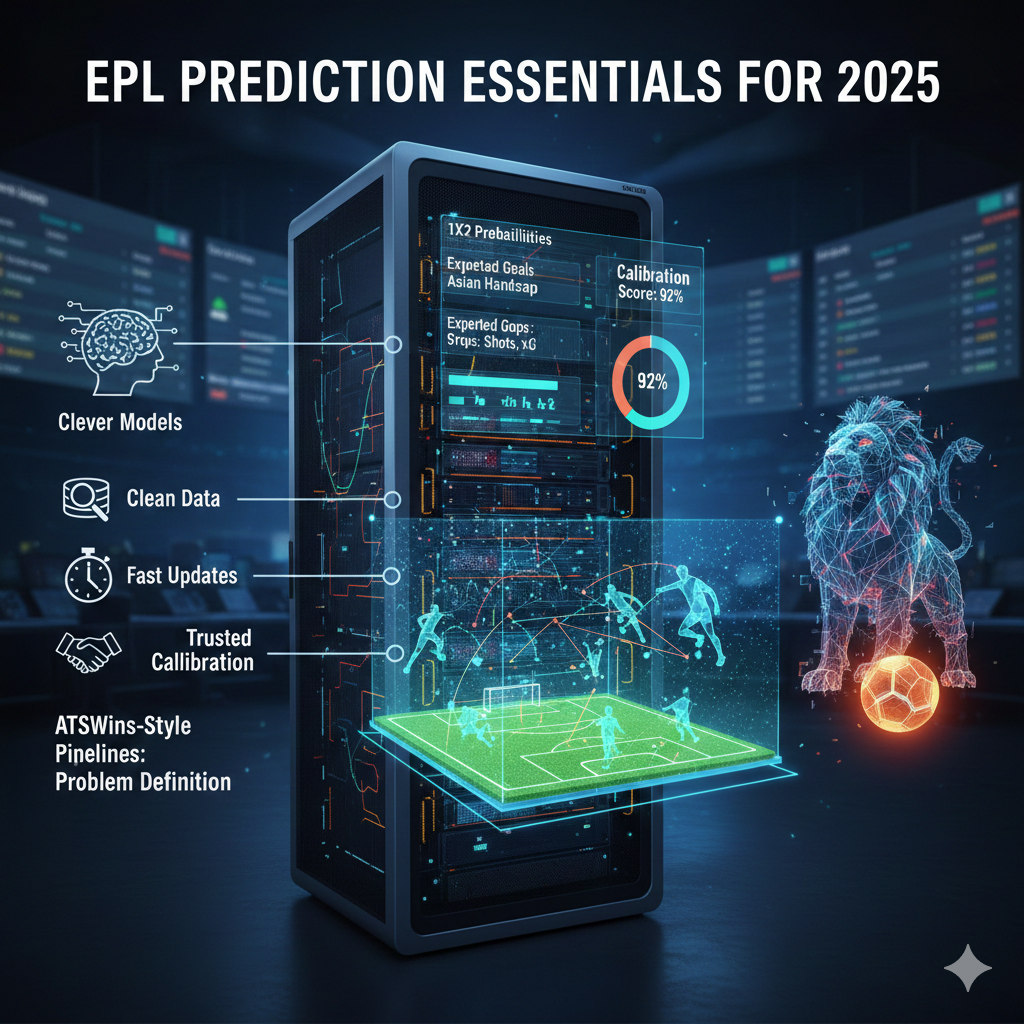
Every weekend I turn models into match edges, blending football sense and data. In this piece, I’ll show how I forecast EPL results with xG, schedule context, and market calibration step by step. We’ll keep it practical, explain choices, and highlight what actually moves probabilities and bankrolls without the fluff. You’ll leave with a clear, repeatable workflow.
Table Of Contents
- EPL prediction essentials for 2025
- Data and feature engineering
- Modeling and workflow
- Evaluation and calibration
- Deployment and workflows
- Step-by-step: from zero to a working MVP
- Practical templates you can reuse
- Modeling choices: what to use when
- Profit-facing design decisions
- Handling injuries and lineups effectively
- Edge detection beyond raw probabilities
- Scaling to props and complements
- Common pitfalls and practical fixes
- Analyst workflow for weekly EPL slates
- Reference stack and where each piece fits
- What “good” looks like after three months
- Conclusion
- Frequently Asked Questions (FAQs)
Calibrated probabilities beat hunches. Use time-based splits, prevent leakage, and track Brier and log loss for truth. The inputs that really matter include xG, shots, injuries and suspensions, lineup news, rest and travel, set pieces, and market odds after removing the vig. Build a repeatable workflow by cleaning data, starting with a Poisson baseline then moving to trees or boosting, and use isotonic or Platt scaling for calibration while shipping daily updates near kickoff. Only act when your edge clears fees and slippage. Bet smaller during noise, log results, and monitor drift season to season. We apply this every week at ATSwins , an AI-powered sports prediction platform offering data-driven picks, player props, betting splits, and profit tracking across NFL, NBA, MLB, NHL, and NCAA. Free and paid plans give bettors insights and guides to make smarter, more informed decisions.
EPL prediction essentials for 2025
Building an EPL prediction tool in 2025 is not just about clever models. It’s about clear targets, clean data, fast updates, and honest calibration that bettors and analysts can trust. From work inspired by ATSwins-style pipelines, here’s a problem definition that keeps projects grounded.
What you predict includes 1X2 outcomes, which are home win, draw, and away win probabilities, Asian handicap lines with fair handicap line and cover probabilities, totals such as expected goals sum and probabilities for common totals, and optionally player-level props like shots, shots on target, goals, cards, and corners. Player-level props are useful, but only after match markets are reliable.
Latency and coverage are key. Latency targets should refresh daily and then update within minutes once lineups drop. First-pass probabilities should be available 24 to 48 hours before kick-off, with sharper numbers released inside 30 minutes. Coverage should include every EPL fixture, not just cherry-picked plays. Full coverage proves stability even if alerts are only sent on high-value spots.
Explainability matters as much as the numbers. Users ask why as much as what. Key drivers for each probability include injuries, rest days, travel, last-five xG trends, and market drift. Explanations should be consistent across matches and concise, with multi-line model insights accompanied by a one-sentence summary.
Evidence over anecdotes is essential. Since there is no single canonical EPL AI tool, authoritative inputs that are updated and unambiguous should be prioritized. This includes official fixtures and results, shot-based xG, injuries and suspensions, schedule congestion, and bookmaker odds for calibration.
Calibration matters because raw model scores are not probabilities. Scores should be calibrated to the market and historical outcomes to reduce overconfidence. For props, separate calibration by market type is necessary.
Finally, predictions should align with ATSwins-style value, offering data-driven picks and probabilities that stand next to market lines. Betting splits and public money can be context but are not the target. Profit tracking and model drift monitoring build trust over time.
Data and Feature Engineering
Core data sources and what to collect include fixtures and results, advanced team and player stats, odds and market signals, injuries and suspensions, congestion, rest, and travel, and managerial and promotion context.
Fixtures and results should capture the official match schedule, kickoff times, venues, referees, full-time results, goals, cards, and substitutions. Advanced metrics include shot-based xG and xA, shot-on-target numbers, shot locations, and set-piece xG. Pressing proxies such as PPDA, high turnovers, and counter-press recoveries can be constructed if direct measures are unavailable. Set-piece rates include corners won, set-piece shot share, and aerial duel win rates. Player stats should cover minutes, roles, positions, and recent lineup continuity.
Odds and market signals include pre-match and closing lines for 1X2, Asian handicap, totals, and implied probabilities after removing the overround. Injuries and suspensions should track expected minutes lost, not just binary in/out, and manual overrides should account for breaking news. Congestion, rest, and travel must consider days since last match, days until the next match, fixture density, and travel burden for European or away trips. Managerial context includes date and style of changes and promoted team priors with adjustment speed.
Data model and merging tips include using consistent team IDs, storing fixture ID, season, matchweek, and kickoff in UTC, and maintaining snapshots at T-48h, T-24h, T-3h, and T-30m for anti-leakage evaluation. Missing values can be forward-filled, and unknown injury statuses estimated probabilistically. Document data rights, usage limitations, and rate limits.
Feature engineering that moves the needle includes rolling form and xG trends, opponent-adjusted stats, set-piece and crossing metrics, pressing and transition proxies, lineup continuity and absences, travel and congestion flags, referee tendencies, promoted team priors, manager change features, and market-implied probabilities.
Targets include 1X2 probabilities, goals for/against using Poisson targets, and totals with binary over/under or regression on expected total goals.
Modeling and Workflow
Baselines first involve Poisson and Dixon-Coles-style modeling. Each team’s goals are modeled with attack and defense strengths and home advantage. Probabilities for 1X2 and totals are derived from joint goal distributions, optionally with Dixon-Coles corrections. Baselines provide a sturdy floor, helping ensure complex models improve upon the basics.
Tree ensembles and modern stacks include gradient boosting or HistGradientBoostingRegressor classifiers and regressors. Classification is used for 1X2 outcomes, regression for goals or totals, and Poisson baseline outputs can feed into classifiers.
Time-aware pipelines should use leakage-safe encoders, feature scaling for continuous features, grouped time splits, and snapshots before and after lineup news. Post-hoc calibration can be done with isotonic regression or Platt scaling per market type. Explainability uses SHAP-style summaries distilled to three to five drivers per match. Experiment tracking logs data snapshots, hyperparameters, model files, calibration objects, and SHAP summaries.
Evaluation and Calibration
Walk-forward backtests split data by week or four-to-six match blocks. Both pre-lineup and post-lineup models are evaluated, storing match lists and opponent context for reruns.
Metrics that matter include Brier score for probability quality, log loss to penalize overconfidence, and mean absolute error for totals and handicaps. Calibration checks involve reliability plots, expected calibration error, segment calibration by odds ranges, clubs, and time windows.
Profit simulations test flat and Kelly fractional staking, with friction assumptions, max stake caps, and comparison against market-implied baselines. Stress tests cover red cards, fixture pile-ups, injury waves, and other edge cases. Leakage guardrails ensure no future data contaminates predictions. Stability checks across clubs and seasons include recalibrating home advantage and monitoring for drift.
Deployment and Workflows
Daily prediction cadence includes nightly ingestion of new data, generation of T-48h and T-24h predictions, matchday updates at T-3h and T-30m, and exposing outputs to users with probabilities, fair lines, and top drivers. Clear handling of high uncertainty, alerts, and monitoring for data freshness, model drift, and market drift are crucial. Documentation, audit trails, and privacy measures maintain compliance and security.
Step-by-Step: From Zero to a Working MVP
Week 1 focuses on data plumbing, storage, fixtures, results, odds ingestion, and first features. Week 2 develops baselines and calibration with Poisson and gradient boosting models. Week 3 expands features, adds SHAP explanations, and starts profit simulation. Week 4 handles deployment and monitoring with scheduled predictions and alerting dashboards.
Practical Templates You Can Reuse
Feature checklists, model pipelines, and deployment checklists are outlined for team strength, situational factors, personnel, style, market, priors, preprocessing, training, calibration, explainability, logging, jobs, alerts, monitoring, and governance.
Modeling Choices: What to Use When
Poisson baselines are simple and explainable but limited in interactions. Tree ensembles are strong on tabular data but require careful calibration. Hybrid approaches feed Poisson outputs into tree models for pre- and post-lineup scenarios, with quantile regression or bootstrapping for uncertainty bands.
Profit-Facing Design Decisions
Market-relative outputs, edge reliability scoring, staking logic, reporting cadence, and ATSwins-style transparency ensure practical, profitable application.
Handling Injuries and Lineups Effectively
Pre-match windows use probability of playing, expected xG impact, and insider updates. Post-lineup windows rebuild features with actual lineups and adjust uncertainty bands. Bench and substitution impacts are considered when data allows.
Edge Detection Beyond Raw Probabilities
Market drift, congestion traps, and weather/pitch conditions are monitored to refine alerts.
Scaling to Props and Complements
Player-level props for shots, shots on target, cards, and corners require strong lineup certainty and careful calibration, integrated with ATSwins-style profit tracking.
Common Pitfalls and Practical Fixes
Leakage, overfitting, miscalibration, ignoring uncertainty, inconsistent data definitions, and silent data outages are addressed with timestamped odds, mixed rolling windows, proper calibration, uncertainty bands, canonical team mappings, and data freshness monitors.
Analyst Workflow for Weekly EPL Slates
From Monday to matchday, calibration review, injury updates, probability generation, alert drafting, pre-match refreshing, and post-match tracking maintain consistent process.
Reference Stack and Where Each Piece Fits
Fixtures, stats, odds ingestion, modeling pipelines, and experiment tracking form the foundation for reproducible and reliable predictions.
What “Good” Looks Like After Three Months
Stable calibration, market-aware edges, transparent reporting, ATSwins-style value delivery, and repeatable results indicate a mature and trustworthy workflow.
Conclusion
We covered the essentials for an AI soccer prediction tool in the EPL. Blend xG and team news, schedule context, and market calibration, with leakage-safe modeling, walk-forward testing, and clear probabilities. Start small with fixtures and rolling xG, validate weekly, and for sharper picks, ATSwins provides a platform for data-driven picks, props, betting splits, and profit tracking across multiple sports. Free and paid plans guide smarter decisions.
Frequently Asked Questions (FAQs)
How does an AI soccer prediction tool for EPL work, and how to predict winners? It converts match data like xG, shots, injuries, rest days, and even weather into win, draw, and loss probabilities. Predictions are calibrated so 55% probability equates to 55% real outcomes. Lineups matter close to kickoff, and edges versus the market guide decisions.
What data should I feed an AI soccer prediction tool for EPL to predict winners more reliably? Use team and player xG/xA, shots, set-piece rates, goalkeeper form, injuries, suspensions, expected starters, rest, travel, schedule congestion, style markers like press intensity, and market odds for calibration.
Can I combine betting odds with an AI soccer prediction tool for EPL? Yes. Convert odds to implied probabilities and compare with model outputs. Persistent gaps indicate potential edges versus closing lines, guiding better decisions.
How do I check accuracy and avoid mistakes? Use walk-forward tests, log loss, Brier score, calibration plots, and avoid leakage, overfitting, ignoring lineup news, and chasing hot streaks. Only act on edges above thresholds.
How does ATSwins fit into running an AI soccer prediction tool for EPL? ATSwins provides an AI-powered platform for picks, props, betting splits, and profit tracking across multiple sports. Its workflow of clean data pipelines, calibrated probabilities, disciplined staking, and result tracking can be applied to EPL to track edges versus closing numbers and maintain a clear ledger of outcomes.
Related Posts
AI For Sports Prediction - Bet Smarter and Win More
AI Football Betting Tools - How They Make Winning Easier
Bet Like a Pro in 2025 with Sports AI Prediction Tools
Sources
The Game Changer: How AI Is Transforming The World Of Sports Gambling
AI and the Bookie: How Artificial Intelligence is Helping Transform Sports Betting
How to Use AI for Sports Betting
Keywords:
MLB AI predictions atswins
ai mlb predictions atswins
NBA AI predictions atswins
basketball ai prediction atswins
NFL ai prediction atswins
ai betting analysis