
AI Soccer Prediction Model - How to Make Smarter Picks
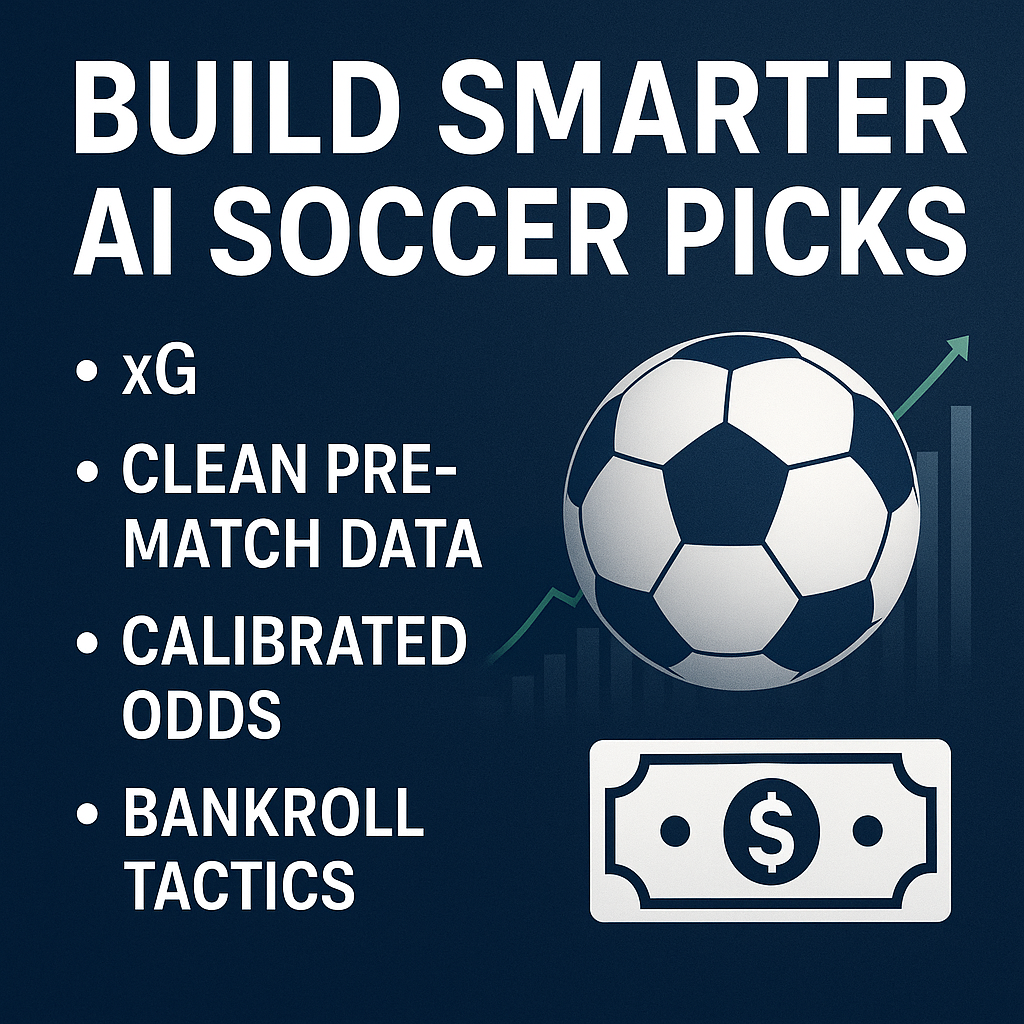
Building an AI soccer prediction model is not magic, and it is definitely not about gut feelings. It is strictly about method. As a professional sports analyst, I am going to show you exactly how to frame your targets, collect data you can actually trust, and turn those pre-match signals into calibrated probabilities that you can use to make real decisions. We are going to cover everything from the modeling and evaluation to the bankroll realism so that your edges are measurable, repeatable, and responsibly deployed.
Table Of Contents
- Problem framing that keeps predictions honest and useful
- Data acquisition and feature engineering you can repeat and audit
- Modeling approaches and pipelines that scale
- Evaluation, calibration and simulation that match bettor needs
- Deployment, monitoring & maintenance that play nicely with ATSwins workflows
- Putting it together for ATSwins-style decision-making
- Conclusion
- Frequently Asked Questions (FAQs)
Before we dive into the heavy lifting, let me give you the rundown of what matters most so you know what you are signing up for. You need to stick to pre-match data to avoid leakage, which means you strictly use time-aware testing like walk-forward validation and judge your results with log loss plus Brier scores. You have to backtest season by season rather than just picking random games. You need to build simple but strong features like rolling xG for and against, lineup quality, rest days, travel fatigue, and weather, and you absolutely must version your data and fix missing fields early. Start with straightforward models before you try to get fancy, because calibrated probabilities matter way more than complex architectures. You should only bet when you have an edge, meaning your fair price beats the book by a clear margin, and use small fractional Kelly stakes while tracking every bet. Our team at ATSwins.ai runs an AI-powered platform for data-driven picks, player props, betting splits, and profit tracking across the NFL, NBA, MLB, NHL, and NCAA, and our free and paid plans are there to help bettors make smarter and more informed decisions.
Problem framing that keeps predictions honest and useful
The first step in this journey is deciding exactly what you want to predict. You have to pick one or more markets because each one requires different modeling choices and evaluation metrics. You might look at the 1X2 market, which covers the home win, draw, and away win. This is a multiclass problem and can be strongly class-imbalanced in some leagues where draws are rare or home wins are dominant. You could also look at the Over/Under total goals market, like over or under 2.5 goals. This is a binary problem where the threshold drifts with league trends and different phases of the season. Another popular option is Both Teams To Score, or BTTS. This is also binary but is super sensitive to tactical matchups and formations. If you want to get really granular, you can try exact goals or goal difference. This requires a count model or ordinal classification, which is harder to do but can enrich your other markets. Finally, there are player props like shots, shots on target, xG, and assists if you are going down to the player level, which aligns with how ATSwins treats props.
For an ATSwins-style use case, the best path is to start with 1X2 and Over/Under, and then add BTTS later. Player prop models can run in parallel and feed cross-sport dashboards and profit tracking like we already do in the NFL or NBA.
Once you have your target, you have to avoid leakage by strictly fixing the prediction timestamp. Every single feature you use must be available before the match starts. You need to set a clear cutoff, like sixty minutes before kickoff for lineups, or twenty-four hours out if you are not going to rely on official lineup announcements. There are some very common sources of leakage you need to watch out for. Using post-match stats is the obvious one, but there are subtler ones like using closing odds while simulating pre-match decisions twenty-four hours in advance. Another killer is incorporating post-match ELO updates into the training window for earlier matches, which often happens during sloppy data merges. You also have to avoid using event-level data from the match you are predicting to compute rolling rates, which is classic window leakage. Be careful with live injury news that is timestamped but not reproducible, so you should always record the exact timestamp you pulled it. You have to lock a decision time and version your dataset relative to that time. This is absolutely non-negotiable for real-money use.
Encoding match context matters way more than most people think. You need to look at the venue, including home or away status, altitude, and turf type. Rest days are huge, so calculate the exact days since the last match for each team and the difference between them. Travel is another big factor, specifically the distance since the last match, cross-border trips, and time zone changes. Schedule congestion is vital, so look at minutes played in the last seven, fourteen, or twenty-one days, and the fraction of full-strength lineups fielded. Officiating can play a role if you know the referee tendencies regarding fouls and cards, but only if pre-assignments are known. Weather is a major variable, including wind, temperature, precipitation, and pitch condition if available pre-match. Finally, look at the market context, such as opening odds, line movement up to decision time, and public betting splits if you have them in real time. ATSwins users appreciate these context features because they explain why picks vary week to week, and they pair really well with user-facing notes.
You also have to choose your granularity between a team-level model and a player-level model. A team-level model is faster to build and simpler to calibrate. It serves as a strong baseline for 1X2 and totals and is good when lineups are noisy or unknown early. A player-level model requires you to build player embeddings and sum or aggregate them to team strengths. This is better for props and BTTS because it captures injuries and rotations more accurately, but it requires strong lineup projections and deeper data plumbing. A practical path is to start with team-level features enriched with player availability summaries. Later on, you can layer player embeddings when your pipeline can ingest projected lineups reliably.
Finally, use xG-informed features and temporal splits. Expected goals and shot quality drive most of the predictive signal beyond odds and venue. Build rolling xG for and against, shot counts, non-penalty xG, and set-piece xG. Maintain strict temporal splits to avoid peeking, and always use a walk-forward or time-based cross-validation.
Data acquisition and feature engineering you can repeat and audit
You need reliable sources to stitch everything together. Start with historical results, fixtures, standings, and team-season metadata from sites like FBref. You can use open event data for research via standard open data repositories to prototype xG-derived metrics and style features. You need odds and market data from regulated sportsbooks or providers, and you must store timestamps for the open and any moves. Injuries, suspensions, and discipline logs should come from league or club reports, and you have to keep the source and timestamps. Formations and lineups come from official match sheets, and for models running an hour before kickoff, include starting XI and bench info. Weather feeds should be aligned to the venue and kickoff time. If you cannot get the exact location, use the closest hourly observation. Keep raw snapshots and do not overwrite them. Use data versioning so you can reproduce any past run.
Stitching, keys, and late-breaking edges are critical. Use canonical keys like league ID, season, match ID, team ID, and player ID with a clear mapping table. Create a fixture index so every match has the kickoff time in UTC, venue ID, home team ID, away team ID, competition, and referee ID if known. Store odds as a time series per market and book. This helps with experiments like comparing performance twenty-four hours out versus sixty minutes out versus closing. Preserve injury and suspension events with effective dates so you can reconstruct squad health at any timestamp. A small data contract helps here, meaning every table should have primary keys, timestamps, and an "as of" time for its validity.
Feature engineering is what actually moves the needle. For team strength and form, look at rolling xG for and against over three, five, and ten-match windows, weighting recent games more. Look at non-penalty xG and open-play xG because penalties inflate the numbers and can mislead you. Check the rolling shot difference, big chance rates, and set-piece xG for and against. If you have them, use rolling expected points models, or otherwise smoothed points per match.
For schedule and fatigue, calculate the minutes played by the top twelve players in the last seven, fourteen, and twenty-one days. Look at the number of matches in the last ten days and create an indicator for three matches in seven days. Track travel miles since the last match and flag back-to-back away trips. You should also look at Elo or Glicko scores and strength of schedule. Maintain a rolling Elo or Glicko per team, updating only after matches conclude. Calculate strength of schedule using opponent Elo in the last N matches. Home-field advantage acts as an Elo offset, and you should allow for league-specific offsets.
Style and tactics are also important. Use proxies for pressing, like opponent pass completion under pressure if available, final-third recoveries, or PPDA-like metrics. Look at pace, including the direct speed of attack, sequences per minute, and verticality. Build-up versus transition indicators from event sequences can tell you a lot. Check formation families, like a three-back versus a four-back system, and formation changes from recent matches. For discipline and set pieces, track cards per match, fouls drawn and committed, and set-piece xG for and against. Referee trend features are useful if assignments are known pre-match.
Weather and conditions matter too. Look at temperature, wind, and rain at kickoff, and check for interaction terms with teams known to suffer in heat or wind. Pitch quality proxies are rare but useful if you can find them. Market features like opening odds, implied probabilities, and movement up to decision time are powerful. Look at consensus versus single book deltas, and public betting splits if available pre-match, treating them as a sentiment feature but watching for leakage if your timestamping is sloppy.
Transfers and squad health are the final piece of the puzzle. Look at net transfers in and out by xG contribution or minutes-weighted rating. Use a new manager indicator and count the matches since the appointment. For injury load, count the starters out, the percent of total minutes missing, and returning players with minutes expected.
You have to handle class imbalance, missingness, and target drift. For class imbalance, use class-weighted loss for 1X2 or focal loss variants. Downsampling draws can also help. For missing data, use robust imputations. For rolling features with little history, include an indicator flag. Do not forward-fill unknown injuries. Target drift is real because goal rates vary by league and season. Use league-season interaction terms and recalibrate per season. For totals, adapt the threshold or build continuous goal expectation then derive market probabilities.
Finally, focus on reproducibility, feature stores, and quality checks. Track data versions. Use a feature store to standardize definitions across training and inference. Run data quality checks for ranges, nulls, and keys. Use experiment tracking for parameters, metrics, and model artifacts. It is worth having templates for a match feature schema with data types and allowed nulls, a rolling window calculator with leak-safe cutoffs, and odds ingestion with time-bucketed snapshots.
Modeling approaches and pipelines that scale
Start with interpretable baselines. Use multinomial logistic regression for 1X2 with L2 regularization, and binary logistic regression for Over/Under and BTTS. Gradient boosting methods like LightGBM, XGBoost, or CatBoost often lift AUC and log loss quickly while staying manageable. Use these first because they set a high bar and let you debug fast.
Tree ensembles and shallow neural nets are your next step. Gradient boosting and random forests handle nonlinearity and interactions well with tabular soccer data. Shallow neural nets with entity embeddings can learn team and player embeddings and concatenate them with numeric features. Use modest depth, like two to four layers, and regularize with dropout and weight decay. Aggregate player embeddings to team strength for the expected lineup using a mean or minutes-weighted approach. Embeddings shine once you stabilize lineup projections and have enough seasons per league.
Keep preprocessing clean, small, and leak-safe. Use feature hashing for high-cardinality categories like player IDs or referee IDs when the feature space explodes. Use leak-safe scaling by fitting scalers on training folds only and applying them to validation and test sets separately. For categorical encoding, target encoding must be time-aware. It is better to use leave-one-season-out encoders or K-fold with purging. Define a single pipeline object that includes all transforms and the model, and ensure the same object runs at inference.
Time-aware cross-validation is essential. Avoid random K-fold. Use a purged, embargoed walk-forward scheme. Split by time chunks, like seasons. Purge any training samples that overlap in time with the validation set to matchday windows, and add an embargo period after validation to avoid label leakage via rolling features. Group by team or match to avoid leakage across home and away rows. This mirrors live deployment because you only train on the past.
For hyperparameter tuning and regularization, tune the learning rate, number of leaves or depth, min child weight, and subsampling for tree ensembles. For neural nets, tune embedding sizes, hidden units, learning rate schedules, dropout, and batch size. Use Bayesian tuning with early stopping, and always tune on walk-forward CV, not random CV.
Calibration, ensembling, and uncertainty estimation are crucial. For calibration, use isotonic regression or Platt scaling per league or globally, fitted on a validation set from the most recent season. For ensembling, blend a logistic baseline, gradient boosting, and a shallow net by averaging logits and then recalibrating. For uncertainty, use bootstrap ensembles or bagging. Quantify probability bands by sampling model seeds or data splits. For totals, model expected goals with a Poisson or bivariate Poisson wrapper, then integrate to get Over/Under and BTTS probabilities with uncertainty bounds.
Let's look at the pros and cons of common model families. Logistic regression is fast, interpretable, and easy to calibrate, but has limited nonlinearity. It shines for baselines and sanity checks. Gradient boosting has strong tabular performance and is robust, but needs careful tuning and carries a feature leakage risk. It is great for 1X2, Over/Under, and BTTS with many context features. Random forests are simple and robust to noise, but have weaker calibration and create big models. They are good for a first pass and feature importance checks. Shallow neural nets with embeddings capture team and player effects and are flexible, but require more data and care and are harder to explain. They are best for player props and lineup-sensitive markets.
A practical pipeline sketch involves building a leak-safe training table with all features as of T-24 or T-60 and targets. Then split data by seasons for walk-forward CV with purging. Train logistic regression and gradient boosting while tracking log loss and Brier score. Add a calibration layer using last-fold validation only. Evaluate on the next-season holdout and check reliability plots. Add a market-aware ensemble to blend models and recalibrate. Simulate bets given thresholds and bankroll rules, adjusting cutoffs for stability. Finally, freeze the model and pipeline, versioning artifacts and the training data hash. Tools like standard machine learning libraries for pipelines and calibration, gradient boosting frameworks for categorical handling, deep learning libraries for embeddings, and interpretability tools like SHAP are all helpful here.
Evaluation, calibration and simulation that match bettor needs
You need to score the right way. Log loss, or cross-entropy, punishes overconfident wrong picks and is good for 1X2 and binary markets. Brier score is the squared error of probabilities and is interpretable and sensitive to calibration. AUC is fine for ranking, but we place more weight on log loss when money is at stake. Report both and keep per-league metrics because some leagues behave differently.
Calibration checks must stick. Use reliability curves to bucket predictions into bins and compare predicted versus actual rates. Check Expected Calibration Error per market and league. Recalibrate each season if drift is observed. Bad calibration often sinks profit even when ranking is strong, so do not skip it.
Backtesting must be honest and chronological. Walk forward by season, training on past seasons, validating on the recent past, and testing on the new season. Roll forward and repeat. Purge overlap windows where rolling features would leak. Do not use data from the future. Keep odds snapshots to the chosen decision time. Track win rate by confidence decile, calibration stability over time, and market coverage to see the number of matches passing your edge thresholds.
Simulate betting decisions with bankroll constraints. Price your predictions against available odds at decision time. Compute the edge as the model probability minus the implied probability for each outcome. Apply staking using flat staking for simple reporting, or fractional Kelly to size by edge, capping bet sizes to account for limits and volatility. Incorporate slippage, which is a worse price by a tick, limits on the max stake per market, and rejection rates if the book changes price mid-bet. Report ROI, CLV if you track closing odds, drawdowns and bankroll at risk, and profit distribution by league and market. Kelly math is standard, and even a quarter fraction makes risk more manageable than full Kelly.
Run stability checks under realistic frictions. Test sensitivity to calibration shifts by re-running with calibration perturbed by plus or minus two percent. Test price sensitivity by re-running with odds worsened by one or two ticks. Test threshold robustness by adjusting cutoffs for placement by a half percent edge. If profitability flips under tiny perturbations, you need better calibration or lower thresholds.
Error analysis improves the next iteration. Slice by league, month, and market type. Check home and away bias to see if home advantage is mis-modeled in specific leagues. Look for tactical mismatches, like whether the model overrates pressing teams on heavy pitches. Track new managers for the first five matches after a change. Look for promotion and relegation edges, as newly promoted sides often break prior-season strength assumptions.
Explainability with SHAP and simple narratives is key. Use SHAP values to show which features pushed a prediction up or down. Summarize per league to reveal feature importance shifts. Provide short, human-friendly notes for ATSwins users, like explaining that Team A has three starters returning or that a referee assignment increases card risk.
Deployment, monitoring & maintenance that play nicely with ATSwins workflows
You need a lightweight inference service. Containerize the pipeline with the exact feature transformations. Create a single predict endpoint that accepts match ID, decision time, and market requested, along with optional lineup info if available for T-60 models. Return probabilities by outcome, uncertainty bounds, key feature contributions, and metadata like model version, data version, and calibration version. Run batch mode for daily slates plus on-demand inference when new odds arrive.
Track drift, decay, and calibration drift. Monitor data drift by looking for distribution shifts in key features like xG rolling means and odds, as well as population drift in the league mix. Monitor performance decay by tracking rolling log loss and Brier score per league. Monitor calibration drift by checking ECE by month, and auto-trigger recalibration if it exceeds a threshold. Use alerting thresholds and store weekly dashboards to show stability to end users.
Retrain cadences should be tied to the soccer calendar. The base cadence should be monthly during the season. Add extra retrains around transfer windows and during coaching changes spikes. Do a pre-season refresh to ingest new promoted teams and adjust league priors. Lock down a schedule that ATSwins ops can plan around so there are no surprise deploys on busy matchdays.
Use shadow deployments and A/B experiments. Shadow the new model in parallel for a few weeks, comparing log loss, calibration, and simulated profit without exposing users to picks yet. Once stable, use A/B testing to expose a fraction of matches to the new model and track deltas versus control. Keep the bankroll simulation identical for both.
Documentation, model cards, and assumptions are vital. Model card fields should include markets covered and decision time, training data range and leagues, known limitations like lineup uncertainties or weather gaps, calibration epoch and method, and expected error ranges and segments with high variance. Transparency keeps trust high and reduces support load.
Maintain an audit trail for every prediction. Log input features, model version, and calibration version for each prediction. Store the odds used and the time they were fetched. Keep a deterministic hash of the feature set so any outcome can be reconstructed. When something looks off, you want to pinpoint the change in minutes, not days.
Security, access, and fail-safes are mandatory. Use read-only database replicas for inference. Implement rate limits and timeout fallbacks so that if a dependency fails, you degrade gracefully to a baseline model or market odds. Restrict permissions so only authorized people can push models to prod and enforce code reviews.
Have a maintenance playbook and on-call practices. Perform weekly checks on drift, calibration, feature coverage, and profit stability. Have a monthly retrain window where you generate a release candidate, shadow for a week, calibrate, then decide. Define incident response steps for a broken data source, odds feed outage, or a model producing NaNs. ATSwins customers value reliability. It is fine to miss a niche feature, but it is not fine to publish stale or incorrect probabilities.
Putting it together for ATSwins-style decision-making
Here is a simple blueprint you can implement this month. In week one, assemble historical fixtures plus odds snapshots at T-24. Build rolling xG features and basic context like venue, rest, and travel. Train logistic regression and gradient boosting for 1X2 and Over/Under. In week two, implement walk-forward CV with purging and calibrate with isotonic regression. Backtest the last three seasons league-by-league. Simulate betting with flat and half-Kelly stakes, applying small slippage. In week three, add injuries, suspensions, and a simple Elo, integrating weather if feasible. Add market movement features and recalibrate. Build reliability plots and SHAP summaries. In week four, stand up an inference service with model versioning. Set drift monitors and weekly reports, start a shadow run, and prepare user-facing notes templates that explain key factors. Once this is live, iterate with player embeddings and lineup-aware features for props and BTTS, then bring in public betting splits in a leak-safe way.
Avoid common pitfalls. Do not overfit rare outcomes like away wins in low-scoring leagues. Use monotonic constraints or regularization if needed. For draws in 1X2, include both goal expectation and goal variance proxies because draws increase when variance is low. Separate calibrators per league if sample sizes allow, or use a hierarchical calibrator with league effects. Avoid feature targets that blend post-match information, like form computed with matches that happen after the prediction date. Keep an eye on promotion and relegation transitions, using cross-league transfer of strength.
This aligns with the ATSwins product experience. We offer data-driven picks by publishing probability, edge versus market, and a concise rationale. For player props, we run separate models, aggregate to team context, and expose confidence intervals. Betting splits are added as a pre-match feature only if captured before your decision time, and we also show splits transparently to users. Profit tracking records every pick, implied probability at placement, and odds taken, providing CLV and drawdowns. Free tiers show top picks and public splits, while paid tiers unlock full probability tables, per-league calibration reports, and bankroll simulators.
Reuse feature groups across markets. Core features include venue, rest days, travel distance, weather, rolling non-penalty xG for and against, and Elo or Glicko with a home advantage term. Market-aware features include opening odds, consensus midline, move up to decision time, and volatility of odds movement. Squad health features include starters missing, minutes lost, players returning, and expected lineup availability. Style interaction features include pressing differential, pace differential, set-piece advantage, and referee card tendency. Competition controls include league fixed effects, month fixed effects, promotion and relegation flags, and international breaks proximity.
Translate calibration and thresholds to decisions. Convert probabilities to edges using current odds. Place bets only when the edge exceeds a minimum, like two to three percent, and the probability is in a calibration-stable band. Recalibrate monthly and re-check thresholds. Record predictions with uncertainty, and when uncertainty is high, reduce the stake or skip.
Extend to player-level and props by building player embeddings with event data. Look at offensive contribution like shot xG, key passes, expected assists, and pressure-escaping passes. Look at defensive contribution like pressures, tackles, interceptions, and aerial wins. Aggregate to projected XI using minutes-weighted average embeddings and include fatigue via recent minutes and travel. Model shots, SOT, and xG per player, then link to team totals consistency checks. Use market microstructure, noting that player prop odds are thin and move fast. Store snapshots at high frequency and build a consensus versus outlier signal to catch mispriced props.
Reporting and UX touches matter to bettors. Use reliability bars to show predicted versus actual calibration across bands. Use confidence bands with plus or minus around probabilities when uncertainty is high. Provide rationale bullets with two to three reasons tied to features. Show history with the last thirty picks with outcomes, CLV, and bankroll change. Use filters for league, edge size, market type, and home versus away status. Make it easy for users to see why a pick is on the slate and how it performed.
There are external resources worth using during build-out. Use sites for match stats, shots, and xG summaries. Use open data repositories for research and prototyping features. Use standard machine learning libraries for pipelines and calibration examples.
Automate data pulls and validation, feature computation and rolling windows, model training, calibration, artifact versioning, and backtests and bankroll simulation with set parameters. Keep league-specific calibration thresholds and bet-sizing caps manual for a bit until stable. Keep feature toggles manual when a source becomes unstable. Keep postmortems manual after large calibration drifts or unexpected losing streaks.
Implement quality gates before publishing any pick. Check data quality to ensure all features are within expected ranges and there are no missing core fields. Check prediction sanity to ensure probabilities sum to one for 1X2 and there are no extreme probabilities unless well-justified. Check that calibration ECE is below the internal threshold. Backtest recent form stability to ensure the last four weeks are within acceptable variance. Check that the market price is still valid and there are no stale odds or known lineup shocks after your decision time. If a gate fails, suppress the pick and trigger a triage check.
Adapt to new leagues and seasons. Cold-start new leagues with hierarchical priors, mapping initial Elo based on transfer market value or historic inter-league strength. Use larger uncertainty bands early and reduce stake caps until you have eight to ten matches. Watch for differences like pace and average xG per shot varying by league, home-field advantage strength differing by geography, and scheduling quirks like winter breaks. Treat these as configuration rather than code rewrites.
Be responsible with disclosure and ethics. Avoid latency arbitrage claims and focus on robust, timestamped decision times. Respect terms for data sources and attribute properly. Communicate uncertainty and avoid overpromising win rates. Share both good and bad weeks because ATSwins users care about honesty and process.
Finally, have a minimal checklist for each release. Record data snapshot IDs as immutable. Tag model and calibrator versions with code commit hashes. Store walk-forward metrics and compare them to the last release. Review shadow results for the latest two weeks. Verify the incident playbook and pass alerting tests. Update user-facing notes templates for any new features. This keeps iteration smooth and reduces surprises when the season heats up.
Conclusion
Smart predictions come from clean pre-match data, xG-informed features, calibrated probabilities, and steady bankroll rules. The key points are to define targets clearly, prevent leakage, use time-aware validation, and measure results in EV rather than just vibes. For turning this into action, ATSwins is an AI-powered platform with data-driven picks, player props, betting splits, and profit tracking across the NFL, NBA, MLB, NHL, and NCAA. Free and paid plans give bettors insights and guides to make smarter decisions.
Frequently Asked Questions (FAQs)
What is an ai soccer prediction model, in plain words?
An ai soccer prediction model is a system that turns pre-match data into probabilities for outcomes like 1X2, which covers home, draw, and away, as well as over/under goals and BTTS. It learns from past matches by analyzing things like team strength, expected goals or xG, injuries, travel miles, rest days, venue, weather, plus recent form. The output isn’t a lock or a guarantee; it is a probability. If your ai soccer prediction model says the home team wins fifty-five percent of the time, you compare that to the market price to see if there is positive value, or you simply pass on the bet.
What data should I feed an ai soccer prediction model before kickoff?
You need to keep it strictly pre-match. Use rolling team performance like xG created and conceded, starting XI quality, injuries and suspensions, rest and travel, home field advantage, tactical style like pressing rate and pace, set-piece strength, and strength of schedule. You should also add coach changes, congested fixtures, transfer windows, and even weather if it moves the goal expectation. Avoid any live stats at all costs because your ai soccer prediction model should make its call before the whistle blows, not after the game has started.
How do I tell if my ai soccer prediction model is actually good?
Start with calibration. If you rate outcomes at sixty percent, they should land about six in ten times over the long run, no more and no less. Track simple accuracy, but rely more on log loss, where lower is better, and Brier score for probability quality. Do walk-forward tests season by season rather than just using random splits. Compare your projected prices to market odds, and if you consistently beat closing prices, known as CLV, that is a healthy sign. Then watch real money performance with conservative staking, and look for steady, repeatable edges rather than short hot streaks.
How does ATSwins.ai help me get more from an ai soccer prediction model?
ATSwins.ai is an AI-powered sports prediction platform offering data-driven picks, player props, betting splits, and profit tracking across the NFL, NBA, MLB, NHL, and NCAA. Free and paid plans give bettors insights and guides to make smarter, more informed decisions. You can use its betting splits to sanity-check sentiment versus price, lean on profit tracking to measure your model’s true edge over time, and use player prop thinking to translate your ai soccer prediction model into micro markets like shots, cards, and goal involvement where appropriate. It complements your workflow with clean tracking and decision support, so you learn faster and avoid guesswork. More at https://atswins.ai
What mistakes hurt an ai soccer prediction model the most?
The big mistakes are data leakage, like using post-match or live info, overfitting to one league, ignoring injuries or lineup changes, and not calibrating probabilities. Also, doing random cross-validation on time-series data is a huge error; don’t do that. Use time-aware splits instead. Don’t mix markets like 1X2 versus totals without separate targets, and never judge the model on a handful of bets because sample size matters. Finally, keep your features stable because sudden tweaks right before evaluation can fool you, and the model, too.
Related Posts
AI For Sports Prediction - Bet Smarter and Win More
AI Football Betting Tools - How They Make Winning Easier
Bet Like a Pro in 2025 with Sports AI Prediction Tools
Sources
The Game Changer: How AI Is Transforming The World Of Sports Gambling
AI and the Bookie: How Artificial Intelligence is Helping Transform Sports Betting
How to Use AI for Sports Betting
Keywords:
MLB AI predictions atswins
ai mlb predictions atswins
NBA AI predictions atswins
basketball ai prediction atswins
NFL ai prediction atswins
ai betting analysis