
AI Betting Trends: What’s Actually Changing, What’s Noise, and How to Stay Ahead
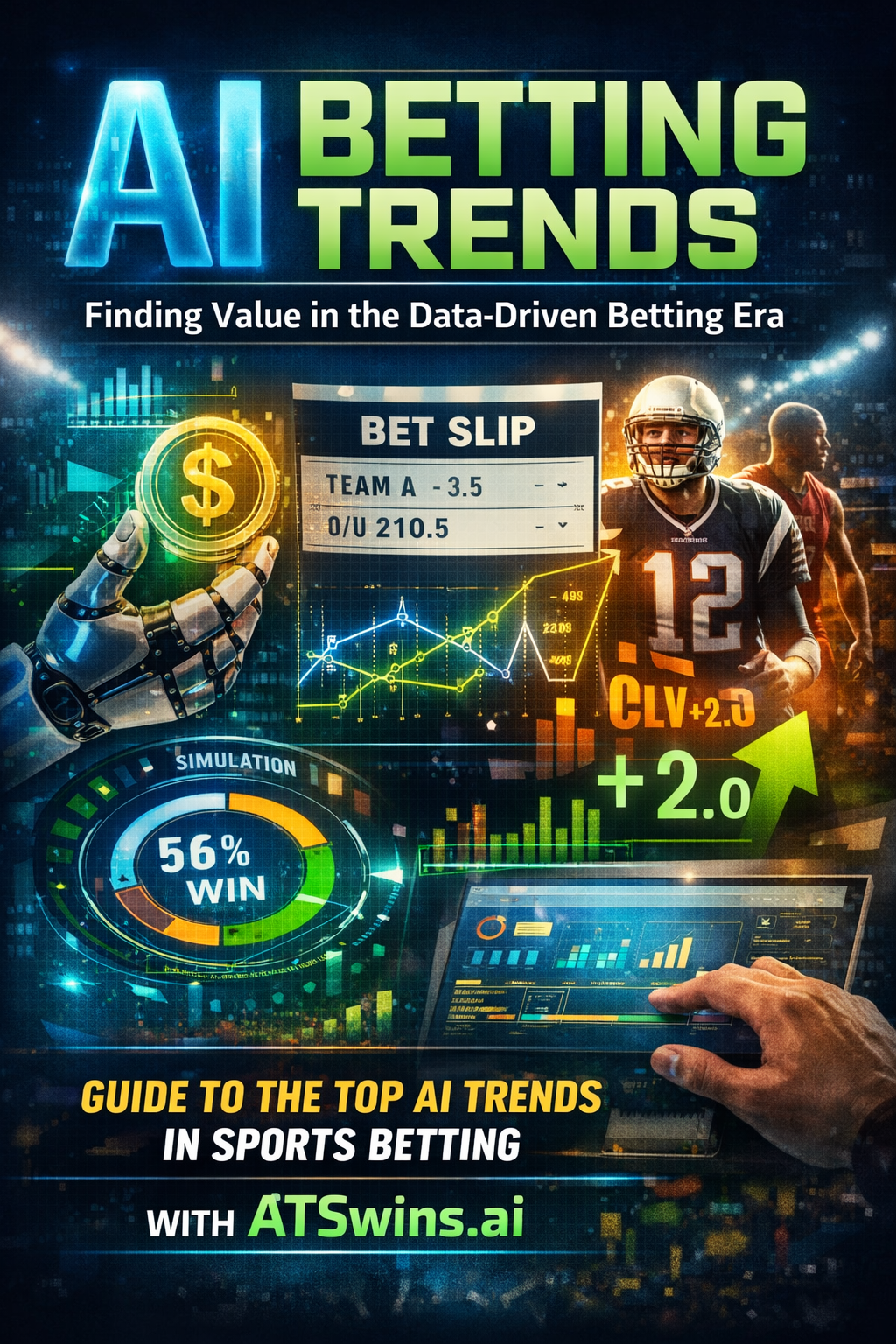
“AI betting trends” gets thrown around like it’s one thing. It’s not. It’s a bundle of shifts happening at the same time: models moving from picks to probabilities, markets reacting faster to information, bettors tracking performance more like a portfolio, and tools getting better at explaining why an edge exists instead of just shouting “play this.”
If you’re trying to understand AI betting trends in a way that actually helps you make smarter decisions (instead of just collecting trivia), this is the lens that matters: what is changing about how lines are formed, how value is identified, and how disciplined bettors operate over the long run? Because that’s where the edge lives—if it exists at all.
ATSwins.ai is built for that exact style of approach: structured, probability-driven, and focused on repeatable decisions instead of guesswork. This article breaks down the biggest AI betting trends shaping the landscape right now, what they mean in plain English, and how you can apply them without turning your brain into mush.
The biggest shift: probabilities are replacing predictions
The first and most important trend is a mindset change. Older betting content was built around predictions. “Team A is winning.” “This game is going over.” “Lock of the night.” You can feel the problem already: it treats sports like they’re certain, and sports are anything but.
Modern AI-driven approaches are pushing bettors toward probabilities. Not “Team A wins,” but “Team A wins X% of the time given the inputs.” That subtle change makes you stop thinking like a fan and start thinking like an analyst. It also gives you a framework for value. If your model believes an outcome happens 56% of the time but the market is pricing it like it happens 50% of the time, you don’t need a speech or a storyline. You have a discrepancy. And discrepancies are where profits come from—if you can handle variance and stay consistent.
This is why “AI betting trends” isn’t just about technology. It’s about behavior. Probability thinking forces discipline. It makes you accept that you can make a good bet and still lose. It also makes you accept the opposite: you can make a bad bet and still win. Over time, that changes how you evaluate your process, how you size your plays, and how you respond to short-term swings.
Simulations are becoming the default engine
Another major trend is the rise of simulation-based modeling. Instead of producing one neat number—like “Team A -3.2”—many modern systems simulate the game thousands of times using inputs like pace, efficiency, matchup factors, and variance. That creates a range of outcomes, not a single outcome. And sports live in ranges.
A simulation model doesn’t just tell you where the average result lands. It tells you how often a team covers a spread, how frequently a total lands over or under, and how volatile the matchup is. Two games can both project similarly on average while being totally different bets because one has a tight distribution (more predictable) and the other has a wide distribution (more chaos). That’s the kind of nuance that gets lost when people treat everything like it’s the same “one-unit play.”
Simulation outputs are also useful because they can expose hidden truths about game scripts. A matchup might look like a clean under based on average pace, but if the simulation shows a high probability of extreme outcomes (overtime risk, late-game foul chaos, or wide scoring swings), it’s a different decision than “under because vibes.”
ATSwins.ai leans into this trend by focusing on actionable simulation-style outputs and making them usable in a decision workflow, not just pretty numbers to stare at.
The CLV era: beating the close is becoming the scoreboard
If you want a quick test of whether someone understands AI betting trends, ask them what they track. If the answer is only “wins and losses,” they’re missing the deeper shift. The serious conversation has moved toward process evaluation, and one of the biggest metrics driving that is closing line value (CLV).
CLV is basically a way to measure whether you beat the market. If you took a number that was better than the closing number, you were likely on the sharper side—even if that particular bet lost. Over time, consistently beating the close is a strong signal that your process identifies value before the market corrects.
This trend matters because AI models often create their edge not by being clairvoyant, but by being systematic. They can identify mispricing early, particularly in spots where the market is slow to adjust: rest and travel situations, rotation shifts, coaching tempo changes, and certain matchup dynamics that don’t show up in basic stats. The market is good. But it isn’t perfect, and it doesn’t always move instantly.
So the trend isn’t “AI wins every day.” The trend is “AI helps you operate like a disciplined trader: find mispricings early, track if the market moved toward your number, and judge your process by whether you consistently took good prices.”
Real-time information is getting priced in faster, and that changes everything
One reason AI is becoming more important is that the market is also getting sharper. When injury news hits, lines move. When a starter is out, pace projections change. When a key player is questionable, the market floats and waits for confirmation.
The trend here is speed and precision. It’s not enough to have a model that updates once a day and calls it a masterpiece. More systems are prioritizing rapid updates tied to lineups, role changes, and availability. This is especially relevant in sports where late scratches matter and rotations aren’t static.
But there’s a catch: fast updates only help if they’re accurate and structured. Overreacting can be just as bad as being slow. The best AI workflows balance stable signals (team strength, long-term efficiency) with responsive signals (who is actually playing, what the current rotation looks like, how that affects pace and shot quality).
Practically, this trend means timing becomes a weapon. Some edges are only available early. Others appear late when the market overreacts or misreads context. AI tools can help you recognize which type of spot you’re in, but you still need a consistent process so you’re not chasing every line move like it’s the last helicopter out of a zombie movie.
Explainability is no longer optional
For a while, AI tools could get away with being black boxes. “Trust the model.” People are over it. One of the clearest AI betting trends is demand for explainability—not for entertainment, but for control.
When a model likes a side, you want to know the drivers. Is it pace? Is it efficiency? Is it a rotation mismatch? Is it a rest advantage? Is it a matchup that historically suppresses certain shot types or creates a rebounding edge? You don’t need the model to write you a novel, but you do need transparency so you can sanity-check the output.
Explainability also protects you from the biggest trap in AI betting: treating outputs like commandments. Sports are messy, and models can be wrong for reasons that are obvious to humans. If a key player’s role changed last game, if the coaching staff is experimenting, if a team’s minutes distribution is unstable, or if the matchup data is misleading due to small samples, you want to spot those landmines before they blow up your bankroll.
ATSwins.ai is designed to be used as a tool inside a decision process, not a replacement for thinking. The trend is moving toward that philosophy across the industry: AI assists disciplined bettors; it doesn’t absolve them from responsibility.
Market-aware modeling is growing: “true line” thinking is trending up
Another important shift is that AI betting trends increasingly include market behavior as part of the analysis. Traditional approaches treat the betting market like a final answer: the line is the line. Newer approaches treat the line like an input, and the market like a system that can be studied.
This is where “true line” thinking becomes powerful. If your model produces a number that consistently differs from the market opener, the question becomes: what happens next? Does the market drift toward the model’s number over time? Does it snap away? Does it do that only in certain contexts?
In other words, you’re not just making a pick. You’re observing price discovery. And the most practical use of AI here is identifying when the market is slow, uncertain, or biased in a particular direction. A disciplined bettor can use that information to time entries, avoid bad prices, and focus on the spots where the model historically aligns with how the market eventually closes.
This is a big reason ATSwins.ai puts emphasis on helping users interpret how the market behaves relative to model outputs. You’re not guessing. You’re tracking patterns.
Selectivity is becoming the edge: fewer plays, better plays
Here’s a trend that doesn’t get enough love because it isn’t sexy: the best AI-driven bettors are not betting everything. They’re filtering.
A model can generate an opinion on every game. That doesn’t mean you should act on every opinion. One of the smartest uses of AI is as a filter that identifies only the plays with meaningful edge. Over time, this improves results not because the model got magically smarter, but because you stopped donating units on marginal edges.
A lot of bettors fail because they confuse activity with progress. AI tools can produce volume. But volume without discipline is just a faster way to lose. This is why confidence tiers are trending: higher-confidence opportunities, standard plays, leans, and no-plays. The trend isn’t “more bets.” The trend is “better selection.”
This also changes how you experience variance. If you bet fewer games with stronger edges, swings still happen, but your process becomes easier to manage and evaluate. You’re less likely to spiral after a bad night because you’re not carrying 14 marginal plays that never should’ve existed.
Ensembles and blended approaches are rising
Another noticeable trend is model blending. A single model can be brilliant and still be fragile. Sports change. Rule emphasis changes. Coaching trends shift. Player roles evolve. When a model is overfit to a certain era or style, it can start bleeding without warning.
Ensemble approaches reduce that risk. Instead of relying on one set of assumptions, blended models combine multiple perspectives: one might be better at tempo and totals, another might handle matchup efficiency, another might emphasize player impact. The combined output tends to be more stable and less prone to extreme mistakes.
You don’t have to build an ensemble yourself to benefit from the trend. The takeaway is simpler: robustness matters. When you evaluate AI outputs, you should care about whether the approach is designed to hold up across different conditions, not just whether it had a hot month.
Player-level impact modeling is taking over
Team stats are blunt instruments. They’re useful, but they can lie. If a team has strong efficiency numbers and then loses a key player, those numbers don’t automatically update themselves. The same is true when a bench player gets promoted and suddenly plays starter minutes, or when a new rotation changes the team’s identity.
That’s why player-level modeling is a major AI betting trend. Better systems account for role, minutes expectations, usage, and lineup combinations. Even without perfect “player value” metrics, the direction is clear: models are getting better at representing who the team is on a given night, not who the team was in aggregate.
This trend is one of the biggest reasons AI can help bettors avoid traps. A team might look like an “auto over” in season-long data, but if key scorers are limited or the rotation is defensive-heavy that night, the game environment can be completely different. Conversely, a team that usually plays slow might speed up based on matchup or necessity. AI is increasingly built to detect these context shifts.
More bettors are treating betting like a portfolio
Another trend is cultural: bankroll management is finally becoming mainstream. People used to talk about picks like they were isolated events. Now, with AI and better tracking, bettors are thinking in terms of expected value, variance, and survivability.
This matters because AI edges tend to be small and consistent rather than huge and obvious. Small edges only compound if you can stay alive long enough to let them work. That means sizing discipline, avoiding emotional escalation, and limiting correlated exposure.
Portfolio thinking also changes how you evaluate performance. Instead of obsessing over last night’s results, you focus on whether your decision process is identifying value and whether you’re getting good prices over time. This fits naturally with CLV tracking, selectivity, and confidence tiers—all trends we’ve already covered.
ATSwins.ai supports this kind of disciplined approach by helping users build structure into their decisions rather than relying on impulsive “I feel good about this one” logic.
The biggest mistake people make with AI: treating it like a cheat code
Let’s talk about what AI betting trends are not . They’re not a guarantee. They’re not a shortcut to skipping learning. They’re not a license to bet bigger because “the model said so.”
AI is powerful, but it’s still modeling a chaotic system. Sports include randomness, human behavior, coaching decisions, and variance that no model can eliminate. AI’s value is in improving decision quality over time, not in creating certainty.
The right way to think about AI is: it reduces the number of bad decisions you make. It helps you recognize value more consistently. It keeps you from overreacting to narratives. It can identify patterns you wouldn’t catch manually. But you still need to apply it responsibly with a process that includes sanity checks and discipline.
The trend is moving toward that reality. The best bettors are not the ones who worship the model; they’re the ones who use it as a consistent input inside a structured framework.
A practical way to use these AI betting trends with ATSwins.ai
If you want to apply what you just read in a way that’s simple and repeatable, here’s a clean mental model—without turning your routine into a full-time job.
Start with probability and simulation outputs. Your goal isn’t to find a bet, it’s to find a discrepancy: where the model believes the true probability differs meaningfully from what the market implies. When you find that, you don’t immediately fire. You check context. Are lineups stable? Are there obvious injury or role factors that might not be fully accounted for yet? Is the timing right, or are you likely to get a better number later?
Then you use selectivity. Not every edge is worth playing. Focus on the higher-confidence opportunities where the discrepancy is meaningful and the context isn’t shaky. This is where many bettors level up: fewer plays, better plays, cleaner evaluation.
After you place a play, you track what matters. Did the line move toward your number? Did you beat the close? Even if you lose, did you make a decision that would be profitable if you repeated it 1,000 times? This is how disciplined bettors improve. They don’t rewrite their process after every bad beat. They use data to calibrate.
ATSwins.ai is useful in this workflow because it’s designed to support structured decision-making: probabilities, simulations, confidence filtering, and tools that help you stay consistent rather than emotional.
Where AI betting trends are heading next
It’s not hard to see where this keeps going. Models will keep improving at handling context: lineup shifts, role changes, and real-time updates. Explainability will keep becoming more important because users want control and clarity. Market-aware tools will continue to evolve because understanding line movement is a huge part of long-run edge. And the culture will keep shifting toward process metrics like CLV and away from short-term, results-only thinking.
The biggest winners won’t be the people who find one magical system. They’ll be the people who build a repeatable routine and stick to it long enough for small edges to compound.
Closing: the real trend is discipline
If you take one thing from the “AI betting trends” conversation, make it this: AI is not the edge by itself. The edge is what AI enables—structure, selectivity, and consistency.
AI helps you think in probabilities instead of narratives. It helps you see ranges of outcomes instead of pretending the future is certain. It helps you spot mispricing earlier and evaluate your process with metrics that actually matter. But it only works if you treat it as part of a disciplined framework.
That’s why the smartest way to approach AI betting trends is to stop asking, “What’s the next play?” and start asking, “Is my process getting sharper?”
If you want to build that kind of process with a tool designed for it, ATSwins.ai is the cleanest way to turn AI outputs into a structured routine you can actually follow—night after night, week after week, without letting emotion run the show.
Related Posts:
AI For Sports Prediction - Bet Smarter and Win More
AI Football Betting Tools - How They Make Winning Easier
Bet Like a Pro in 2026 with Sports AI Prediction Tools
Sources:
The Game Changer: How AI Is Transforming The World Of Sports Gambling
AI and the Bookie: How Artificial Intelligence is Helping Transform Sports Betting
How to Use AI for Sports Betting
Keywords:
MLB AI predictions atswins
AI MLB predictions atswins
NBA AI predictions atswins