
49ers vs Colts Monday Night Football Preview: Week 16
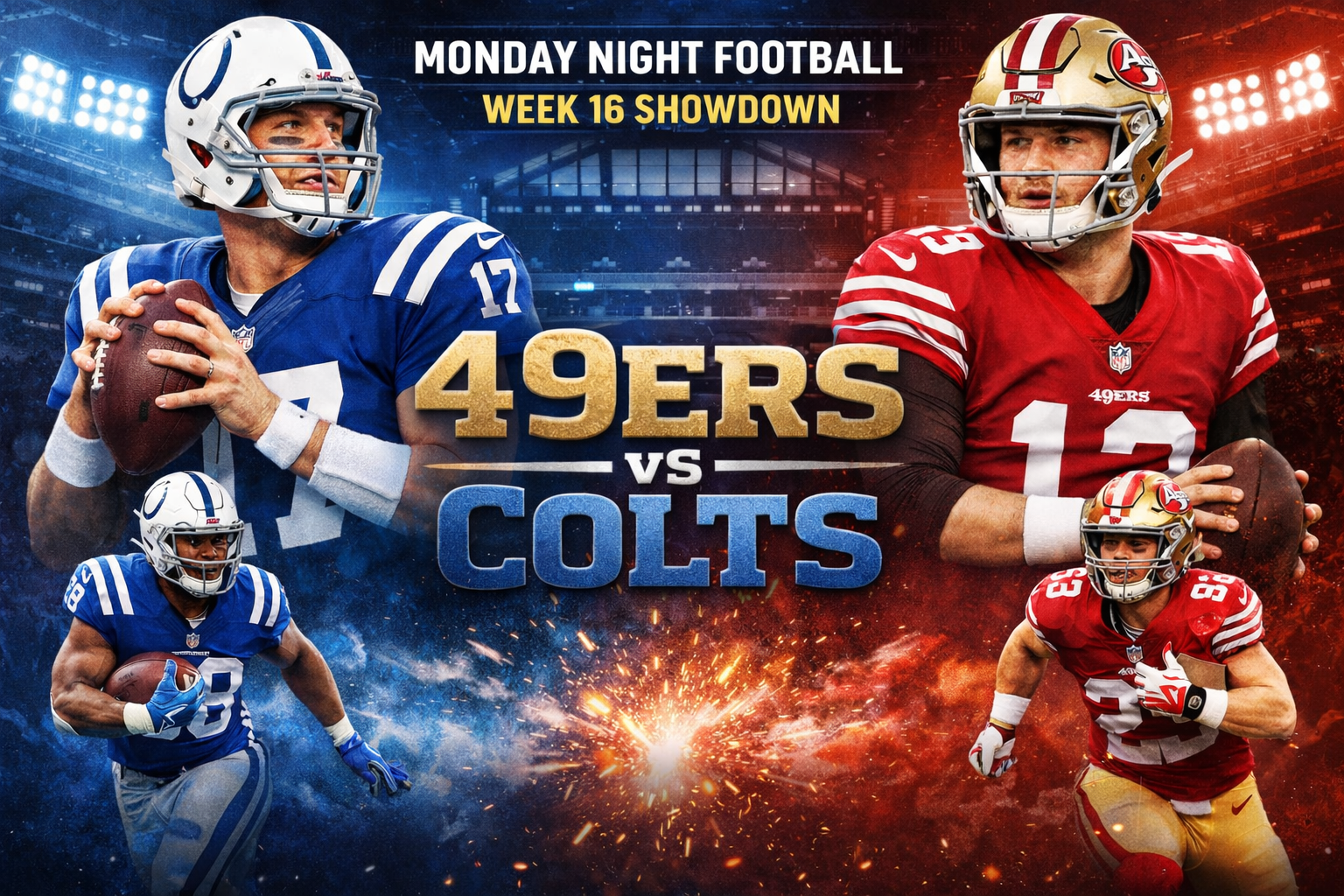
Week 16 wraps up with San Francisco (10-4) visiting Indianapolis (8-6) at Lucas Oil Stadium, a matchup that feels like it was built in a lab for late-season chaos: one team sprinting, one team stumbling, and both operating like every snap is worth double because the calendar is running out. Kickoff is 8:15 p.m. ET, and the vibe is simple: the 49ers are chasing the kind of January path you only get by stacking wins now, while the Colts are trying to stop the bleeding before “good season” becomes “how did this slip away?”.
The state of both teams: same record window, totally different momentum
On paper, 10-4 vs. 8-6 looks like a clean “good team vs. good team” spot. The reality is messier and more interesting.
San Francisco arrives on a four-game win streak and already has a playoff berth locked up. They’re in the middle of the NFC traffic jam where one hot month can swing you from “wild card road trip” to “bring a pillow for the first round.” The 49ers’ remaining schedule is also loud: this trip to Indy, then home games against Chicago and Seattle to close the regular season.
Indianapolis, meanwhile, is the definition of a team that’s been living on the edge. They haven’t won since November 9, they haven’t won at home since October 26, and they’ve dropped four straight since their Week 11 bye. That’s a long time to stare at the standings and talk yourself into “we’re right there” while the losses pile up.
So yes, the records say “competitive.” The recent form says “one team is building confidence and answers, the other is collecting questions.”
The headline twist: Rivers is really doing this
If you told someone in August that a late-December Colts game would feature Philip Rivers starting at quarterback, you’d get the kind of look usually reserved for “I’ve been awake for 38 hours.”
But here we are. Rivers is the starter for Indianapolis right now, stepping in after Daniel Jones suffered a season-ending Achilles injury. Rivers came out of retirement at 44 and immediately gave the Colts something they’ve badly needed during this skid: structure. He’s not here to run around and turn broken plays into highlights. He’s here to get the ball out, stay on schedule, and make the offense feel normal again.
That also explains why the Colts’ game plan has leaned into quick decisions and short throws. In his first game back, Rivers was extremely efficient on throws under 10 air yards (16-of-18 for 87 yards and a touchdown), and much shakier once the game demanded deeper shots (including a brutal efficiency line on longer throws). The Colts can live with that if they control tempo, lean on their backfield, and treat explosives like a bonus instead of a requirement.
The other key piece: Anthony Richardson is out for Monday night. He’s been practicing again after a scary eye injury, but he won’t be active for this game. So the “Rivers experience” is not a novelty cameo — it’s the plan.
Purdy’s return raised San Francisco’s ceiling — and changed the math
On the other sideline, the 49ers’ season story has been defined by one thing: what they look like when Brock Purdy is actually on the field.
He missed eight games this year, which is a massive chunk of time for any team trying to win the conference. Yet here’s San Francisco anyway, sitting at 10-4 and playing meaningful football in late December. One reason is that, when Purdy plays, the offense tilts upward. San Francisco has averaged 27.0 points per game with him compared to 22.8 with their primary backup, Mac Jones .
The early-season downside was turnovers. Purdy threw seven interceptions in his first four games, the kind of stretch that can flip a few tight results and quietly wreck your seeding. More recently, he’s been cleaner, and he’s coming off a Week 15 performance against Tennessee that included a 140.3 passer rating in a 37-24 win.
That “clean vs. chaotic” tug-of-war is basically the Purdy conversation in one sentence. When he’s decisive and protected, the 49ers can score on anyone. When he starts trying to win every play twice, defenses get opportunities. Indianapolis has built a season’s worth of hope on creating those opportunities.
The Colts’ defense has one obvious goal: make Purdy pay for being aggressive
The Colts haven’t been winning games, but their defense just showed something worth taking seriously. In Rivers’ first start back, Indianapolis held Seattle to 18 points — all field goals — which is the kind of “we can keep you in this” performance a team needs when its offense is still figuring itself out.
The best trait of the Colts defense in this matchup is the ball production: they entered Week 16 with 12 interceptions , tied for seventh in the league. If you’re facing a quarterback whose best version is fearless (and whose worst version is also fearless), that matters.
The question is whether Indianapolis can marry that turnover threat with consistent pressure. Because if Purdy gets clean pockets and easy play-action windows, the 49ers’ offense tends to look like it’s running downhill.
The 49ers’ defensive reality: they can be moved through the air right now
San Francisco’s brand is usually “front-seven violence + takeaways + make you play left-handed.” This season has forced them to live in something closer to “score enough to cover for what’s missing.”
In the most straightforward terms, the 49ers’ defense has been unusually vulnerable: they’ve produced just 16 sacks (fewest in the league), they’ve picked off only five passes (tied for the second-fewest), and since Week 5 they’ve been allowing 252.6 passing yards per game (third-most over that stretch).
That context matters because Rivers is not walking into a nightmare matchup. He’s walking into a defense that — because of injuries and inconsistency — can be forced to defend horizontally, then punished when tackling slips.
And inside a dome, with no wind and no weather variables, timing routes and quick-game rhythm become easier to sustain. That’s exactly what Rivers wants.
The game within the game: two workhorse backs who basically are their offenses
If you’re looking for the “this is what the night will revolve around” answer, it’s probably the running backs.
San Francisco has Christian McCaffrey ; Indianapolis has Jonathan Taylor . Both have been asked to carry an absurd amount of offensive responsibility, and both have the kind of usage that makes defensive coordinators lose sleep.
McCaffrey entered Week 16 leading the league with 345 touches , turning that into 1,742 scrimmage yards and 14 scrimmage touchdowns . Taylor has been right there too: 310 touches , 1,761 yards , and an NFL-leading 18 scores .
The funniest part is that both guys are still being described as “in a lull”… because the standard is so high. McCaffrey has been under 90 scrimmage yards in each of his last two games after almost never dipping below that mark earlier in the season, and Taylor’s rushing output has slid during Indy’s four-game losing streak.
That sets up the most predictable chess match of the night:
-
Can the 49ers use McCaffrey to keep the Colts’ pass rush honest and create easy throws off play-action?
-
Can the Colts use Taylor to keep Rivers from needing to live on third-and-8 and to keep Purdy watching from the sideline?
Because if either team wins time of possession cleanly, it changes everything — especially late.
Injury report: who’s missing, and why it matters
Late-season games are always about who’s actually available. For Monday night:
San Francisco (notable):
-
Out: QB
Kurtis Rourke
(knee), WR
Ricky Pearsall
(knee/ankle), CB
Renardo Green
(neck)
-
Questionable: DE
Yetur Gross-Matos
(hamstring)
Pearsall being out matters because it narrows certain personnel packages and changes how San Francisco can distribute targets (especially if they’re trying to manufacture space underneath). And Gross-Matos being limited matters because the 49ers already aren’t generating enough sacks — they can’t really afford to lose more edge juice.
Indianapolis (notable):
-
Out: QB
Anthony Richardson
(eye), OT
Bernhard Raimann
(elbow), CB
Sauce Gardner
(calf), WR
Anthony Gould
(foot), S
Daniel Scott
(knee)
-
Questionable: DT
DeForest Buckner
(neck/rest)
If Buckner can’t go (or isn’t himself), that’s a big deal. Interior pressure is one of the cleanest ways to mess with a quarterback like Purdy because it disrupts the launch point and forces earlier throws. On the flip side, Raimann being out affects how Indy protects Rivers, which matters because the Colts will want to throw quickly but still need to survive obvious passing downs.
How Indianapolis can make this ugly (in a good way)
The Colts’ path in this game is pretty clear, even if executing it is hard:
1) Live in the quick game.
Rivers has already shown he can run an efficient short passing attack right now, and the dome environment helps. If Indy can stack completions to Michael Pittman Jr., Josh Downs, and Taylor underneath, they can avoid the kind of long-dropback reps that expose an older quarterback to hits.
2) Let Taylor set the temperature.
The best way to protect your quarterback is to make the defense respect your run game. Taylor’s workload and scoring production suggest the Colts will keep feeding him until the 49ers prove they can consistently win early downs.
3) Turnovers have to swing at least one possession.
When you’re in a losing streak like this, you rarely win “clean.” Indy’s defense has been one of the better interception units in the league, and Purdy has had interception-heavy stretches this season. If the Colts steal one short field, it changes the script.
How San Francisco can impose its identity anyway
The 49ers’ advantage is that they can win in multiple ways — and their “best way” travels:
1) Make the Colts defend the entire width of the field.
McCaffrey’s receiving role is a cheat code, especially in a dome where spacing and timing are crisp. Even when he’s not exploding for huge yardage totals, his presence dictates coverage and personnel.
2) Force the Colts into longer-yardage situations.
Rivers can be very efficient when everything is on schedule, but the preview data from his first start back highlighted the limitations of the deeper passing game right now. If San Francisco can win first down defensively and make Indy chase sticks, the offense becomes easier to predict.
3) Let Purdy stay patient.
This is the subtle one. Indy wants to bait throws. San Francisco doesn’t have to accept every invitation. If Purdy is willing to take checkdowns, avoid the hero-ball windows, and lean on McCaffrey plus the run game, the 49ers can keep the game on their terms — even if it’s not always pretty.
The “watch this early” checklist
The first quarter will tell you what kind of game it becomes.
If Indianapolis is completing quick throws, staying ahead of schedule, and Taylor is ripping off efficient runs, you’ll likely see a game where every drive matters and third downs feel like coin flips.
If San Francisco is getting chunk plays off play-action, McCaffrey is winning matchups in space, and Purdy is comfortable, the Colts’ defense gets stressed in a way that’s hard to maintain for four quarters.
Also, don’t underestimate the dome effect: when two offenses want rhythm, a controlled environment often turns “nice concept” into “that’s open again.”
Why this matchup is so compelling
This game has a rare mix of storylines that actually affect how the football will be played.
-
A contender trying to climb the ladder and stack confidence before January.
-
A team in a skid trying to rediscover traction before the season slips away.
-
A returning veteran quarterback running an offense built on efficiency and timing.
-
A young-ish contender QB whose best trait (aggression) is also what the defense is hunting.
-
Two running backs who can hijack the entire night if either defense starts missing tackles.
Whatever happens, it’s a classic late-December NFL test: execution, health, and which team can stay disciplined when the game gets tight — because it usually does when both teams can run the ball and both quarterbacks can punish mistakes.
If you want one clean way to follow along while you watch, track two things drive-by-drive: turnovers and early-down success. Those are the levers that decide whether this feels like a controlled chess match or a messy fight with momentum swings.
And if you’re looking to cross-check the matchup from a projections-and-trends angle after you read this, you can always pull up the numbers on ATSwins.ai .